
Close Menu
CEOColumnCEOColumn
    What's Hot

    How Shift Fatigue Can Become Evidence in a Texas Oilfield Negligence Case

    October 29, 2026

    Planning Next Season’s Pasture Fence While the Prairie Ground Is Frozen

    October 29, 2026

    Where the Hay Goes: Cutting Winter Feeding Waste on Prairie Cattle Operations

    October 29, 2026
    Facebook X (Twitter) Instagram
    Facebook X (Twitter) Instagram
    CEOColumnCEOColumn
    Subscribe
    • Home
    • News
    • BLOGS
      1. Health
      2. Lifestyle
      3. Travel
      4. Tips & guide
      5. View All

      Critical Illness Insurance Explained: Key Features, Inclusions & Claims

      October 26, 2026

      Doctors’ Indemnity Insurance: Why Every Healthcare Practitioner Needs It

      October 26, 2026

      How to Make Personal Training Fit Your Schedule, Goals, and Budget

      October 26, 2026

      Healthy Habits for Feeling More Relaxed and Centered

      October 23, 2026

      Signs Your Florida Home Has a Humidity Problem and How Experts Can Fix It

      October 27, 2026

      Motion Sofa: Flexible Seating for Modern Living Spaces

      October 24, 2026

      How to Plan a Proposal Around Your Partner’s Style

      October 8, 2026

      Best Shampoo for Dandruff: Top Picks for a Healthy Scalp

      October 5, 2026

      How to Efficiently Manage Dual SIMs on One Phone for Frequent Business Travel

      October 22, 2026

      How to Find the Best Villas in Goa for Birthday Celebrations and Parties

      October 16, 2026

      Red Sea Days and Desert Nights in Hurghada

      October 7, 2026

      Luxury Crewed Yacht Charters in Greece: A Complete Guide to Private Yacht Holidays

      October 2, 2026

      How Pool Size and Depth Affect Water Chemistry Stability

      October 24, 2026

      Language Barriers While Traveling: What Actually Helps in Real-World Conversations?

      September 29, 2026

      How therapeutic techniques can vary from one practitioner to another

      September 29, 2026

      Turning Anger Into A Boundary Statement

      September 11, 2026

      8 Reasons Parents Trust Ambitions ABA for Their Child’s Behavioral Growth

      October 29, 2026

      Top 5 Personal Injury Lawyers in Texas for 2026

      October 29, 2026

      Garage Makeover in Fairfax: What to Keep, Donate, Recycle, or Remove

      October 29, 2026

      A Calmer Trading Routine With Cloud Trade Copying

      October 28, 2026
    • BUSINESS
      • OFFLINE BUSINESS
      • ONLINE BUSINESS
    • PROFILES
      • ENTREPRENEUR
      • HIGHEST PAID
      • RICHEST
      • WOMEN ENTREPRENEURS
    • Lifestyle
    CEOColumnCEOColumn
    Home»BUSINESS»Planning Next Season’s Pasture Fence While the Prairie Ground Is Frozen

    Planning Next Season’s Pasture Fence While the Prairie Ground Is Frozen

    OliviaBy OliviaOctober 29, 2026No Comments6 Mins Read

    Most fence trouble on a cattle operation shows up in May and June, when the herd is out, the seeder is running and nobody has an afternoon to rebuild a corner that let go. The decisions behind that corner were made, or skipped, months earlier. Frozen ground keeps the post pounder parked, but winter is when a producer can plan fence at the kitchen table, with a pasture map and no cows leaning on the wire.

    Table of Contents

    Toggle
    • Start With a Map, Not a Roll of Wire
    • Matching Wire to the Job Each Fence Does
    • Energizers and Grounding in Dry or Frozen Soil
    • Posts, Corners, Gates and Water
    • Wildlife, Labour and Ordering Ahead

    Start With a Map, Not a Roll of Wire

    Under rotational grazing, fence moves cattle through paddocks on a schedule set by grass recovery, so the layout should follow water and forage rather than quarter lines. Mark every current and possible water site, then shade the areas that regrow at different speeds, such as a low meadow that stays green into August beside a gravel ridge that browns off in July. Note where drifts pile up in coulees and behind shelterbelts, since a wire built there spends every winter buried.

    Then split the plan into permanent and temporary fence. Perimeters and the main divisions around water justify permanent construction because they stand for decades and take the most pressure. Internal subdivisions are often better left temporary for a season or two, on step-in posts with poly wire or tape, until grazing records show where a cross fence belongs. Rolling up poly takes an hour. Pulling a row of misplaced driven posts takes a weekend.

    Matching Wire to the Job Each Fence Does

    Barbed wire still earns its place along a road allowance or a neighbour’s crop, where a physical barrier matters most. For grazing cells, electrified high-tensile wire is the usual choice. In the spring 2026 issue of Saskatchewan’s Agriview, a provincial agri-environmental specialist calls high-tensile steel the most commonly seen electric fence on pastures and farms, with poly wire and tape suited to shorter portable runs and stranded steel cable to winter swath and bale grazing.

    Choosing the wire also decides how the corners get built, because tight high-tensile wire loads the end assemblies far more than loosely stapled barbed wire. Cattle trained to a hot wire respect two or three strands, which saves material, but the fence then depends entirely on power. A barbed fence with a broken section still slows cattle down. A dead two-wire electric fence barely registers with them.

    Energizers and Grounding in Dry or Frozen Soil

    Grounding is where many Prairie electric fences come up short. The pulse passes through the animal into the soil and back to the energizer through the ground rods, and Alberta Agriculture’s Agdex on protecting stored hay from elk and deer notes that soil conducts poorly next to wire, especially when frozen or snow-covered. It recommends alternating charged and grounded wires, beginning with a grounded bottom wire. Alberta’s bear-fencing factsheet gives the same advice for dry ground.

    An Ohio State University Extension rule of thumb calls for at least three feet of ground rod per joule of energizer output, with rods at least 10 feet apart and 40 to 50 feet from any other ground. Put them where the soil stays moist, such as under the drip line on the north side of a building, and stick with one metal, since mixing galvanized and copper invites electrolysis. Size the energizer for the fence planned three years out, and keep grass trimmed back from the bottom wire, where it drains output.

    Posts, Corners, Gates and Water

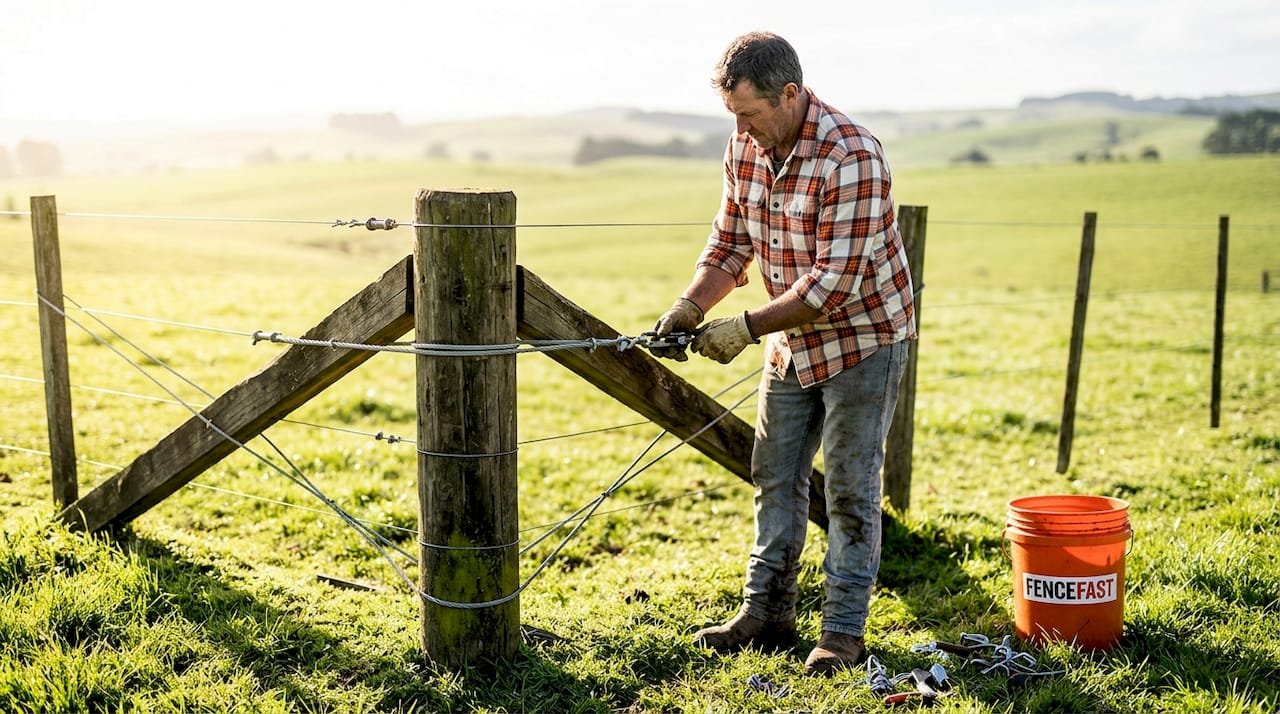
    Treated wood remains the standard for corners and gate posts because it holds staples and tension. Steel T-posts drive quickly for barbed line fence. Fibreglass line posts are light and need no insulators, handy on long high-tensile runs but no substitute for wood at a brace. One H-brace guide recommends a horizontal member at least twice the corner post’s height and generally no shorter than eight feet, with corner and brace posts set to the same depth, preferably about four feet.

    Gates and water deserve their own pass on the map. Put gates in the corners cattle drift toward when they are moved, wide enough for the largest machine that has to get through, often a bale processor. Decide early whether each paddock gets its own water or shares a central source through a lane, because that choice reshapes the whole layout.

    Wildlife, Labour and Ordering Ahead

    Wildlife shapes the wire spacing too. Deer jump over wire or crawl under it, while pronghorn on the southern grasslands cannot jump fences and need room underneath. Wildlife-friendly specifications circulated in Alberta generally call for a smooth bottom wire about 45 to 46 cm off the ground and a smooth top wire no higher than one metre. Where bears threaten livestock or bee yards, Alberta’s bear-fencing factsheet calls for roughly 5,000 volts or more from an energizer rated at least 0.7 joules.

    Labour is the constraint most plans underestimate. Count the posts, decide between a rented pounder and a hired crew, and book that work for the short gap between frost leaving the ground and seeding. Request utility locates before any new line goes in. Alberta’s and Saskatchewan’s one-call services are free, and Saskatchewan guidance lists fence posts among the digging that needs one, which matters on pasture crossed by pipelines.

    Materials move quickly once the snow goes, and April buyers often build with whatever is left on the lot. A material list drawn from the winter map, with posts broken out by type and length, sent to two or three dealers in January or February leaves time to compare stock and delivery dates. A regional listing of farm fencing suppliers helps narrow that to dealers within a sensible haul on gravel roads.

    Before the thaw, walk or snowmobile the planned lines with a GPS app open and drop a pin at every corner and gate. Add what a map will not show, like the soft spot that swallowed a quad last May or the gap where the neighbour’s cattle came through in the fall. Keep the pin file and the material list in the truck for the first dry morning of spring.

    Share. Facebook Twitter Pinterest LinkedIn Tumblr Telegram Email
    Previous ArticleWhere the Hay Goes: Cutting Winter Feeding Waste on Prairie Cattle Operations
    Next Article How Shift Fatigue Can Become Evidence in a Texas Oilfield Negligence Case
    Olivia

    Olivia is a contributing writer at CEOColumn.com, where she explores leadership strategies, business innovation, and entrepreneurial insights shaping today’s corporate world. With a background in business journalism and a passion for executive storytelling, Olivia delivers sharp, thought-provoking content that inspires CEOs, founders, and aspiring leaders alike. When she’s not writing, Olivia enjoys analyzing emerging business trends and mentoring young professionals in the startup ecosystem.

    Related Posts

    Where the Hay Goes: Cutting Winter Feeding Waste on Prairie Cattle Operations

    October 29, 2026

    Wealth Management Firms Worth Considering for International Families in 2026

    October 29, 2026

    6 Important Details to Share With a Ladder Accident Lawyer in NYC, NY

    October 29, 2026
    Add A Comment
    Leave A Reply Cancel Reply

    You must be logged in to post a comment.

    Latest Posts

    How Shift Fatigue Can Become Evidence in a Texas Oilfield Negligence Case

    October 29, 2026

    Planning Next Season’s Pasture Fence While the Prairie Ground Is Frozen

    October 29, 2026

    Where the Hay Goes: Cutting Winter Feeding Waste on Prairie Cattle Operations

    October 29, 2026

    8 Reasons Parents Trust Ambitions ABA for Their Child’s Behavioral Growth

    October 29, 2026

    Wealth Management Firms Worth Considering for International Families in 2026

    October 29, 2026

    Top 5 Personal Injury Lawyers in Texas for 2026

    October 29, 2026

    What Business Owners Should Look for in Dispensary Card Services

    October 29, 2026

    Why Successful Entrepreneurs Still Buy Expensive Watches

    October 29, 2026

    Germany Has €500 Billion for Infrastructure, but Finding the Workers Is the Harder Part

    October 29, 2026

    Enterprise Architecture And AI Governance For Smarter Business Decisions

    October 29, 2026
    Recent Posts
    • How Shift Fatigue Can Become Evidence in a Texas Oilfield Negligence Case October 29, 2026
    • Planning Next Season’s Pasture Fence While the Prairie Ground Is Frozen October 29, 2026
    • Where the Hay Goes: Cutting Winter Feeding Waste on Prairie Cattle Operations October 29, 2026
    • 8 Reasons Parents Trust Ambitions ABA for Their Child’s Behavioral Growth October 29, 2026
    • Wealth Management Firms Worth Considering for International Families in 2026 October 29, 2026

    Your source for the serious news. CEO Column - We Talk Money, Business & Entrepreneurship. Visit our main page for more demos.

    We're social. Connect with us:
    |
    Email: Support@gposting.com

    Facebook X (Twitter) Instagram Pinterest LinkedIn WhatsApp
    Top Insights

    How Shift Fatigue Can Become Evidence in a Texas Oilfield Negligence Case

    October 29, 2026

    Planning Next Season’s Pasture Fence While the Prairie Ground Is Frozen

    October 29, 2026

    Where the Hay Goes: Cutting Winter Feeding Waste on Prairie Cattle Operations

    October 29, 2026
    © Copyright 2025, All Rights Reserved
    • Home
    • Pricacy Policy
    • Contact Us

    Type above and press Enter to search. Press Esc to cancel.