

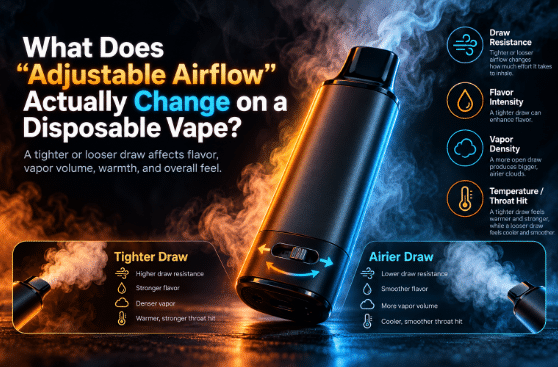
Adjustable airflow is one of those features that’s easy to overlook — until you actually start using it. A small ring or slider near the base controls how much air enters with each pull. That one variable shapes your draw resistance, flavor, vapor temperature, throat hit, and how satisfying the nicotine feels.
Most vapers leave it in whatever position the device shipped in. That’s a missed opportunity. Understanding what airflow does lets you tune any device to match how you prefer to vape, without switching brands or buying something new.
What Adjustable Airflow Is
On most disposables, adjustable airflow is a physical control — usually a ring, dial, or side slider — that opens or restricts the air intake vents. Turning it one way widens the passage; the other way narrows it.
The reason that matters: vapor and air always mix before reaching your mouth. More air means a lighter, airier pull. Less air means a tighter, more intense one. It’s a small mechanical change with a surprisingly wide impact on the overall experience.
A simple way to picture it: drawing through a narrow coffee straw versus a wide smoothie straw. Same drink, very different sensation.
How Airflow Works Inside the Device
When you inhale, air enters through the intake vents, moves past the heated coil, and travels up through the mouthpiece. The coil converts e-liquid into vapor; the incoming air carries that vapor to you and cools it slightly along the way.
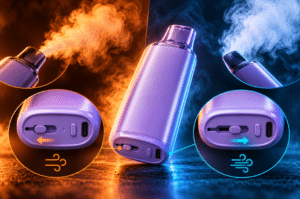
The airflow setting controls how much air joins that process:
- Open airflow: More air, cooler vapor, easier pull.
- Closed airflow: Less air, warmer vapor, tighter pull.
That’s really all there is to it mechanically. No software, no settings menu — just the ratio of air to vapor on every inhale.
The 6 Things Airflow Actually Changes
Airflow doesn’t adjust one isolated thing. When you move the slider, several aspects of the draw shift together. Here’s what changes and why it matters.
1. Draw Resistance: MTL vs DTL
Draw resistance is simply how hard you pull to get vapor moving. Airflow is the main dial.
- MTL (mouth-to-lung): Tight airflow. Vapor goes into your mouth first, then you inhale to your lungs — very similar to how a cigarette feels.
- DTL (direct-to-lung): Open airflow. You pull vapor straight to your lungs in a single breath, with little resistance.
For anyone switching from cigarettes, a tighter MTL draw is usually the more comfortable starting point. Cloud-focused vapers tend to prefer a wide-open DTL draw.
2. Vapor Temperature
Air cools vapor as it moves through the device. Let in more air and each pull feels cooler and smoother. Restrict the airflow and the vapor arrives warmer and denser — which can feel richer, but also harsher at the end.
Temperature is largely a comfort preference. Most vapers land on a middle setting where the pull feels warm enough to be satisfying without being sharp.
3. Flavor Intensity
Tighter airflow concentrates vapor, which concentrates flavor. With less air diluting each puff, the taste is bolder and more defined. Open airflow spreads the vapor thin — flavors read as lighter and cleaner, but with less intensity.
This is worth knowing practically: if a flavor is disappointing you, closing the airflow slightly is often the fix. It’s a simple adjustment that many vapers skip entirely.
4. Vapor Volume and Clouds
Open airflow pushes more vapor through the coil per pull, producing bigger, denser clouds. Tight airflow limits that, resulting in thin, discreet puffs that don’t draw much attention.
Neither is objectively better. It depends on whether visibility or discretion matters more in your situation.
5. Throat Hit
Throat hit is the physical sensation at the back of the throat during inhalation. Closed airflow sharpens it — warm, concentrated vapor through a restricted passage creates a more pronounced hit. Open airflow softens it considerably.
Former smokers often find that a firmer throat hit makes vaping feel more familiar. Vapers who prefer a smoother experience tend to open up the vents.
6. How Nicotine Feels
Airflow doesn’t touch the nicotine concentration in the e-liquid. What it does change is how that nicotine registers per puff. Tight airflow delivers a more concentrated hit, so the same device feels more satisfying. Open airflow dilutes it, making the same strength feel milder.
This is a useful lever if a device feels too harsh — before writing it off, try opening the airflow first.
How to Choose Your Setting
There’s no correct position. The right setting depends on what you’re after. A rough starting guide:
- Coming from cigarettes: Start tight. The MTL draw and firmer throat hit will feel closer to what you’re used to.
- Chasing big clouds: Open it fully for maximum vapor output.
- Flavor feels flat: Close the airflow partway to concentrate the taste.
- Pulls feel too harsh: Open up for cooler, smoother vapor.
- Trying to extend the device: A slightly tighter draw uses e-liquid more efficiently, which can add a bit of longevity.
The practical approach: move one small step at a time and take a few puffs before adjusting again. Most people end up preferring something in the middle range rather than a fully open or fully closed position.
Which Brands Include Adjustable Airflow?
Adjustable airflow has moved from a premium feature to a standard one. Across the disposable vape market in 2026, it’s now found on devices at almost every price point — from entry-level options to flagship releases.
Raz Vape builds it into most of their lineup, pairing it with wide flavor ranges and smart display screens. If you want control alongside an easy setup, Raz is a reliable place to start.
Geek Bar includes adjustable airflow across their higher-tier devices, often combining it with dual-mode power settings and large-capacity tanks. For vapers who like to fine-tune more than one variable, Geek Bar’s hardware tends to reward that approach.
Beyond those two, most established brands now offer at least one device with proper airflow control. The distinction worth checking before you buy: make sure you’re looking at a physical ring or slider rather than a fixed vent with minimal range. A true adjustable system makes a noticeable difference. A token slider that barely moves doesn’t.
Frequently Asked Questions
Does adjustable airflow change the nicotine strength?
No. The nicotine level in the e-liquid stays fixed. Airflow only changes how intense that nicotine feels per puff — tighter for a stronger hit, more open for a milder one.
Should I vape with open or closed airflow?
It depends on your preference. Closed airflow gives you a tighter draw, stronger flavor, and a more pronounced throat hit. Open airflow produces cooler vapor, bigger clouds, and a smoother pull.
Does tighter airflow save e-liquid?
To a small degree. Restricted draws use vapor slightly more efficiently. The difference adds up over time but won’t dramatically extend a device.
Why does my flavor taste weak?
Airflow is often the culprit. When the vents are too open, air dilutes the vapor and the flavor reads thin. Close it partway before assuming the flavor itself is at fault.
Is adjustable airflow better than fixed?
For most vapers, yes — it’s more flexible. Fixed airflow works well if the preset draw happens to suit your style, but it gives you no room to adapt. Adjustable airflow lets one device serve different moods and preferences.
The Bottom Line
Adjustable airflow isn’t a gimmick. It’s a functional feature that directly shapes flavor intensity, vapor size, throat hit, temperature, and how long your device lasts. On a fixed-airflow disposable, you get one experience. On an adjustable device, you get to decide what that experience actually is.
The feature has matured significantly since it first appeared on disposables. What started as an occasional addition on premium hardware is now standard across most mid-range and high-capacity devices. If you haven’t used it intentionally before, taking a few minutes to experiment with the setting can make a real difference in how much you enjoy a device.
When you’re shopping for your next disposable, it’s worth checking whether adjustable airflow is included — and if it is, actually using it rather than leaving it wherever it is shipped from the factory.
