

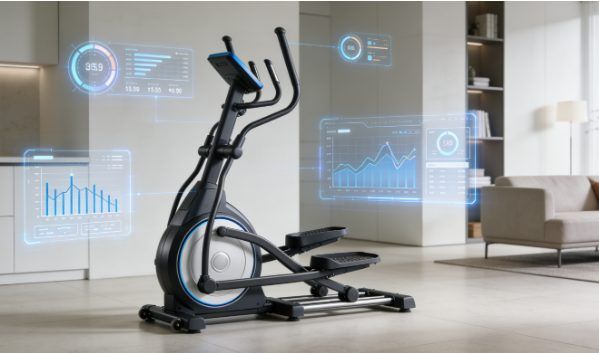
For global executives and investors, the domestic wellness sector has transitioned into a high-stakes arena of digital-physical integration. The narrative in 2026 is no longer about the distribution of raw materials—steel and rubber—but about the mastery of DTC brand evolution and predictive data loops. As the boundaries between technology and hardware blur, understanding the underlying logic of the market is essential for identifying the next generation of industry leaders.
The “Algorithmic Gym” is not a specific machine; it is a closed-loop data infrastructure. It represents a fundamental shift away from the traditional model, which has long been plagued by high Customer Acquisition Costs (CAC) and fragile retention rates. By synthesizing hardware, artificial intelligence, and predictive commerce, the Algorithmic Gym transforms static equipment into proactive health terminals, thereby maximizing Customer Lifetime Value (LTV). This revolution is supported by three core strategic pillars.
Pillar 1: AI-Driven Personalization as a Retention Engine
To solve the churn crisis of the early, industry leaders are pivoting toward a framework that resembles Product-as-a-Service (PaaS). In this model, the initial equipment sale is merely the “on-ramp” to a long-term data relationship. The true product is the continuous, algorithmic adaptation of the user’s routine.
Consider the evolution of cardiovascular programming. An AI-guided low impact elliptical workout is no longer just an exercise routine; it is a continuous diagnostic test. By leveraging adaptive AI frameworks, the software analyzes real-time biometric and mechanical data to instantly adjust resistance and pacing. This precision-led approach ensures the user remains within a sustainable, optimal training zone. By preventing overtraining and burnout, the AI acts as a sophisticated retention engine, firmly securing the brand’s place in the user’s daily habit loop.
Pillar 2: Spatial Economics and Hardware Infrastructure
To achieve a high-conversion digital ecosystem, the physical hardware must be as sophisticated as the software that drives it. Executives must recognize that urban living constraints are driving a new “Spatial Economics.” The modern consumer demands equipment that occupies a minimalist footprint—the “0.2-square-meter station”—while offering professional-grade utility.
Furthermore, for an AI agent to function effectively, it requires an environment with minimal sensory noise. In a shared domestic setting, silence is a strict product requirement, not an aesthetic luxury. The engineering behind a quiet elliptical machine is a necessity for the seamless integration of AI voice-coaching and biometric tracking. When a machine operates with near-zero acoustic interference and zero structural flex, it creates the high-fidelity training experience required by the 2026 premium market.
This architectural philosophy is clearly visible when examining industry case studies. For instance, the engineering standards showcased on the FED Fitness official website illustrate how to successfully build these “AI-compatible” physical terminals. By focusing on high-damping structural materials and internal drive system optimization, they provide a blueprint for hardware intended to serve as the frictionless backbone of a multi-generational health network.
Pillar 3: Predictive Commerce and the Data Loop
The ultimate strategic advantage of the algorithmic model is the creation of a predictive data loop. By capturing and analyzing every repetition, stride length, and resistance adjustment, AI systems can map a user’s progress trajectory with pinpoint accuracy. This unlocks a level of Direct-to-Consumer (DTC) logistics optimization that was previously impossible.
When a brand’s ecosystem identifies that a user’s cardiovascular and strength metrics have hit a specific threshold, the algorithm can proactively suggest an expansion of their physical setup. This might involve the perfectly timed recommendation of an integrated strength module. This is not a traditional, friction-heavy sales pitch; it is a data-backed expansion of the user’s personal health infrastructure. This predictive commerce model anticipates consumer needs before they are consciously recognized, creating a highly resilient and self-sustaining revenue stream.
Conclusion The Operating System of Future Wellness
Leadership in the 2026 fitness market is defined by the ability to synthesize physical engineering with algorithmic intelligence. Success is no longer measured by the volume of raw equipment pushed out of warehouses, but by the depth of the digital-physical integration provided to the consumer.
The Algorithmic Gym is rapidly becoming the universal operating system of home wellness. In this new paradigm, hardware becomes the essential infrastructure, AI becomes the retention engine, and data becomes the currency of growth. The most successful enterprises will be those that view their hardware not as an endpoint, but as the entry point for a lifelong, algorithmically optimized health service.
