

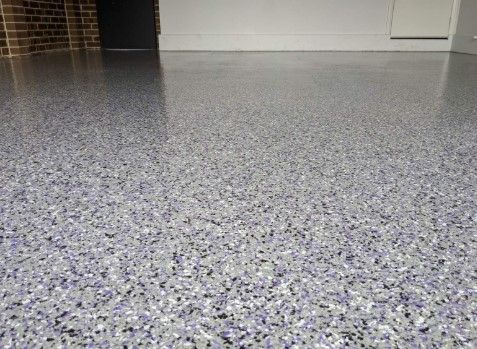
Concrete has a reputation for being indestructible. It isn’t. Spend enough time around garages, warehouses, or pool decks in South Florida and you’ll see the truth: dark moisture stains creeping up from below, hairline cracks branching out like spider veins, powdery dust collecting along the edges. Concrete holds up, yes, but it absorbs everything. Humidity, oil, pressure, impact. Over time, that absorption shows. That’s exactly why we install epoxy coating for concrete floors.
At NiSe, we’ve worked on enough slabs to know that most failures don’t happen overnight. They build slowly. Quietly. And usually, because the surface was left unprotected.
Concrete Is Porous. That’s the Problem
Concrete looks solid, but under a microscope,e it’s full of tiny capillaries. Those pores pull in water vapor from the ground and absorb spills from above. In Florida, where humidity rarely takes a day off, that moisture migration is constant.
When water moves through a slab, it weakens the internal structure. You’ll start to see efflorescence, flaking, and surface pitting. If the slab freezes and thaws in cooler climates, expansion can accelerate cracking. Even without freeze cycles, trapped moisture softens the surface and compromises anything applied on top.
A properly installed epoxy coating for concrete floors seals those pores. Once cured, it forms a dense, non-permeable layer that blocks water intrusion from above and dramatically reduces vapor transmission from below. But here’s the part many contractors skip: surface preparation.
We grind every slab mechanically. No shortcuts. If the surface isn’t properly profiled, epoxy won’t bond correctly. And if it doesn’t bond, it fails. It’s that simple.
Cracks Don’t Fix Themselves

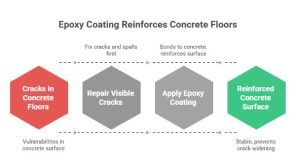
Hairline cracks are common. Concrete shrinks as it cures, soil shifts, and foundations settle. Not every crack is structural, but every crack is a vulnerability.
Before we apply epoxy coating for concrete floors, we repair visible cracks and spalls. The goal isn’t cosmetic. It’s structural continuity. Once the epoxy system is installed, it bonds to the concrete and reinforces the surface layer. That added tensile strength helps prevent minor cracks from widening under traffic or temperature change.
It’s not magic. If a slab has major structural movement, coating alone won’t solve that. But for typical wear-and-tear cracking? Epoxy adds stability and keeps small problems from turning into bigger ones.
Wear Is Relentless
Garages take abuse that most homeowners underestimate. Hot tires pull at the surface. Jack stands concentrate weight into tiny contact points. Tools drop. Chemicals spill. Over time, bare concrete erodes and turns dusty.
An epoxy coating for concrete floors creates a hardened surface that resists abrasion and impact. When installed correctly, it doesn’t just sit on top like paint. It chemically bonds with the prepared slab. That bond is what gives epoxy its durability.
We’ve coated residential garages where the homeowner parks a daily driver and changes their own oil. We’ve coated commercial spaces with rolling carts and steady foot traffic. The performance difference between coated and uncoated concrete is obvious after a few years. One looks tired and chalky. The other still looks intentional.
At NiSe, we tailor systems based on use. A decorative flake floor in a garage has different thickness requirements than a commercial workspace. Matching the build to the environment matters.
Oil, Chemicals, and Everyday Mess

Concrete stains easily. Oil seeps in fast and leaves permanent dark patches. Brake fluid, cleaners, pool chemicals, they all penetrate untreated slabs.
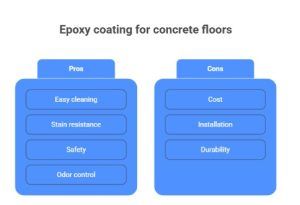
With epoxy coating for concrete floors, spills stay on the surface long enough to clean them. That alone changes how a space feels. Instead of fighting stains, you wipe them away.
It’s also a safety consideration. In commercial settings, sealed floors reduce contamination risks and simplify maintenance protocols. In homes, it means less scrubbing and no lingering odors trapped inside porous concrete.
Maintenance Becomes Simple
Bare concrete constantly sheds dust. That fine powder isn’t just annoying; it’s a sign the surface is breaking down. Once coated, the surface becomes stable and easy to maintain.
Most epoxy coatings for concrete floors require nothing more than routine sweeping and occasional mopping. No waxing. No resealing every year. Just basic upkeep.
And longevity? When installed properly, a high-quality system can last many years before needing attention. Not because it’s indestructible, but because it’s built to handle real use.
Installation Is Where It’s Won or Lost
We’ve seen plenty of peeling floors installed by crews who skipped grinding or applied product over moisture issues. Epoxy is unforgiving if preparation is sloppy.
At NiSe, our process is methodical: mechanical grinding, moisture evaluation, crack repair, primer application, base coat, broadcast or metallic layer if specified, and a protective topcoat. Each step matters. Miss one, and the lifespan drops.
That discipline is why our epoxy coating for concrete floors holds up the way they do.
Protect the Slab Before It Costs You
Replacing concrete is expensive. Repairing widespread damage is disruptive. Protecting it early is far simpler.
If you’re seeing moisture stains, surface dusting, or expanding cracks, don’t ignore them. Visit our website and schedule a consultation with NiSe. We’ll assess your slab honestly and recommend the right system for your space.
Whether you’re considering a full epoxy coating for concrete floors or exploring alternatives like polyaspartic garage floor coating for faster cure times, we’ll help you choose a solution that actually fits how the space is used.
Concrete can last decades. But only if you protect it properly. Let’s do it right.
