

For years, local businesses treated their websites as the center of their online presence. A well-built website still matters, but for many local service companies, the first real interaction with a potential customer now happens somewhere else: on Google Search and Google Maps.
When someone searches for a plumber near me, dentist in Austin, roof repair company, or best HVAC contractor, they often make a decision before ever clicking through to a website. They compare Google Business Profiles, check reviews, look at photos, scan services, review opening hours, and decide who feels trustworthy enough to call.
That is why Google Business Profile optimization has become one of the most important growth channels for local businesses.
Google describes local search visibility around three core ideas: relevance, distance, and prominence. Relevance is how well a business matches what someone is searching for, distance is how close the business is to the searcher or searched location, and prominence is how well-known or trusted the business appears online.
For local businesses, this means one thing clearly: your Google Business Profile is not just a directory listing. It is a conversion asset, a trust signal, and a local SEO engine.
Why Google Business Profile Matters More Than Ever
A Google Business Profile can display your business name, category, phone number, address or service area, hours, photos, products, services, posts, reviews, and customer questions. For a local business, this creates a direct path from discovery to action.
A potential customer can call directly from the profile, request directions, visit the website, read reviews, compare services, check opening hours, view photos, ask questions, or decide to contact a competitor.
In competitive local markets, small profile details can influence whether a business gets the call or loses the customer.
The problem is that many businesses set up their profile once and then ignore it. Their categories are incomplete, service descriptions are generic, photos are outdated, reviews are unanswered, and posts are rarely updated. Over time, the profile becomes less competitive.
A modern local SEO strategy requires ongoing optimization, not a one-time setup.
The Core Elements of Google Business Profile Optimization
Google Business Profile optimization is the process of improving the completeness, accuracy, relevance, and conversion quality of a business profile. It is not about tricking Google. It is about giving Google and potential customers clearer, more complete information about the business.
1. Primary and Secondary Categories
Categories are one of the strongest relevance signals inside a Google Business Profile. The primary category should describe the core business as accurately as possible. Secondary categories should support additional services without becoming irrelevant or spammy.
For example, a roofing company may need to carefully choose between categories such as roofing contractor, gutter cleaning service, siding contractor, or general contractor depending on what it truly offers. The goal is simple: make it easy for Google to understand what the business does.
2. Service Optimization
Many local businesses list only a few broad services. That is a missed opportunity.
A dental clinic may offer teeth whitening, emergency dentistry, implants, Invisalign, veneers, and family dentistry. A contractor may offer roof replacement, roof repair, storm damage repair, siding, gutters, and inspections.
Each service should be written clearly and naturally. It should match the way customers search without keyword stuffing. Good service optimization helps improve topical relevance and helps customers quickly understand whether the business can solve their problem.
3. Business Description
The business description should explain who the business serves, what it does, where it operates, and why customers choose it.
A weak description sounds like this: We are a professional company offering high-quality services.
A stronger description sounds like this: We help homeowners in Dallas and nearby areas with roof repair, roof replacement, storm damage inspections, gutter installation, and emergency roofing services.
The second version is more specific, more useful, and more aligned with real search intent.
4. Photos and Visual Trust
Photos help customers understand what kind of business they are dealing with. For local service businesses, strong photos may include team photos, before-and-after work, vehicles, completed projects, office or storefront photos, equipment, branded uniforms, and customer-facing spaces.
A profile with real, updated photos often feels more trustworthy than a profile with no visuals or generic stock images. Photos are not just decoration. They influence perception, engagement, and confidence.
5. Reviews and Review Responses
Reviews are one of the strongest trust signals for local customers. But review management is not only about getting more stars. It is about building credibility through consistent, authentic feedback and professional responses.
Businesses should respond to positive and negative reviews in a way that feels human, specific, and helpful. Review signals can influence both customer decisions and perceived prominence.
However, businesses should avoid fake or incentivized reviews. The safest long-term strategy is simple: provide a great service, ask real customers for honest reviews, and respond professionally.
6. Posts, Offers, and Updates
Google Business Profile posts can help businesses communicate promotions, events, updates, seasonal offers, service reminders, and educational content.
- An HVAC company can post about seasonal maintenance.
- A dentist can post about emergency appointments.
- A law firm can post about consultation availability.
- A restaurant can post weekly specials.
- A roofing company can post storm damage inspection reminders.
Posts show activity and help customers see that the business is alive, responsive, and current.
7. Q&A Optimization
The Questions & Answers section is often overlooked, but it can be valuable for conversion. Businesses can use it to answer common questions such as:
- Do you offer free estimates?
- Which areas do you serve?
- Do you provide emergency services?
- Are you open on weekends?
- Do you work with commercial clients?
- What payment options are available?
This helps reduce friction before the customer calls.
8. Local Landing Pages and Website Alignment
Google Business Profile optimization should not happen in isolation. The website should support the same service areas, services, categories, and customer intent. If the profile says the business provides emergency plumbing in Phoenix, the website should clearly support that with relevant content. Agencies that handle both sides can make this easier. Zen Web Services, for example, pairs website work with local SEO services that cover Google Business Profile optimization, local citations, service and location pages, and monthly reporting on rankings and conversions.
This alignment helps build stronger local relevance. For multi-location or service-area businesses, local landing pages can help support organic rankings beyond the profile itself.
The New Challenge: Local SEO Is Becoming More Dynamic
Local search is no longer static. Competitors are constantly adding photos, getting reviews, updating services, creating new content, and improving their local landing pages. Google is also increasingly focused on matching businesses to search intent with more precision.
That creates a challenge for small business owners. Most local business owners do not have time to manually monitor every profile detail, write weekly posts, analyze profile performance, track Google Maps rankings, optimize service descriptions, and respond to every review strategically.
This is where automation and AI can help.
How AI Is Changing Google Business Profile Optimization
AI is making local SEO more scalable. Instead of treating GBP optimization as a manual checklist, businesses can now use AI to:
- Generate optimized service descriptions.
- Create Google Business Profile posts.
- Analyze reviews.
- Identify missing profile elements.
- Suggest local SEO improvements.
- Monitor profile performance.
- Track Google Maps visibility.
- Create location-specific content.
- Support ongoing optimization workflows.
This does not replace strategy. It improves execution.
A local SEO expert still needs to understand positioning, search intent, categories, competition, and customer behavior. But AI can help reduce the manual workload and make optimization more consistent.
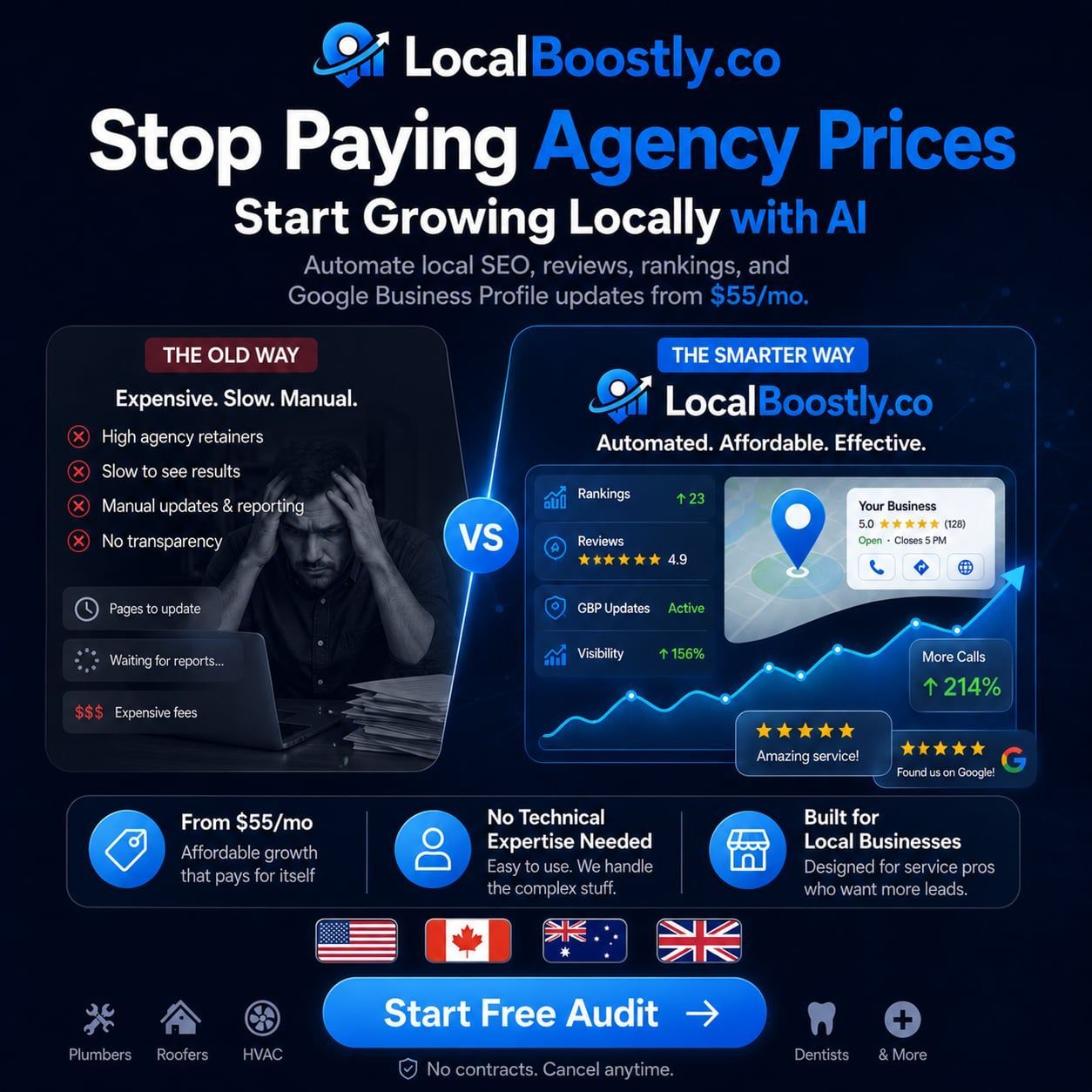
That is the idea behind platforms like LocalBoostly, an AI-powered Google Business Profile optimization platform built to help local businesses improve visibility, optimize their profiles, and generate more customer actions from Google Search and Google Maps.
For businesses that rely on local demand, tools like this can help turn the Google Business Profile from a passive listing into an active acquisition channel.
What a Well-Optimized Google Business Profile Should Do
A strong Google Business Profile should answer five questions quickly:
- What does this business do?
- Where does it serve customers?
- Can I trust it?
- Does it solve my specific problem?
- What should I do next?
If the profile fails at any of these, the business may lose leads.
A well-optimized profile should include accurate contact information, complete categories, detailed services, strong photos, consistent review activity, professional review responses, helpful posts, clear service areas, accurate opening hours, updated business details, and alignment with the website.
This is the foundation of local visibility and conversion.
Common Google Business Profile Mistakes
Mistake 1: Choosing the Wrong Primary Category
The primary category should reflect the main service, not a broad or loosely related business type.
Mistake 2: Ignoring Reviews
Unanswered reviews can make a business look inactive. Poor review management can damage trust.
Mistake 3: Using Generic Service Descriptions
High-quality services does not help Google or customers understand what the business actually offers.
Mistake 4: Not Adding Photos
A profile without recent photos feels less credible, especially in service industries where customers want proof of work.
Mistake 5: No Local Content Strategy
The profile and website should work together. A strong GBP paired with weak website content limits growth.
Mistake 6: Inconsistent Business Information
Name, address, phone number, hours, and service areas should be consistent across the business profile, website, and major directories.
Google Business Profile Optimization Is Not a One-Time Task
The biggest misunderstanding about GBP optimization is that it is a one-time setup. In reality, it is an ongoing process.
A business should regularly update services, publish posts, upload new photos, respond to reviews, check profile performance, monitor competitor activity, improve website alignment, and refine local SEO content.
The businesses that win in Google Maps are usually not the ones that set up a profile once and forget about it. They are the ones that maintain, improve, and measure it over time.
The Future of Local Search Belongs to Active Businesses
Local customers want fast answers, trusted providers, and clear proof that a business can help them. Google Business Profile is one of the most powerful places to communicate that.
For local businesses, the opportunity is simple: a better profile can mean more visibility. More visibility can mean more calls. More calls can mean more customers.
But the businesses that benefit most are the ones that treat their Google Business Profile as a living asset.
Whether managed manually, through an agency, or with an AI-powered tool like LocalBoostly, ongoing Google Business Profile optimization is becoming a core part of modern local SEO.
In a world where customers search, compare, and decide directly inside Google, the businesses with the clearest, most complete, and most trustworthy profiles have a major advantage.
