

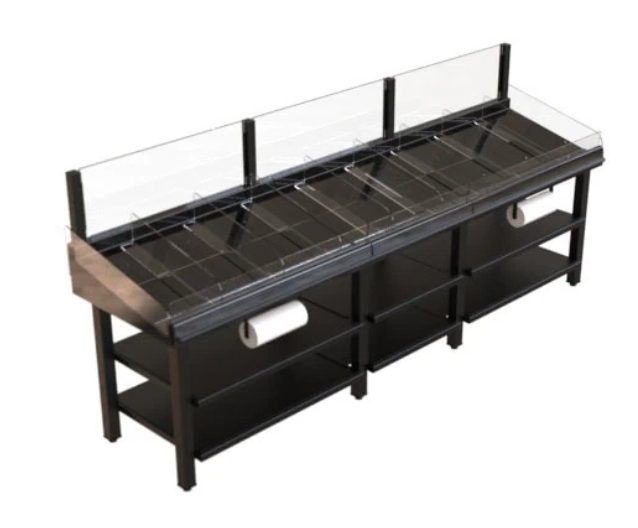
Produce departments carry more pressure than many shoppers realize. They’re expected to look fresh, full, colourful, clean, and abundant from open to close, all while protecting delicate inventory that can bruise, wilt, leak, or spoil quickly. For grocery executives, the fixture decision is not simply a store design choice. It affects sales velocity, labour efficiency, shrink control, food safety, brand perception, and a customer’s first emotional response to your store.
In short, choosing the right grocery store fixtures manufacturer matters. The best produce displays do more than organize fruit and vegetables. They support your merchandising strategy, help teams replenish faster, protect product quality, and make the department easier to manage at scale. When produce is often one of the highest-visibility areas in the store, fixtures should be evaluated as operational assets, not background equipment.
Prioritize Product Protection and Shrink Reduction
Produce is visually driven, but it is also highly vulnerable. Bruising, compression, poor airflow, overstacking, excess moisture, and difficult rotation can all increase shrink.
Good produce fixtures should support controlled abundance. Angled decks, adjustable bins, false bottoms, dividers, and product-friendly surfaces can help maintain the appearance of fullness without forcing staff to overload the display. This matters because shoppers respond to abundance, but operators need that abundance to be profitable.
Evaluate Labour Efficiency on the Sales Floor
Labour is one of the most important hidden costs in fixture selection. A produce display that takes too long to refill, clean, move, or reconfigure can become expensive across dozens or hundreds of stores.
Look for fixtures that simplify daily work. Can staff replenish from the back or top without awkward lifting? Are crates, trays, or inserts easy to remove? Can employees clean underneath and around the fixture without disassembling the entire unit? Are casters, brakes, and modular components durable enough for real store use?
These details may seem small, but they compound. Saving a few minutes per display, per day, across multiple locations can translate into meaningful labour savings. Just as importantly, efficient fixtures help teams maintain presentation standards during peak times when managers are stretched and departments are moving quickly.
Think Beyond the Initial Purchase Price
A lower-cost fixture can become expensive if it needs frequent repairs, fails under heavy use, damages product, slows staff down, or looks worn down after a year.
Consider durability, replacement part availability, finish longevity, cleaning requirements, mobility, and adaptability. A well-built fixture should hold up under moisture, produce acids, repeated impacts from carts, heavy loads, and constant customer contact. Materials matter, especially in a department where water, soil, leaves, and organic residue are part of the daily environment.
It also helps to ask how easily the fixture can evolve with the store. If your produce strategy changes, can the display be reconfigured? Can accessories be added later? Can the same fixture support different product categories during seasonal shifts? The more adaptable the equipment, the longer its useful life.
Match Fixtures to the Shopper Journey
Produce departments often sit near the entrance because they create an immediate impression of freshness. That first impression can influence how shoppers feel about the rest of the store. Fixtures should guide movement naturally, encourage discovery, and make the department feel abundant without creating congestion.
Sightlines matter. Low-profile displays can open up the department and make it easier for shoppers to scan categories. Taller fixtures can work well for perimeter displays, promotional zones, or packaged produce, but they shouldn’t block visibility or create tight corners.
Also think about basket-building. Strategic fixture placement can connect complementary items, such as berries near whipped toppings, salad vegetables near dressings, or citrus near seafood and beverages.
Choose Materials That Support Cleanliness and Food Safety
Rough surfaces, hard-to-reach gaps, exposed seams, and absorbent materials can make sanitation harder than it needs to be.
Look for smooth, durable surfaces and designs that limit debris buildup. Removable liners, washable components, and accessible undersides can make cleaning more consistent. If fixtures include wood elements, make sure they’re properly finished and suitable for the demands of a produce environment.
Food safety is often discussed in terms of handling procedures, but equipment design plays a direct role. The easier a fixture is to maintain, the more likely staff are to keep it clean during real operating conditions.
Plan for Brand Consistency Across Locations
For multi-location grocers, fixture decisions should support a recognizable brand experience. Customers may not consciously notice display specs, but they notice whether a department feels premium, practical, local, value-driven, or cluttered.
Consistency doesn’t mean every store needs to look identical. Flagship locations, urban formats, discount banners, and neighbourhood stores may need different layouts. Still, the fixture system should feel connected to the brand. Colour, material, height, signage integration, and merchandising style all shape perception.
Ask Better Supplier Questions
The right supplier should understand grocery operations, not just fabrication. Ask about load ratings, lead times, customization options, replacement parts, installation support, cleaning requirements, warranty coverage, and past experience with produce departments.
You should also ask how the supplier approaches scalability. Can they support a small refresh and a chain-wide rollout? Do they document specifications clearly? Can they reproduce fixtures consistently over time? Are they able to adjust designs based on store format, merchandising feedback, or operational constraints?
Make the Fixture Decision a Business Decision
Produce fixtures sit at the intersection of merchandising, operations, finance, and customer experience. The right ones help your department look better, but they also make it easier to sell fresh product profitably.
Before your next remodel, rollout, or department refresh, take a closer look at what your fixtures are really doing for the business. The right investment can help every apple, pepper, melon, and head of lettuce work harder on the sales floor.
