

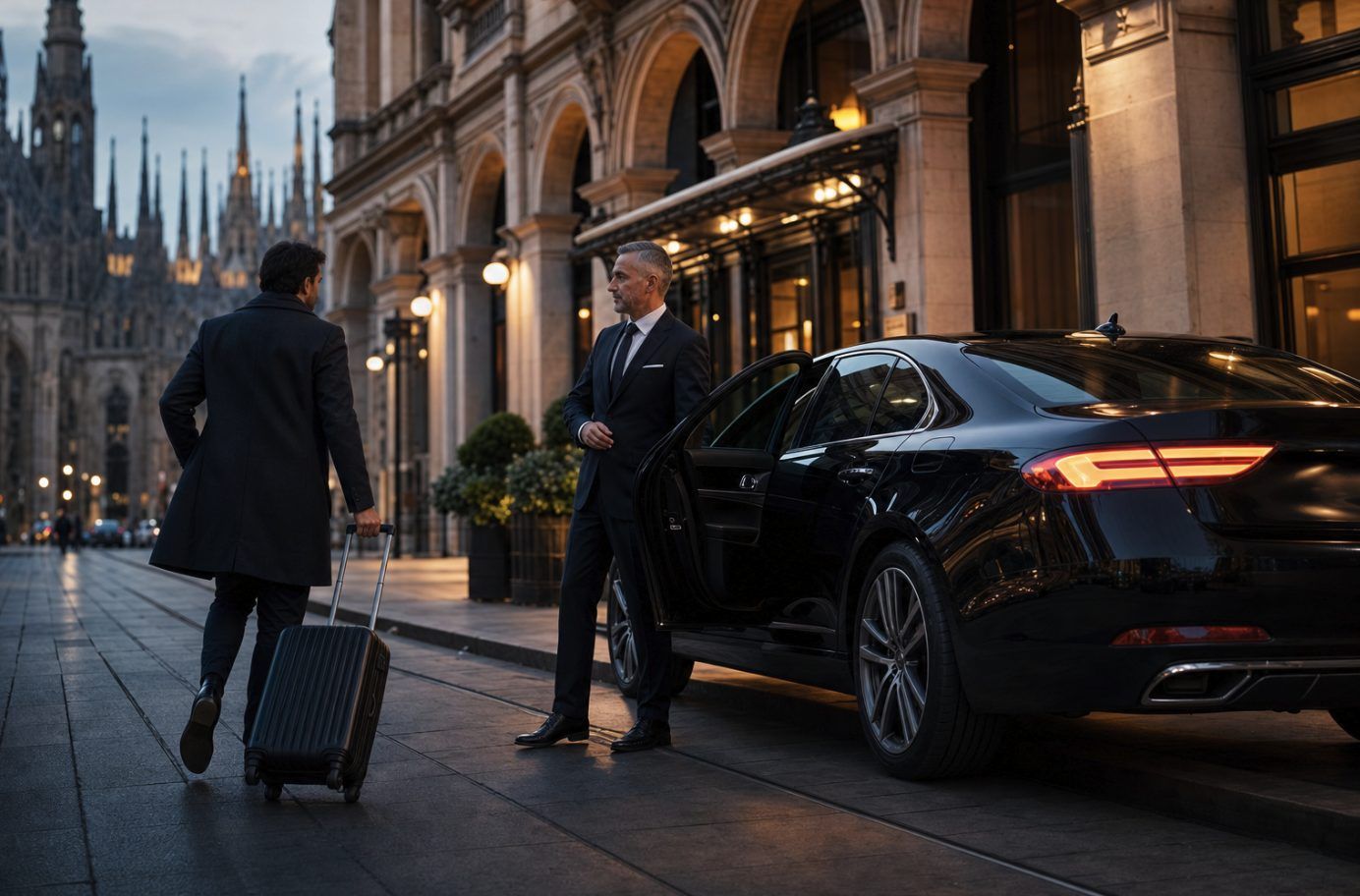
Is booking a chauffeur in Milan an indulgence or a practical decision? For travellers working with a demanding schedule, it is often the latter.
A pre-booked car turns transport into a planned part of the day. The pickup time is agreed in advance, the route can be organised around appointments, and there is no need to search for parking or navigate unfamiliar traffic restrictions.
Comfort certainly matters, but the real return lies in controlling time, reducing uncertainty and preventing transport problems from affecting the rest of the schedule. Vivaldi Professional Driver Service becomes particularly valuable when the day includes airport connections, several appointments, important guests or events with little room for delay.
The practical question is therefore not whether a passenger deserves to travel in a chauffeur-driven car. It is whether the cost of a disrupted journey could be higher than the cost of organising it properly from the beginning.
Practical value rather than display
Luxury is usually associated with appearance, exclusivity and personal comfort. Practical value is measured by the problems a service prevents.
A clean vehicle, a quiet interior and help with luggage are immediately noticeable. The less visible benefits may be more important: knowing when the car will arrive, having one person responsible for the journey and avoiding the mental effort required to drive, navigate, park and reorganise transport between appointments.
For a business traveller, that freed attention has real value. Time in the vehicle can be used to prepare for a meeting, answer messages, make calls or simply recover after a flight.
A chauffeur-driven service becomes a rational choice in several common situations:
- the itinerary includes multiple stops;
- the time between appointments is limited;
- a missed connection would have significant consequences;
- the passenger is unfamiliar with Milan;
- luggage or equipment must be transported;
- an international client or senior executive is being welcomed;
- the vehicle must remain available for several hours;
- demand is expected to be high because of a fair, conference or major event.
In these cases, the service is not primarily about status. It is a way to reduce the number of variables that can disrupt the day.
Understanding the hidden cost of disruption
Transport is often evaluated by comparing fares. This approach overlooks the cost of what happens when the cheaper or more spontaneous option fails.
A delayed pickup may lead to a missed train. Difficulty finding a vehicle after an event may postpone a dinner or an airport departure. An incorrect meeting point can leave a guest waiting outside an unfamiliar terminal or station.
These problems rarely appear on the transport receipt, but they consume time, create stress and can damage professional relationships.
The most useful comparison is therefore not simply the price per kilometre. It is the total cost of the journey, including:
- time spent waiting;
- time lost looking for parking;
- the risk of arriving late;
- the cost of reorganising appointments;
- lost productivity;
- administrative work;
- the effect on a client or guest.
The more important the appointment, the more valuable predictability becomes.
Why travelling by car in Milan requires planning
Milan is a compact city with a high concentration of businesses, hotels, exhibition centres, cultural venues and transport hubs. The same density that makes the city economically dynamic can make road travel less predictable.
Normal weekday traffic is only one factor. Trade fairs, fashion events, football matches, concerts and conferences can concentrate demand along the same routes and during the same hours.
A journey that is straightforward on an ordinary morning may require more time during Milan Fashion Week, the Salone del Mobile or a major event at San Siro.
Planning does not eliminate traffic, but it allows the itinerary to account for it. Pickup times can be adjusted, suitable routes considered and realistic buffers placed between appointments.
Area C and restricted access in central Milan
Central Milan includes restricted traffic areas that visitors may not immediately understand.
Area C covers part of the historic centre and uses electronic gates to monitor vehicle access. It is normally active from Monday to Friday, between 7:30 am and 7:30 pm, excluding public holidays.
Access depends on the type of vehicle, current environmental requirements and the applicable payment or exemption rules. Other streets and pedestrian areas may have additional restrictions.
For passengers, the practical consequence is simple: the most obvious entrance to a hotel, office or restaurant is not always the most convenient legal pickup point.
A driver familiar with Milan can check whether the address is accessible and suggest a nearby meeting location when necessary. Sometimes moving the pickup by a short distance can avoid delays, restricted streets or crowded entrances.
Guests staying in the historic centre should always provide the complete name and address of their hotel. Some properties have pedestrian entrances and use a separate location for private cars and transfers.
Taxi, ride-hailing or pre-booked chauffeur?
Each service has a legitimate role. The right choice depends on the journey rather than on a general hierarchy of quality.
Taxi
A taxi is a practical option for a single journey when a vehicle is readily available.
It is well suited to spontaneous travel within the city, especially when the passenger does not require a specific vehicle, extended waiting time or several planned stops.
Availability may vary according to location, weather, time of day and major events. Organising a full day through separate taxi journeys can also involve repeated bookings, different drivers and several receipts.
Ride-hailing service
An app-based service can make requesting and tracking a journey easier.
The passenger sees the request on a screen and may receive an estimated arrival time and fare. However, availability and pricing can still change during busy periods.
An app also does not necessarily provide continuity across an entire business itinerary unless each journey is booked separately.
Professional chauffeur service
A chauffeur-driven car is reserved in advance for a particular passenger, group or itinerary.
The pickup location, schedule, vehicle category and principal requirements can be agreed before departure. The service may cover a single airport transfer, several stops or hourly availability.
The central difference is planning. Instead of requesting transport each time it is needed, the organiser prepares the movement of the passenger as part of the day’s agenda.
Airport transfers without last-minute uncertainty
Milan is served by three major airports: Malpensa, Linate and Bergamo Orio al Serio. Each has different distances, traffic conditions and transport connections.
Airport travel is particularly vulnerable to small delays. The flight may land late, baggage reclaim may take longer than expected, or the passenger may have difficulty locating the correct exit.
A pre-booked transfer provides a defined contact and meeting process.
The organiser should provide:
- the passenger’s full name;
- a mobile telephone number;
- the flight number;
- the scheduled arrival time;
- the airport and terminal;
- the number and type of bags;
- the final destination;
- any child-seat or accessibility requirements.
The flight number is more useful than the arrival time alone because it allows the operator to identify changes to the flight schedule.
Waiting conditions should also be confirmed before booking. A transfer fare may include a defined waiting allowance, while additional charges can apply when baggage reclaim or flight delays extend beyond the agreed period.
This information should be clear before the journey, not discovered after arrival.
From the airport directly to a meeting
The practical value of a chauffeur is especially clear when a traveller must go directly from an airport to an appointment.
After a flight, the passenger does not need to compare options, queue for a vehicle or work out the route. The destination has already been communicated, luggage capacity considered and the journey planned.
This becomes important when the meeting has a fixed starting time or when the passenger is carrying presentation materials, samples or confidential documents.
A well-organised transfer also creates a buffer between the unpredictability of air travel and the precision expected in a professional setting.
No transport service can guarantee that a severely delayed flight will have no effect on the day. It can, however, reduce the number of additional decisions required once the passenger lands.
A full day of appointments
A business day may involve an airport, hotel, company headquarters, restaurant, exhibition centre and railway station.
Booking each journey separately creates a new point of uncertainty every time the passenger moves. A vehicle reserved for several hours can provide continuity throughout the itinerary.
The route and expected waiting periods should be discussed in advance. The schedule may include:
- collection from a hotel;
- transfer to a morning meeting;
- waiting during the appointment;
- transport to a business lunch;
- a second office or exhibition visit;
- return to the hotel, station or airport.
The driver already knows the sequence of locations, while the passenger does not need to repeat addresses or arrange a new car after every appointment.
Hourly availability is also useful when the precise finishing time of a meeting is uncertain. The vehicle remains assigned for an agreed period, allowing the itinerary to absorb reasonable changes.
Welcoming international guests
Transport is often the first direct contact an international guest has with the organisation hosting them.
A confusing pickup, unclear instructions or a long wait can create an impression of disorganisation before the official visit has begun.
A planned service helps standardise the arrival experience. The guest receives the meeting instructions, knows who to contact and has a vehicle suitable for the journey and luggage.
When language is important, the organiser should confirm which languages are spoken by the assigned driver. This should not be assumed merely because the service operates in an international city.
Discretion also matters. A business guest may need to make telephone calls, discuss appointments or review documents during the journey. A professional chauffeur should respect the passenger’s privacy and avoid unnecessary conversation.
Trade fairs, conferences and corporate events
Milan hosts exhibitions, design events, fashion shows, congresses and international business meetings throughout the year.
During major events, large numbers of passengers may need transport between airports, hotels, exhibition venues, restaurants and private locations at similar times.
The main challenge is not the individual journey. It is the coordination of several journeys.
An effective event transport plan should define:
- passenger names and contact details;
- flight or train information;
- accommodation;
- pickup and destination addresses;
- meeting points;
- luggage requirements;
- vehicle assignments;
- expected waiting times;
- the person authorised to request changes.
One coordinator should manage updates whenever possible. Instructions sent by several colleagues can lead to duplicated reservations, incorrect pickup times or conflicting destinations.
For groups, the organiser should also decide whether passengers can share vehicles. A minivan or minibus may be more efficient than several separate cars, provided that arrival times and luggage capacity are compatible.
Evening events and return journeys
Transport can become more difficult after a concert, football match, private dinner or late reception.
Many people leave the same area at once, road access may be modified and the availability of spontaneous transport can decrease.
A pre-arranged return journey provides a specific meeting point and time. The passenger does not need to search for a vehicle in a crowded street or move away from the venue without knowing where transport will be available.
For events with an uncertain finishing time, hourly availability may be more appropriate than a rigid pickup. The conditions and maximum waiting period should be agreed in advance.
Selecting the correct vehicle
Vehicle choice should be based on passengers, luggage and purpose, not merely on appearance.
A saloon may be suitable for one or two travellers with standard luggage. A minivan offers more flexibility for families, colleagues or passengers carrying several suitcases. A minibus may be necessary for larger delegations and event teams.
Before confirming the reservation, communicate:
- the exact number of passengers;
- cabin and checked luggage;
- pushchairs;
- child seats;
- wheelchairs or mobility equipment;
- skis or sports equipment;
- trade-fair materials;
- instruments or oversized objects.
Passenger capacity does not automatically equal luggage capacity. A vehicle that can seat several people may not have enough room for all their suitcases.
Oversized or unusual items should always be declared. The operator must be able to confirm that they can be loaded safely.
Vivaldi provides different Mercedes-Benz vehicle categories, including saloons, minivans and minibuses, allowing the service to be adapted to individual passengers, small groups and larger parties.
What to communicate when booking
A precise booking reduces the chance of misunderstandings.
The essential information includes:
- date and requested pickup time;
- complete pickup address;
- complete destination address;
- passenger telephone number;
- number of travellers;
- amount of luggage;
- flight or train details;
- additional stops;
- preferred vehicle category;
- special assistance requirements.
For an office, residential complex or hotel with several entrances, specify the exact reception, gate or street access.
For a multi-stop journey, list the locations in the correct order. Expected waiting time should be mentioned, especially if the driver is required to remain available.
Any change to the itinerary should be communicated through the agreed contact channel. A single updated message is more reliable than several partial instructions from different people.
What a clear quotation should contain
A chauffeur quotation should make it possible to understand the complete expected cost.
Before confirming, check whether it specifies:
- the route;
- vehicle category;
- number of passengers;
- included luggage;
- included waiting time;
- additional waiting charges;
- extra-stop charges;
- motorway tolls;
- parking costs;
- night or public-holiday supplements;
- payment method;
- amendment conditions;
- cancellation and no-show rules.
Vague information about waiting, parking or additional stops often causes more dissatisfaction than the initial fare itself.
For airport journeys, particular attention should be paid to the period included after landing and the procedure in the event of a delay. Vivaldi publishes specific waiting conditions and asks passengers to communicate significant flight changes, so these rules should be checked during confirmation.
The cheapest initial quotation is not necessarily the least expensive final service. A transparent quotation makes comparison more meaningful.
Operational reliability beyond the vehicle
A premium vehicle alone does not create a reliable transport service.
The quality of the service depends on several operational habits.
Confirmation
The passenger or organiser should receive written confirmation containing the principal journey details.
This creates a shared reference for the pickup time, route, vehicle and payment conditions.
Communication
There should be a clear telephone, messaging or email contact for updates and emergencies.
For airport and station pickups, the meeting instructions should be easy for a visitor to understand.
Punctuality
The service should plan around normal traffic conditions and arrive with an appropriate margin.
The organiser must also create a realistic itinerary. No driver can recover time that was never allowed between two distant appointments.
Local knowledge
A driver working regularly in Milan should understand the main business districts, transport hubs, exhibition venues and access restrictions.
Technology assists navigation, but local experience remains useful when streets are closed, traffic patterns change or a hotel entrance is difficult to reach.
Privacy
Professional passengers may work or hold confidential conversations during the journey.
Discretion should be treated as a standard part of the service rather than an optional luxury.
Contingency planning
For an important journey, it is useful to understand how vehicle problems, driver changes or exceptional demand are managed.
A professional operator should have a process for communicating unexpected changes and, where possible, arranging an alternative.
Administrative value for companies
The benefits of a planned service extend beyond the passenger.
Centralised bookings can simplify expense management. Rather than collecting several unrelated receipts, the company has clearer documentation of routes, passengers and costs.
This can be helpful for:
- executive travel;
- visiting clients;
- recurring airport transfers;
- conference speakers;
- group travel;
- event transport;
- internal cost allocation.
A corporate travel policy does not need to require chauffeur services for every journey.
A more efficient approach is to identify the situations in which transport failure would have a significant cost. These might include airport connections, senior visitors, several appointments in one day or travel during major events.
Routine city journeys can still be managed through taxis or public transport. The chauffeur becomes the preferred option where predictability produces a measurable benefit.
How early should a chauffeur be booked?
There is no single booking period suitable for every journey.
A straightforward transfer may sometimes be arranged at relatively short notice, subject to vehicle availability. Earlier booking is strongly advisable for:
- trade fairs;
- Fashion Week;
- the Salone del Mobile;
- concerts and football matches;
- large groups;
- minibuses;
- early-morning airport journeys;
- late-night collections;
- multi-stop itineraries;
- trips requiring a specific vehicle.
Booking early does more than reserve a car. It provides time to check addresses, luggage, access requirements and the realistic duration of the itinerary.
When a chauffeur is not necessary
A professional chauffeur service should not be presented as the only sensible way to travel in Milan.
For a simple, flexible journey within a well-connected area, the metro, tram or taxi may be faster and more economical.
A chauffeur may be unnecessary when:
- the passenger has no fixed schedule;
- there is only one short journey;
- luggage is limited;
- no special vehicle is required;
- the passenger is comfortable using public transport;
- the consequences of a delay are minor.
The service offers the greatest value when coordination matters. Using it selectively is often more rational than treating it as either essential for every journey or unnecessary in all circumstances.
Frequently asked questions
Is a chauffeur service the same as a taxi?
No. A taxi is generally requested for an immediate journey, while a chauffeur-driven NCC service is normally booked in advance for a defined passenger, route or period.
The chauffeur service can include several stops, waiting time or hourly availability agreed before departure.
When is Area C active?
Area C is normally active from Monday to Friday, between 7:30 am and 7:30 pm, excluding public holidays.
Access rules can change and depend on the vehicle, so current information should be checked when planning the journey.
Can a chauffeur collect passengers inside Area C?
The practical pickup point depends on the precise address, current access rules and road restrictions.
The complete destination should be provided during booking so that the operator can confirm the most suitable meeting point.
Can the same car remain available for several appointments?
Yes. An hourly chauffeur service can be arranged for journeys with multiple stops or uncertain finishing times.
The minimum duration, itinerary and included waiting time should be confirmed before booking.
What happens if the flight is delayed?
The operator should be given the correct flight number and informed of significant changes.
Waiting allowances and additional charges vary, so the conditions must be checked at the time of confirmation.
Which vehicle is suitable for a group with luggage?
The answer depends on both passenger numbers and luggage volume.
A minivan may be appropriate for a small group, while a minibus can serve a larger party. Exact luggage capacity should always be confirmed rather than assumed.
Are tolls and parking included?
This depends on the quotation and the route.
The customer should ask for written confirmation of what is included, particularly for motorway journeys, airport parking, additional stops and extended waiting.
Is the service available for fairs and events?
Professional chauffeur services can be arranged for meetings, fairs, concerts and corporate events.
Early booking is advisable because demand may become concentrated during major dates in Milan.
The practical choice when the schedule leaves no margin
Once the imagery of luxury is removed, the value of a professional chauffeur service is straightforward.
It provides a confirmed vehicle, a driver who knows the itinerary and a transport plan that has been considered before the passenger steps outside. It reduces the decisions that must be made during the day and limits the effect of traffic, parking and access restrictions on the wider schedule.
For an ordinary journey across Milan, another form of transport may be entirely sufficient. For an airport connection, a visiting executive, a sequence of meetings or a major event, the balance can change.
In those situations, the relevant question is not whether the vehicle feels exclusive. It is whether a planned service protects time, reduces risk and allows the passenger to focus on the reason for the journey.
In a city where a few lost minutes can quickly spread across an entire agenda, that is not indulgence. It is careful organisation.
