



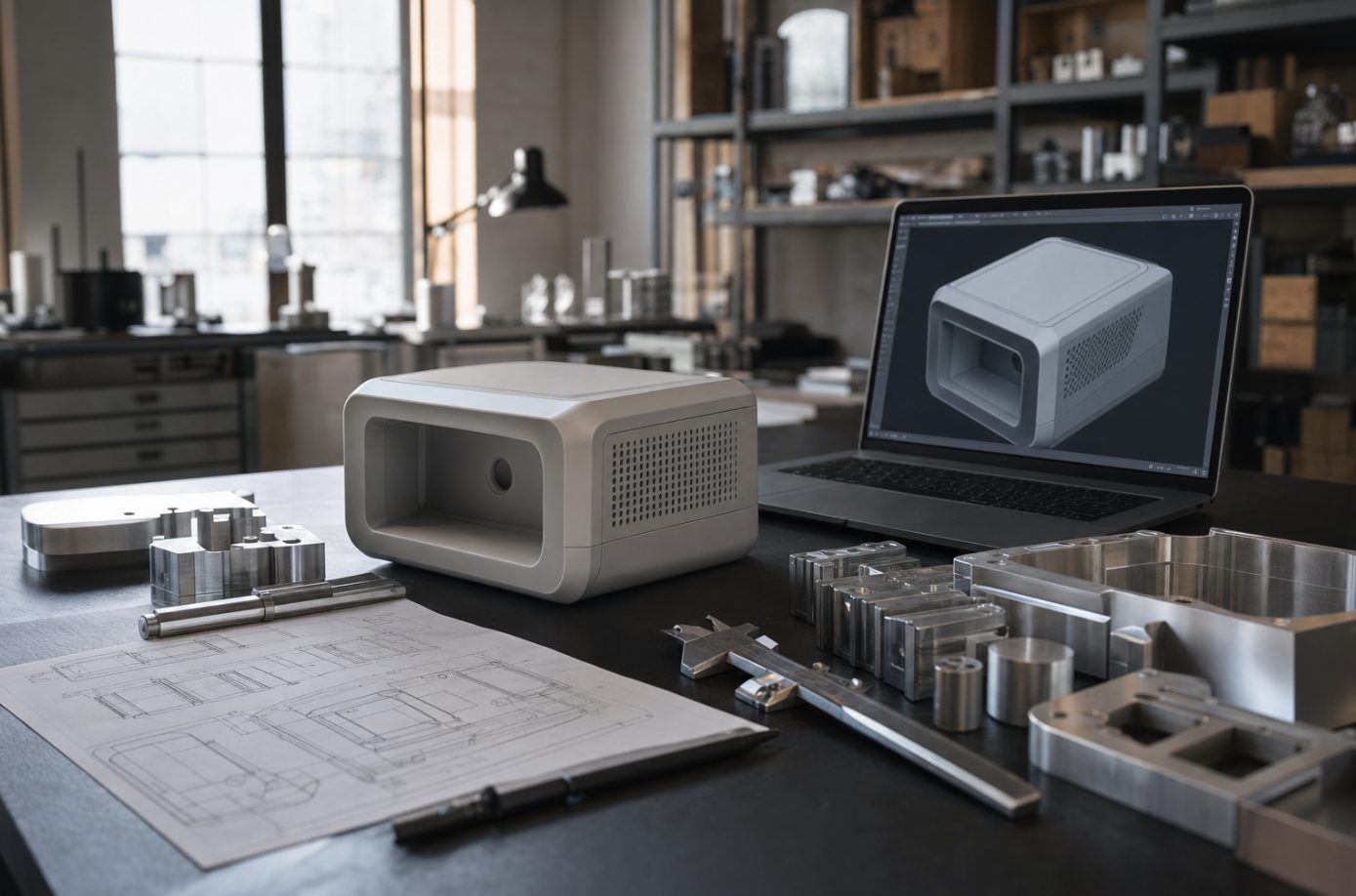
Why do so many promising product ideas stall somewhere between an approved rendering and the first production tool?
The problem is often not the quality of the concept. It is the fact that manufacturing constraints are considered too late. A design may look convincing on a screen and still prove too expensive, unreliable or complicated to manufacture at the required scale.
An industrial design consultancy such as PQ Design helps bridge this gap by translating a concept into materials, dimensions, tolerances, components and manufacturing processes that can support real production without compromising the product’s usability or identity.
The practical benefit is not simply a more attractive design. It is a controlled development process with fewer surprises involving cost, timing, quality and technical feasibility.
What does industrial design consulting actually involve?
Industrial design is often described as a strategic problem-solving process that drives innovation through products, systems and services.
That definition is accurate, but product managers and entrepreneurs usually face a more immediate question: can this object be manufactured at the target cost, in the required quantities and with consistent quality?
Concept design explores meaning, form and user experience. It produces scenarios, sketches, preliminary architectures and renderings that help define the direction of the product.
Production-oriented development begins from the same foundation but adds another layer:
- measurable requirements;
- material selection;
- manufacturing constraints;
- assembly principles;
- component integration;
- tolerances;
- testing criteria;
- supplier considerations;
- industrialisation planning.
The result should not be limited to a persuasive image. It should become a controlled design package that manufacturers can assess, quote and produce.
A mature industrial design partner connects brand objectives, user needs, engineering and manufacturing. This is particularly important because many product-development problems emerge in the spaces between disciplines.
Who defines the wall thickness of a plastic enclosure? Who checks whether components developed by different suppliers will fit together correctly? Who ensures that an attractive surface can be released from a mould without damaging the part?
Reducing this ambiguity reduces development risk.
The value of industrial design consulting therefore extends beyond appearance. It influences development time, tooling costs, unit price, reliability, maintenance, assembly and compliance with the applicable standards.
From an idea to a measurable product brief
A solid project does not begin with a list of aspirations. It begins with a brief that translates needs into requirements that can be tested.
The process starts with the people who will use the product and the context in which it will operate:
- Where will it be used?
- Who will handle it?
- How frequently will it be operated?
- What physical or environmental conditions will it face?
- Will users wear gloves?
- Will the product need to withstand water, dust, heat or impact?
- How will it be cleaned, maintained or repaired?
Business constraints must then be added:
- target cost;
- expected production volumes;
- target markets;
- development schedule;
- desired product lifetime;
- certification requirements;
- supply-chain limitations.
It is useful to distinguish between hard and soft requirements.
Hard requirements are measurable. They may include operating temperature, mechanical load, power consumption, ingress protection, battery life or minimum durability.
Soft requirements concern ergonomics, maintainability, perceived quality, brand consistency and the emotional response the product should create.
Both categories matter, but they must be prioritised. The team should agree on what is essential, what is desirable and what is optional.
This hierarchy becomes especially important when cost, performance and timing begin to conflict. Without clear priorities, every compromise turns into a lengthy negotiation.
Useful outputs from the early stages may include:
- a product requirements document;
- detailed use scenarios;
- a preliminary architecture;
- an initial risk map;
- a list of technical priorities;
- target cost and production assumptions.
These documents may appear administrative, but they protect the project from late redesign.
Changing a written requirement is inexpensive. Modifying a finished mould, replacing a selected component or delaying certification can be extremely costly.
Product architecture: where manufacturable concepts begin
An attractive concept can still be difficult to manufacture.
The difference often lies in product architecture: the way the product is divided into systems and components, and how those elements interact through mechanical, electrical and thermal interfaces.
Well-defined interfaces prevent conflicts between parts developed in parallel.
Consider a plastic enclosure assembled with snap-fit clips. On paper, this can look elegant. It eliminates visible screws and may reduce assembly time.
In production, however, problems can arise if:
- the walls have inconsistent thicknesses;
- the clips are too rigid;
- undercuts are not managed correctly;
- mould shrinkage is underestimated;
- the material is unsuitable for repeated opening;
- assembly tolerances accumulate.
The enclosure may warp, the clips may break during maintenance or operators may begin using adhesives to compensate for poor fit.
The same product developed with a folded sheet-metal enclosure follows a different industrial logic. Tooling investment may be lower for limited quantities, while the unit cost and finishing operations may be higher.
Neither solution is inherently better. The correct choice depends on volume, geometry, performance, appearance and investment.
Internal packaging also needs to be addressed early. Renderings rarely show:
- electronics;
- wiring;
- fastening points;
- batteries;
- seals;
- ventilation paths;
- heat-dissipation space;
- maintenance access.
Yet these elements often determine the external dimensions and final feasibility of the product.
Part count is another important variable. Every additional component must be designed, sourced, stocked, assembled and inspected.
Reducing parts, standardising components and creating modular systems can lower cost before any aesthetic change is considered.
Choosing materials and manufacturing processes together
There is no universally correct material. There is only a material and process combination that fits a particular geometry, production volume, performance requirement and price.
The manufacturing process is influenced by several key variables:
- expected quantity;
- required tolerances;
- geometry;
- surface finish;
- cycle time;
- tooling investment;
- product lifetime;
- possibility of future modifications.
Injection moulding can provide a low unit cost at high volumes, but it requires significant investment in tooling and careful attention to draft angles, wall thicknesses, parting lines and undercuts.
Die casting follows similar principles for suitable metal components.
Extrusion works well for parts with a continuous cross-section. Sheet metal is effective for enclosures, structures and industrial assemblies. CNC machining offers accuracy and flexibility for low-volume production and critical components.
Additive manufacturing is valuable for prototypes, customised components and short production runs, although material behaviour, surface quality and dimensional accuracy must be evaluated according to the application.
The recurring trade-off is clear: a process with high initial investment can reduce the cost of each unit, but only when the production volume justifies that investment.
At lower volumes, a more flexible process may be economically preferable even if its unit cost is higher.
Material selection follows the same logic.
Engineering plastics provide low weight, electrical insulation and considerable freedom of form. Metals offer rigidity, thermal performance, durability and a particular perception of quality. Elastomers can provide sealing, grip, protection and vibration damping.
Selection must consider:
- mechanical strength;
- chemical resistance;
- ultraviolet exposure;
- operating temperature;
- fire behaviour;
- recyclability;
- regulatory requirements;
- availability;
- long-term supply.
Finishes also affect both perceived quality and manufacturability.
Textures, coatings, paint, anodising and decorative treatments can improve the product, but they also introduce potential issues involving scratches, wear, colour variation, adhesion and batch consistency.
Finishes should therefore be considered while the geometry can still be modified, not after tooling has already been completed.
Design for Manufacturing and Design for Assembly
Two principles sit at the centre of production-oriented product development: Design for Manufacturing and Design for Assembly.
Design for Manufacturing, commonly shortened to DFM, means designing each component with its production process in mind.
For a moulded plastic part, this may involve:
- maintaining consistent wall thicknesses;
- adding radii instead of sharp internal corners;
- including suitable draft angles;
- managing ribs and bosses;
- positioning parting lines deliberately;
- controlling undercuts;
- anticipating shrinkage and warping;
- considering ejector-pin marks;
- selecting realistic surface finishes.
A component may be technically possible to manufacture but still inefficient, unreliable or unnecessarily expensive. DFM aims to identify these issues before the tooling stage.
Design for Assembly, or DFA, focuses on how the components are put together.
Typical objectives include:
- reducing the total number of parts;
- simplifying the assembly sequence;
- limiting the number of tools required;
- making components difficult to install incorrectly;
- improving access to screws and connectors;
- reducing handling and repositioning;
- using standard fasteners;
- making inspection easier.
A good assembly process should not depend on operators compensating for unclear design decisions.
If a component can easily be mounted backwards, the product should be redesigned to prevent that error rather than relying only on instructions.
Tolerances should follow function
Tolerances are one of the easiest places to increase manufacturing costs without creating additional value.
A tight tolerance is not automatically a sign of quality. It is a requirement that must be justified by function.
Critical fits, sealing surfaces, alignment features and moving mechanisms may need precise dimensional or geometric control.
Other dimensions can often accept wider variation without affecting performance, assembly or appearance.
Specifying unnecessarily narrow tolerances may require:
- more expensive processes;
- additional machining;
- slower production;
- more frequent inspection;
- increased rejection rates;
- tighter supplier controls.
The correct question is not how precise a component can be made, but how precise it needs to be for the product to work.
General tolerance standards may be used where appropriate, while critical features should receive explicit controls.
For more complex geometric relationships, engineering teams may use Geometric Dimensioning and Tolerancing to define requirements involving position, flatness, parallelism, perpendicularity and runout.
The purpose of this language is not to make drawings more complicated. It is to communicate which variations are acceptable without creating ambiguity between designers, engineers, suppliers and quality teams.
Prototyping according to the risk
Prototyping should not mean producing one impressive model and hoping it answers every question.
Different prototypes serve different purposes.
A visual prototype, sometimes called a look-like model, can validate:
- overall form;
- dimensions;
- proportions;
- surfaces;
- colours;
- perceived quality;
- brand consistency.
A functional prototype, or work-like model, can test:
- mechanical behaviour;
- electronics;
- thermal performance;
- movement;
- sealing;
- usability;
- assembly;
- durability.
A prototype may also be developed specifically to evaluate ergonomics, manufacturing feasibility or a single critical component.
Problems arise when the team expects one prototype to provide answers it was not designed to give.
A visually accurate model may use materials and internal structures that are completely different from the final product. A functional prototype may perform correctly while having little resemblance to the intended appearance.
The right prototype should be chosen according to the risk that needs to be reduced.
Before pre-production, validation may include:
- functional testing;
- ergonomic trials;
- drop testing;
- environmental testing;
- repeated operating cycles;
- assembly trials;
- heat and airflow evaluation;
- sealing checks;
- component-life testing.
Each iteration should answer a defined question.
Rapid iterations are useful only when the team understands what is being tested, what result is expected and which decision will follow.
Testing should also be documented. A record of prototypes, results and design changes protects the project and improves communication with suppliers.
Design validation before tooling
Tooling is often one of the most expensive and least flexible stages of product development.
Before approving a mould or other dedicated equipment, the team should have sufficient confidence in:
- dimensions;
- product architecture;
- component selection;
- assembly;
- material choice;
- user interaction;
- thermal behaviour;
- mechanical performance;
- certification strategy.
This does not mean that every uncertainty can be removed. It means that the critical risks should be understood and reduced before investment becomes difficult to reverse.
Design reviews should involve the relevant disciplines. Industrial designers, mechanical engineers, electronics specialists, manufacturing partners, marketing teams and decision-makers may each identify different risks.
The purpose of alignment is not to allow everyone to redesign the product. It is to ensure that important constraints are not discovered after the design has already been frozen.
From CAD data to industrialisation
At a certain point, the project needs a controlled design freeze.
Not every detail must be frozen at the same moment. Critical interfaces and geometries that affect tooling usually need to be finalised first. Graphic details, documentation or some packaging elements may remain flexible for longer.
Knowing what to freeze and when is an important product-development skill.
Supplier involvement should not be treated as the last step.
Manufacturers and tooling partners can provide valuable feedback on:
- process limitations;
- tooling strategy;
- material availability;
- production cycle;
- quality risks;
- cost drivers;
- alternative component solutions.
Requests for quotation should be based on sufficiently developed information. A supplier cannot provide a meaningful price when volumes, materials, finishes and tolerances remain undefined.
Pre-production and production ramp-up should then be monitored using measurable indicators such as:
- cycle time;
- line yield;
- rejection rate;
- assembly time;
- dimensional stability;
- cosmetic defects;
- supplier consistency.
The objective is to move from a theoretically manufacturable product to a stable and repeatable production system.
Packaging is part of the product system
Packaging is often considered late, but it can affect the design long before the product is shipped.
It must protect the product during:
- manufacturing;
- storage;
- transport;
- distribution;
- handling;
- final delivery.
The packaging volume influences logistics and cost. Its internal structure must prevent movement, impact and surface damage.
It also affects the user’s first physical interaction with the product.
Material selection, recyclability, instructions, accessories and opening sequence should therefore be considered as part of the wider product system.
Poor packaging can damage an otherwise well-designed product, increase returns and generate unnecessary waste.
Working with suppliers and the supply chain
A product may perform perfectly in a prototype workshop and still fail when production is distributed across several suppliers.
Each supplier works with its own equipment, process capabilities and quality controls. Components must meet correctly even when they are manufactured in different locations.
This requires:
- controlled drawings;
- revision management;
- approved materials;
- inspection criteria;
- reference samples;
- clear communication of changes;
- incoming quality procedures.
The supply chain should also be evaluated for availability and continuity.
A highly specialised component may offer excellent performance but create significant risk if it has a long lead time, a single source or an uncertain future.
Design decisions should balance technical performance with supply-chain resilience.
Designing for maintenance and product life
Manufacturability is not limited to the moment when the product leaves the factory.
A product may need to be installed, cleaned, serviced, updated or repaired throughout its life.
Maintenance requirements should influence the architecture from the beginning.
Questions may include:
- Can the enclosure be opened without damage?
- Can high-wear parts be replaced?
- Are connectors accessible?
- Can technicians reach fasteners with standard tools?
- Can the product be reassembled reliably?
- Are dangerous areas protected?
- Can components be separated at the end of life?
A permanently sealed construction may improve appearance or water resistance, but it can make repair impossible.
A modular design may simplify maintenance, but it can increase component count and assembly complexity.
Once again, the objective is not to maximise every quality at the same time. It is to choose the most appropriate balance for the product and its market.
How to evaluate an industrial design consultancy
A portfolio demonstrates previous work, but it does not fully explain how a consultancy manages development.
Companies should ask practical questions before selecting a partner:
- Which production volumes have you worked with?
- How do you manage target cost?
- Which manufacturing processes do you understand directly?
- How do you define and document requirements?
- How are prototypes planned?
- Which validation criteria do you use?
- When are suppliers involved?
- How do you manage design changes?
- How do you support industrialisation?
- Who is responsible for each project stage?
Clear answers indicate that the consultancy understands product development as a controlled process rather than a sequence of attractive presentations.
Three capabilities are particularly valuable.
Integration
Design, engineering, user experience and manufacturing should not operate as isolated activities.
The product becomes stronger when decisions are considered across disciplines from the beginning.
Transparent management of trade-offs
Cost, quality, performance and speed cannot all be maximised without consequences.
A reliable consultancy makes these trade-offs visible and helps the client decide where value should be protected.
Promises of maximum quality, minimum cost and extremely short timing should be treated cautiously when no compromise or risk is acknowledged.
Traceability
Important decisions should be recorded.
Requirements, design reviews, prototypes, test results and approvals create a development history that supports the team and reduces confusion.
A traceable process also makes it easier to understand why a decision was taken when the project changes months later.
When external industrial design support creates the most value
External consulting is particularly useful when:
- the product contains several interacting systems;
- the internal team lacks specific design or manufacturing expertise;
- production investment is significant;
- usability and brand identity are important;
- technical and market requirements conflict;
- the company is entering a new product category;
- the route from prototype to production is unclear;
- several suppliers must be coordinated;
- late redesign would be expensive.
The cost of consulting should not be compared only with the option of doing nothing.
It should be compared with the potential cost of discovering, after tooling or certification, that the product cannot be assembled efficiently, does not meet user needs or cannot be manufactured within the target price.
The bridge between a good idea and a viable product
The distance between concept and production is filled with decisions.
Some involve form and user experience. Others concern materials, interfaces, tolerances, suppliers, assembly and testing. None of them can be treated as entirely separate.
A successful industrial design process maintains the value of the original idea while gradually removing ambiguity.
The concept becomes a product architecture. The architecture becomes testable components. Those components become a controlled manufacturing and assembly system.
This does not eliminate every risk. Product development will always involve uncertainty and compromise.
It does, however, make the risks visible while they can still be managed.
That is the practical role of industrial design consulting: not merely to make an idea look complete, but to help ensure that it can become a functional, reliable and market-ready product.


