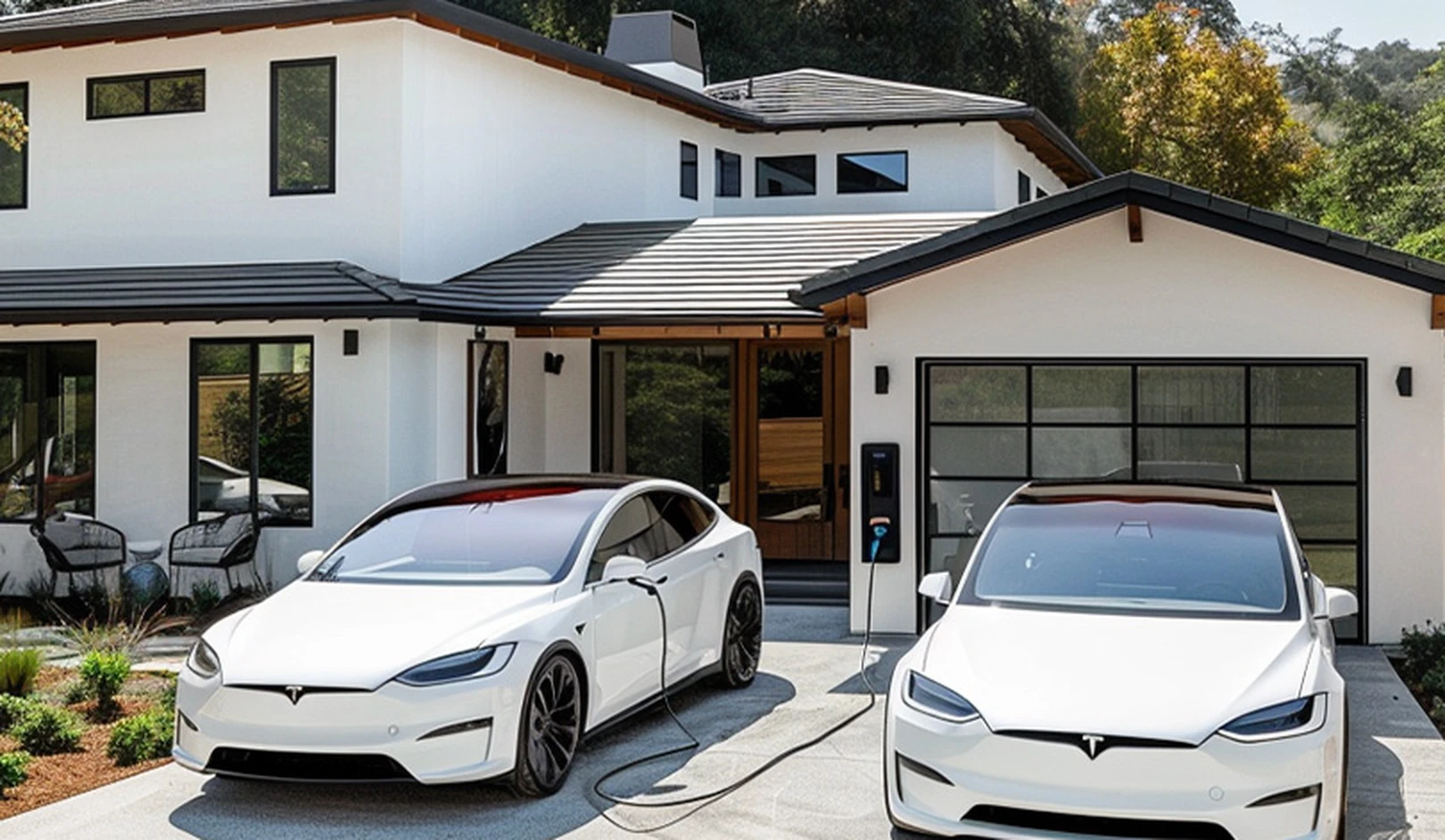
The first time I noticed the problem, I was at a neighbor’s house in Naperville for a barbecue. His Model Y was plugged in at the side of the garage. His wife’s Ioniq 5 was sitting in the driveway with about 30 miles of range left. He looked at it, looked at me, and said, “I’ll move mine in around midnight when hers is done.” Then he laughed, but not really.
That’s the conversation happening in a lot of two-car garages right now. Naperville has one of the higher EV adoption rates in DuPage County, and a lot of those families are on their second EV. The first one was easy. The second one is where things get complicated.
I wanted to understand what actually works, so I called Alexandr Godonoaga, who runs COB Services, a residential electrical contractor that does a lot of EV install work across the western suburbs. He’s been doing this long enough to have seen which solutions hold up and which don’t.
The math is usually the problem
Before anyone talks about chargers, Godonoaga said, you have to do the load calculation.
“Most homeowners assume that because they have a 200-amp panel, they can add two 40-amp chargers. That math doesn’t work in a lot of houses. By the time you account for the existing loads under Article 220, you can be over capacity before you plug anything in.”
He told me about a recent job in a home off Book Road. 200A service, gas heat, gas range, no pool, no hot tub — a setup most people would assume could handle anything. The standard calc came back at 218 amps with two dedicated EV circuits added. Not even close.
“It’s not the EV chargers themselves that are the problem. It’s that those chargers pull continuously for hours at a time, and the code treats continuous loads at 125 percent. Two chargers at 40 amps each becomes 100 amps of calculated load. That’s half a 200-amp service before the rest of the house gets counted.”
This is why the first thing he tells homeowners is to not start by shopping for chargers. Start by knowing what the panel can actually carry.
Load sharing is the answer most people don’t know about
When the calc doesn’t work for two dedicated circuits, the obvious move is a service upgrade. But Godonoaga said that’s almost never his first recommendation.
“Most two-EV families don’t need a service upgrade. They need load sharing. People hear that and assume it means slower charging, but it really doesn’t matter in practice.”
Here’s how it works. You run one circuit instead of two. Both chargers connect to it. When only one car is plugged in, that car gets the full amperage. When both are plugged in, the chargers automatically split the available current. Tesla’s Wall Connector does this natively. Wallbox calls it Power Boost. ChargePoint and Emporia have their own versions.
The reason it doesn’t matter, he said, is the math of overnight charging. “Most people plug in at 6 or 7 PM and unplug at 7 AM. That’s twelve hours. Even at a shared 24 amps per car, you’re adding more range than the average driver uses in a day. The full speed of a 48-amp circuit is only useful if you’re trying to top off in two hours, and almost nobody actually needs that at home.”
The install cost is dramatically lower too — one circuit run instead of two, one breaker instead of two, less labor. He estimated load-shared installs in Naperville typically run around 40 percent less than two dedicated circuits, depending on where the panel sits relative to the garage.
When load management makes sense instead
For older homes where even one full-amperage EV circuit is tight, there’s another option: a load management module that watches the whole panel and throttles the chargers when the rest of the house is pulling hard.
“Article 750 of the NEC explicitly allows this,” Godonoaga said. “It’s not a workaround. The system measures current at the main and tells the chargers to back off if the house is drawing close to capacity. Then it lets them ramp back up when the dryer stops.”
DCC-9, Emporia, and a few other manufacturers make these modules. They sit between your panel and the EV circuit and cost a fraction of what a Span panel runs.
The advantage is that you can install EV chargers in homes where the load calc would otherwise fail. The system guarantees you’ll never exceed service capacity, which is what the code cares about. Some inspectors in DuPage County are still getting familiar with the approach, Godonoaga said, but it’s been in the code for several cycles and most plan reviewers in Naperville know it now.
When you actually do need a service upgrade
There are cases where the right answer really is more amps.
“If a family is planning to add a heat pump, a hot tub, a pool, or an addition in the next few years, and they already want two EVs, sometimes the cleanest answer is just to go to 320 or 400 amps. ComEd will run the new meter socket, we install the new main panel, and you have headroom for everything that’s coming.”
He was direct about when not to do this. “If the only reason for the upgrade is the EVs, it’s usually overkill. Load sharing or load management will solve the problem for less than half the price.”
Service upgrade costs in Naperville run roughly $4,000 to $8,000 depending on where the meter is, how far the service drop is, and whether the panel location works with current code. ComEd permitting in DuPage County has been running 4 to 6 weeks lately, so it’s not a same-week project.
A note on subpanels
One thing Godonoaga wanted to clear up: a subpanel by itself usually doesn’t solve the two-EV problem.
“People hear ‘subpanel’ and think it adds capacity. It doesn’t. It just gives you more breaker slots. If your main panel is full but your load calc still works, a subpanel is useful. If your load calc doesn’t work, a subpanel changes nothing.”
This comes up a lot, he said, because contractors who don’t specialize in EV charger installations sometimes sell subpanels as a fix when they’re really just adding a place to put the breakers. The amperage problem stays the same.
The ComEd angle worth knowing
One thing that came up at the end of our conversation that I hadn’t thought about: ComEd has a residential rate program specifically for EV owners. The Whole House Hourly Pricing program combined with the EV adder can significantly reduce overnight charging costs.
“For a two-EV family charging every night, it’s real money,” Godonoaga said. “I always mention it to homeowners during the install consultation. Not everyone enrolls, but they should at least look at it.”
So what would I do?
After the interview, I tried to summarize what I’d actually do if it were my house.
Get the load calculation done first. Not a guess. An actual Article 220 calc by a licensed electrician. Half the time the panel handles two chargers fine and the worry was unnecessary. The other half, the calc tells you exactly which solution fits.
If the calc works, load sharing is probably still the better answer than two separate circuits. The wiring cost is lower, and the practical difference at night is nothing. If the calc doesn’t work, a load management module is almost always cheaper than a service upgrade and gets you to the same outcome.
A service upgrade only makes sense if there are other big loads coming. Doing one just for the EVs is usually paying for capacity you’ll never use.
Two EVs in one Naperville driveway is a solvable problem. The mistake most people make is assuming the only solution is more amps. Usually it’s smarter wiring.
Alexandr Godonoaga is the founder of Cob Services, a residential electrical contractor based in the western Chicago suburbs.