

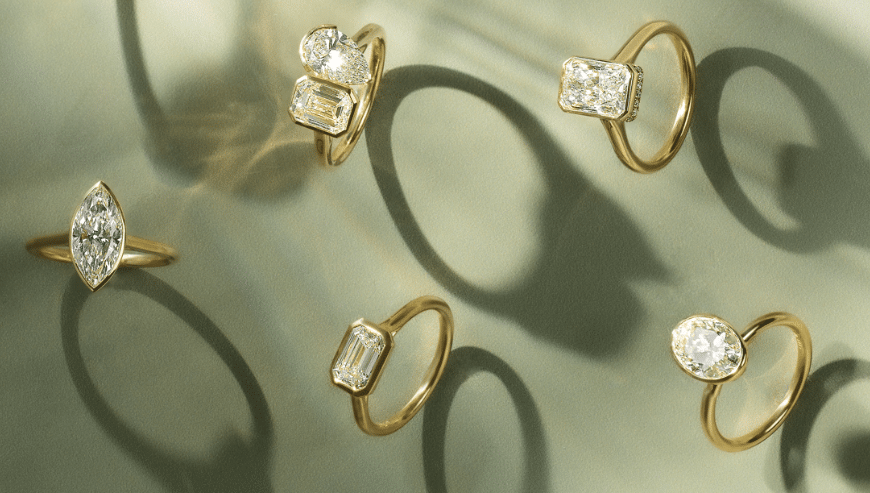
An engagement ring gets worn through roughly 15,000 days over forty years. The stone gets the attention, but the setting does the quiet work of keeping it safe through every one of them.
Two Ways to Hold a Diamond
Prong settings grip the stone with slim metal claws, usually four or six, and raise it above the band. Bezel settings take a different approach. A band of gold or platinum curves up and around the stone’s edge, either all the way round or along two opposite sides.
It’s one of the oldest settings in jewellery, and it had a real moment in the 1940s and 50s thanks to its clean lines and toughness. Scroll through Cullen’s bezel engagement rings and you’ll see how far the look has come, with the rim adapting to almost any cut, from a classic round to an elongated cushion or a sharp-cornered marquise. Some bezels are bold and chunky while others are a fine sliver of metal, so it’s worth comparing a few side by side to find your comfort zone.
Bezel Settings Win on Security
Metal where it matters most
A diamond scores 10 on the Mohs hardness scale, so it shrugs off scratches. Chips are another story. A hard knock at the wrong angle can nick an edge, and pointed cuts like pear, princess and marquise carry the most exposed tips. A bezel wraps those edges in metal, so the benchtop meets gold instead of gemstone. That’s why jewellers rank it among the most secure settings you can choose.
The smooth, low profile is kind to knitwear and long hair, too. Raised claws are the part most likely to catch on sheets or sleeves.
Prongs thrive on a yearly check-in
A well-made six-claw setting is still highly durable. Claws are small, though, and everyday contact slowly works on them. The easy fix is a professional clean at least once a year, where a jeweller also checks the claws and looks for any loose stones. Some jewellers, Cullen included, offer an ultrasonic clean free for their own rings, and it takes about five minutes.
Prong Settings Win on Light
With most of the diamond open to the air, light enters from every angle and bounces back up through the top. That’s the bright, flashing fire people love in proposal photos.
Here’s the surprise, though. A well-cut stone in a bezel loses far less sparkle than most people expect, and the metal frame can actually make the centre stone look bigger and bolder. Bezels are also a beautiful match for coloured gems like sapphires, where the rim deepens the colour.
Prongs use less metal, so they usually come in slightly cheaper than a bezel, which needs more gold or platinum and more skill at the bench. Home cleaning is simple either way: warm soapy water and a soft toothbrush, paying extra attention around the claws and setting.
Picking the Setting That Fits Your Week
Start with what your hands do, not what the ring looks like in a display case.
Nurses, physios, vets and parents of toddlers often love bezels, because the ring keeps up with busy, hands-on days and asks for very little in return. (Whatever the setting, it still pays to slip any ring off for weights, contact sport or heavy gardening.) Office workers chasing maximum brilliance usually lean towards a six-claw solitaire and rarely regret it.
Can’t decide? A half bezel protects two opposite edges, often the shorter ends of an emerald cut, while the long sides stay open to the light. Some designs also tuck a hidden halo beneath the bezel for a flash of sparkle from side-on.
One last practical tip: give the metal as much thought as the setting. Platinum is dense, durable and low-maintenance, which makes it a natural partner for daily wear. White gold gives a similar bright look at a friendlier price, but its rhodium plating may need a refresh over the years, so build that into your long-term plan.
