

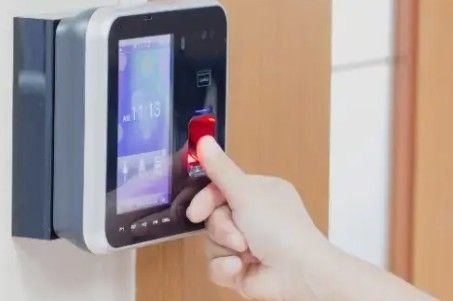
Commercial building security used to be relatively straightforward: locks controlled entry, cameras recorded activity and security personnel dealt with incidents.
That separation is disappearing.
Modern access control systems are increasingly connected to cameras, building-management platforms, identity systems and network infrastructure. Instead of simply unlocking a door when someone presents a card, the system can evaluate who the person is, which area they are trying to enter, when they are requesting access and whether that activity fits established security rules.
This makes physical access control part of a much larger technology environment.
For offices, warehouses, manufacturing facilities, data centres and other commercial properties, the important question is no longer simply whether a door should be electronically controlled. It is how access information can be used securely and intelligently across the building.
From Electronic Locks to Connected Security Systems
Traditional electronic access control usually follows a simple process.
A person presents a credential, such as a card or PIN. The system checks whether the credential has permission to open that door. Access is then granted or denied.
Modern systems can add considerably more context.
Credentials may include:
- Smart cards
- Mobile credentials
- PIN codes
- Biometric authentication
- Temporary digital credentials
Permissions can also depend on conditions such as location, employee role or time of day.
An engineer may have access to a technical room while an office employee does not. A contractor may receive permission for one entrance during a three-day maintenance period. An employee may have normal access during working hours but require additional authorisation outside that window.
The principle resembles the distinction between role-based and attribute-based access control in computer security. Digital RBAC and ABAC concern access to systems and data, while physical access control concerns buildings and protected areas, but both rely on policies that determine what an authenticated identity should be permitted to access.
Access Control Is Becoming Operational Technology
One of the biggest changes is that physical access systems can no longer be viewed as isolated door hardware.
The US National Institute of Standards and Technology classifies physical access control systems among the types of operational technology that interact with or control the physical environment.
More recently, NIST noted that modern commercial buildings increasingly depend on building automation and control systems to manage functions including access control, fire alarms, lighting, HVAC and energy systems.
That convergence creates useful opportunities, but it also means building-security technology needs to be managed with the same care as other connected infrastructure.
A failure may no longer affect only one door.
Poor configuration, weak credentials or insecure network access could potentially affect a much broader part of the building environment.
Better Credential Management
One practical advantage of modern access control is the ability to manage credentials throughout their lifecycle.
Consider what happens when an employee leaves a company.
With a physical key, management needs to retrieve it and assume that no copy exists. If a key cannot be accounted for, replacing the lock may be necessary.
Electronic credentials can usually be disabled instead.
The same applies when:
- An access card is lost
- An employee changes departments
- A contractor completes a project
- A visitor’s temporary permission expires
- An employee no longer requires access to a sensitive area
For organisations evaluating an access control system in Singapore, credential administration is therefore just as important as the readers and electronic locks themselves.
Businesses should look at how easily users can be added, permissions changed, credentials revoked and access activity reviewed.
Time Can Become Part of the Access Policy
Physical keys generally provide a binary choice.
Someone either has the key or they do not.
Connected access control can apply more specific rules.
An employee may be authorised to enter an office between 7 a.m. and 9 p.m. on weekdays.
Cleaning personnel may receive access only during scheduled evening hours.
A technician could be authorised to enter a server or equipment room for a predetermined maintenance window.
This means access can be temporary rather than permanent.
It also reduces the risk of old contractor or visitor credentials remaining active simply because nobody remembered to remove them manually.
Access Logs Add Context After an Incident
Another significant difference between mechanical and electronic access is visibility.
A normal lock cannot tell a security team which person used it.
An electronic system can create an event record containing information such as:
- Credential presented
- Entry point
- Date and time
- Access granted or denied
- Repeated unsuccessful attempts
- Activity outside normal hours
Suppose equipment disappears from a restricted room overnight.
The access log does not necessarily prove who removed it, but it can show which credentials interacted with the room around the relevant period.
That information becomes considerably more useful when paired with other security data.
CCTV and Access Control Can Work Together
An access log identifies a credential.
It does not always identify the person holding it.
Imagine a staff card opens a restricted entrance at 11:15 p.m.
The access system knows the credential was accepted, but several questions remain:
- Was the authorised employee actually carrying the card?
- Did another person follow them through the entrance?
- Was the door held open?
- Did several people enter on one credential?
- What happened immediately after entry?
CCTV can provide that missing visual context.
A security team can compare the access event with footage covering the same location and time.
The same principle is appearing elsewhere in smart-building technology, where connected access points, cameras, sensors and other systems increasingly exchange information rather than functioning as separate technologies.
Integration does not automatically make a building secure, but it can give operators a more complete view of an event.
Physical and Cybersecurity Are Converging
Connectivity also creates a new responsibility.
A network-connected access controller is still a network-connected device.
That means physical-security teams increasingly need to consider questions that once belonged mainly to IT departments.
For example:
- How are administrator accounts protected?
- Who can remotely manage the system?
- Are default credentials removed?
- How are controllers segmented from other networks?
- How are software and firmware updates handled?
- Who reviews system logs?
- What happens when an administrator leaves the organisation?
NIST’s current guidance on building automation and control system cybersecurity highlights this convergence. Building systems now include a mixture of physical infrastructure, programmable controllers, networks and software, making cybersecurity an important part of reliable building operation.
The security of the door and the security of the network controlling the door therefore cannot be treated as completely separate problems.
Biometrics Add Security and Data Responsibilities
Biometric access can provide stronger identity verification than a card that can be lost or shared.
Fingerprint and facial-recognition technologies are therefore increasingly considered for high-security areas.
But biometric authentication also changes the type of information the organisation is responsible for protecting.
Replacing a compromised access card is relatively straightforward.
Replacing someone’s biometric characteristics is not.
Organisations considering biometric access should therefore think carefully about:
- How biometric templates are stored
- Whether information is encrypted
- Who can access biometric records
- How long information is retained
- What happens when an employee leaves
- Whether biometrics are necessary for every controlled area
A higher-security technology is only useful when the data required to operate it is protected appropriately.
Not Every Door Needs the Same Security Level
Connected systems make sophisticated authentication possible, but that does not mean every entrance needs it.
Security should reflect risk.
A general office entrance may work perfectly well with employee cards.
A server room might require stronger authentication.
A data centre or particularly sensitive operational area may justify multi-factor or biometric access.
This risk-based approach can keep the system practical for everyday users while applying stronger controls where the consequences of unauthorised entry are more serious.
It can also prevent organisations from creating unnecessarily complex security procedures that employees eventually try to bypass.
Access Control Can Support Multi-Site Operations
Centralised management becomes particularly valuable when an organisation operates several locations.
A company may have a headquarters, warehouse, manufacturing facility and multiple smaller premises.
Without centralised access management, administrators may need to maintain separate user lists and credentials at each site.
A connected platform can make it easier to:
- Add or remove employees centrally
- Apply common access policies
- Manage temporary credentials
- Review events across locations
- Change permissions when roles change
This reduces administrative duplication and can make security policies more consistent across the organisation.
The system still needs appropriate controls around who has administrative authority. Centralisation improves efficiency, but it also makes privileged access to the management platform more important.
Automation Should Not Replace Security Judgement
Connected systems can automate many routine decisions.
A valid credential can open a door automatically. A temporary credential can expire without manual intervention. An unusual access attempt can generate an alert.
But automation cannot understand every situation.
A denied access attempt at 3 a.m. could represent an intrusion attempt.
It could also be an employee who has legitimately been asked to respond to an emergency but has not been given the correct temporary permission.
Technology identifies the event.
Security policies and people still determine what that event means.
This is why organisations need clear procedures for:
- Security alerts
- Lost credentials
- After-hours access
- Emergency entry
- Contractor access
- Employee departures
- System failures
The technology and operational processes need to be designed together.
What Should Organisations Consider Before Deployment?
Choosing an access-control system should start with the building and its risks rather than with a particular reader or credential technology.
Useful questions include:
Which areas genuinely need controlled access?
Not every internal door requires electronic security.
Prioritise areas where unauthorised access would create meaningful operational, safety or security risks.
Who will administer credentials?
A sophisticated system can still become insecure if old users remain active or permissions are rarely reviewed.
Does the system need to connect with CCTV?
Integration can provide useful visual context around important access events.
Can it grow across additional locations?
The architecture should reflect likely future requirements, particularly for expanding organisations.
How is the system protected digitally?
Network configuration, administrator accounts, updates and remote-access policies should form part of the deployment plan.
What happens during a failure?
Businesses should understand how doors operate during power, network or controller failures and what emergency procedures are available.
Access Control Is Becoming Part of the Building’s Technology Infrastructure
The biggest change in access control is not the move from keys to cards.
That happened years ago.
The more significant change is the move from standalone door systems to connected security infrastructure.
Access events can now contribute to a wider picture that includes identity, video surveillance, building operations and network security.
That creates opportunities for better administration, stronger investigation and more adaptable physical-security policies.
It also creates new responsibilities.
Once access control becomes connected infrastructure, businesses need to think about system architecture, credential lifecycle, cybersecurity, data governance and integration—not merely which device unlocks the door.
The result is a much closer relationship between physical and digital security.
And as commercial buildings become more connected, organisations that design those two areas together are likely to have a clearer understanding of who is entering their premises, why they have access and what happens when something does not look right.
