

Crimp beads and crimp tubes permanently attach beading wire to a clasp. The way they’re applied determines whether a piece holds for years or fails on its first outing. The difference between a correctly applied crimp tube and a poorly applied one is not visible from outside, but it’s felt immediately when a piece fails. This guide covers the complete crimp tube technique using the GRIFFIN Bead Crimper, including what makes crimp tubes different from crimp beads, exactly how the two-stage technique works and what to do when it goes wrong.
What is a Crimp Tube?
A crimp tube is a small cylindrical metal finding with a channel running through it. Beading wire threads through this channel twice, once going toward the clasp, once returning after looping through the clasp eye, creating a doubled-wire configuration inside the tube. When the tube is compressed with the correct tool, its metal walls grip the doubled wire permanently, creating a secure and lasting connection without any adhesive, knot or additional hardware.
GRIFFIN Crimp Tubes are distinguished from crimp beads by their cylindrical shape. A crimp bead is round or oval and provides a smaller metal-to-wire contact surface when compressed, while a crimp tube provides a longer contact area along the full length of the cylinder. This larger contact surface translates directly into stronger grip, particularly important for heavier wire diameters and multi-strand constructions where total bead weight is significant.
GRIFFIN confirms that its crimp tubes are barrel finished and completely smooth inside the channel, no rough edges that could nick or weaken the wire strands during compression. This production detail matters significantly, because a rough interior surface can damage wire at exactly the point where mechanical stress is highest.
Available in 925 sterling silver (confirmed nickel-free per GRIFFIN’s catalogue specifications) and 24K gold plated, to coordinate with the full GRIFFIN Jewelry Wire range. Always match crimp metal to wire surface and clasp metal.
Tools You Need: GRIFFIN Bead Crimper (Two-Oval Design)
The GRIFFIN Bead Crimper is the dedicated tool for applying crimp tubes correctly. It is a plier-format tool with two distinct jaw recesses, each shaped for one of the two compression stages. GRIFFIN’s own catalogue describes them as the “second oval” (with a small internal tooth) and the “first oval” (the larger smooth recess):
First stage, the notch with the small internal tooth (folding): This notch creates a crease through the centre of the tube, mechanically separating the two wire strands into their own channels within the compressed metal. This separation is what gives the crimp its structural grip, the two strands are locked independently rather than loosely together.
Second stage, the larger smooth oval (rounding): This recess takes the folded tube and compresses it back on itself into a compact, smooth cylinder. The finished result resembles a standard round bead in profile, neat, professional and with no sharp edges.
Flat-nose pliers can produce a simple flat compression on crimp beads and are adequate for light single-strand designs. For crimp tubes and professional work, the GRIFFIN Bead Crimper’s two-stage process is required. A flat crushed crimp tube provides significantly less grip than a correctly folded and rounded one.
GRIFFIN also produces a Micro Crimper is a separate, smaller tool that works with the same crimp tube range for very fine wire and miniature work. If you work regularly at sub-0.30mm wire diameters, the Micro Crimper is a worthwhile addition to the bench.
Stage 1: Folding the GRIFFIN Crimp Tube
This stage establishes the mechanical separation of the two wire strands inside the tube.
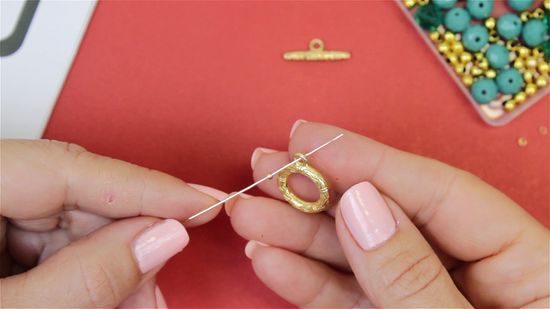
- Thread the wire through the crimp tube, then through the clasp loop or jump ring, then back through the crimp tube. Both wire strands now run through the tube from the same end.
- Slide the tube along the wire until it sits approximately 3mm to 5mm from the clasp loop. This small gap is important: a tube pressed flush against the clasp restricts movement and concentrates stress at the tube edge.
- Place the crimp tube in the first-stage notch (the one with the small internal tooth) of the GRIFFIN Bead Crimper. The tube should sit completely inside the notch.
- Close the pliers firmly. The tube will crease at its centre, forming a shape resembling a sideways figure-eight, two distinct channels separated by the fold.
- Open the pliers and inspect. Both wire strands should be clearly visible, separated into their own channel by the fold. If the strands are still running together in one channel, repeat with more firm pressure.
The strand separation in Stage 1 is the most structurally important step. A crimp that grips both strands together as a single bundle has significantly less holding power than one where each strand is locked in its own channel independently.
Stage 2: Rounding the GRIFFIN Crimp Tube
- Rotate the folded tube 90 degrees from its Stage 1 orientation, the folded face should now point toward the curved centre of the rounding oval.
- Place the folded tube in the second-stage oval (the larger, smooth recess) of the bead crimper.
- Close the pliers firmly in one smooth motion. The tube will fold back on itself, compressing into a rounded, compact cylinder.
- Open the pliers. The finished crimp should be smooth and rounded, with no sharp protrusions or open gaps.
- Test immediately: grip the wire on both sides of the crimp and pull firmly in opposite directions. The crimp must not move at all. If it moves even slightly, Stage 1 needs to be repeated with more pressure before Stage 2 can be redone.
Important: never attempt to re-crimp a tube that has already been compressed and slipped. Work-hardened metal from the first compression prevents reliable re-gripping. Cut the failed crimp off and use a fresh tube.
Matching GRIFFIN Crimp Tube to GRIFFIN Jewelry Wire Diameter
The crimp tube must accommodate two passes of the wire comfortably.
GRIFFIN Crimp Beads are confirmed in two sizes: Outside Diameter 1.8mm / Inside 0.8mm (for fine wire 0.25mm to 0.35mm) and Outside Diameter 2.5mm / Inside 1.2mm (for heavier wire 0.45mm to 0.60mm).
GRIFFIN Crimp Tubes are confirmed in three sizes: small (Ø A 1.7mm, Ø I 0.9mm), medium (Ø A 2.0mm, Ø I 1.2mm) and large (Ø A 2.3mm, Ø I 1.5mm). Choose the tube whose inner diameter accepts two passes of your wire with slight resistance. The doubled wire should pass through the tube with slight resistance before crimping.
Common Crimp Mistakes and How to Fix Them
Crimp slips after finishing: Stage 1 was not applied firmly enough, leaving the wire strands in a single bundle rather than separated. Cut the failed crimp and redo from Step 1 with more pressure.
Wire breaks at the crimp: Over-compression or a tube that is too small for the wire diameter. The tube is crushing the strands rather than gripping them. Use a larger tube or reduce pressure in Stage 2.
Crimp is flat rather than round after Stage 2: The tube was placed in the wrong orientation for Stage 2 (folded face not pointing into the notch curve) or placed in the Stage 1 notch instead of Stage 2. Both stages must use the correct notch in the correct orientation.
Tube is flush against the clasp: The small gap between crimp and clasp was not maintained. This restricts clasp movement and concentrates stress at the tube edge. Cut and redo with the gap maintained.
Mismatched metals: A silver crimp tube on a gold-plated wire is a material specification error. Always match crimp metal to wire surface and clasp metal throughout the piece.
Frequently Asked Questions
Q1. What is the difference between crimp beads and crimp tubes?
A. Crimp beads are small and round, providing a compact but limited metal-to-wire contact surface. Crimp tubes are cylindrical with greater contact surface, delivering stronger grip, particularly for heavier wire and multi-strand designs. Crimp tubes applied with the two-stage fold-and-round technique produce a more professional, secure and aesthetically clean result.
Q2. Do I need a special tool for crimp tubes?
A. Yes. A dedicated bead crimper with two oval stages (like the GRIFFIN Bead Crimper) is needed to apply the two -stage fold and round technique: the first stage uses the notch with the small internal tooth (folding), the second stage uses the larger smooth oval (rounding). GRIFFIN also produces a Micro Crimper for very fine wire. Flat-nose pliers can be used for crimp beads in lighter work but do not produce the folded, rounded finish required for professional crimp tube application.
Q3. How do I know my crimp tube is secure?
A. Grip the wire on both sides of the applied crimp and pull firmly in opposite directions. The crimp should not move at all under normal hand strength. Any movement means Stage 1 was not applied firmly enough, the strand separation has not occurred correctly.
Q4. Why does my crimp tube keep slipping?
A. The three most common causes are: insufficient pressure in Stage 1 (strands not separated); crimp tube too large for the wire diameter (not enough grip); or only one wire strand threading through the tube instead of two. Check all three before assuming the technique is at fault.
Q5. What metal should my crimp tubes be?
A. Always match crimp metal to your wire surface and clasp metal: 925 sterling silver crimps (confirmed nickel-free) for clear or silver plated wire with silver findings; 24K gold plated crimps for gold plated wire with gold findings. Mixing metals at the crimp point reads as a material specification error.
