

Executive Summary
As DFW continues its trajectory as a premier national distribution and manufacturing hub, the “visual gap” between companies using stock imagery and those investing in professional industrial photography has become a critical competitive differentiator. This report explores how high-caliber imagery challenges traditional marketing boundaries by humanizing complex processes, establishing technical authority, and accelerating the B2B sales cycle. Take a look at what a professional industrial photographer can do.
The DFW Industrial Landscape: A New Era of Competition
The Dallas-Fort Worth Metroplex is currently witnessing an industrial renaissance. With over 27 million square feet of positive net absorption in recent years, the region is home to titans like Amazon, Lockheed Martin, and Medline Industries. However, this growth brings intense competition. In a market where facilities often look identical from the outside—vast gray concrete “tilt-wall” buildings—the internal story becomes the only way to differentiate.
Traditional marketing focused on “what” a company does. Modern industrial marketing in DFW focuses on “how” they do it better. Professional photography is the lens through which this “how” is articulated, transforming sterile environments into narratives of precision and innovation.
Breaking the “Boring B2B” Boundary
For decades, industrial marketing was characterized by dense spec sheets and low-resolution snapshots. The prevailing wisdom was that engineers and procurement officers only cared about data.
The Psychology of Visual Speed
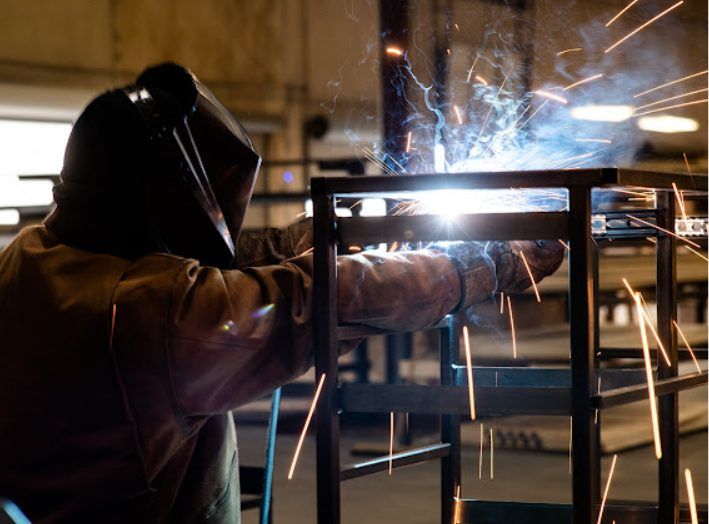
Research indicates that humans process visual information up to 60,000 times faster than text. In the fast-paced DFW business environment, a procurement manager at a Northlake distribution center doesn’t have time to read a 10-page capability statement. A single, high-impact photograph of a robotic sorting system or a master-welder at work communicates “capability” and “scale” instantly. Professional photography challenges the boundary of “boring” by finding the aesthetic beauty in grit, steel, and sparks.
Humanizing the Machine
One of the most significant shifts in industrial marketing is the “Human-to-Human” (H2H) approach within B2B. By capturing the skilled workforce—the faces behind the CNC machines in Grand Prairie or the logistics coordinators in Alliance—companies build an emotional bridge. Professional photography moves beyond the machine to show the expertise that drives it, creating a sense of trust that stock photos simply cannot replicate.
Technical Authority through Visual Precision
In industries such as aerospace (prominent in Fort Worth) and semiconductor manufacturing (growing in Richardson’s Telecom Corridor), precision is the primary product.
Macro-Photography and Detail
Standard photography often fails to capture the tight tolerances required in high-tech manufacturing. Professional industrial photographers use specialized equipment to highlight the microscopic perfection of a circuit board or the seamless weld on a turbine blade. This visual evidence serves as a “silent testimonial” to the company’s quality control standards.
The Death of the Stock Photo
Nothing undermines a DFW industrial brand faster than a stock photo of a “generic” factory that looks nothing like a Texas facility. Sophisticated B2B buyers can spot stock imagery instantly. Using authentic, site-specific photography signals transparency. It says, “This is our floor, this is our team, and this is exactly what we are capable of delivering.”
Accelerating the Sales Cycle in the Digital Age
The B2B buying journey has moved almost entirely online. According to recent industry reports, nearly 70% of the buyer’s journey is completed before a prospect even contacts a sales representative.
The Virtual Facility Tour
In a post-pandemic world, site visits are often late-stage events. Professional photography acts as the “first tour.” For a company based in Plano looking to partner with a manufacturer in Arlington, high-quality visuals provide the “proof of life” necessary to move a lead from the awareness stage to the consideration stage.
Social Proof and LinkedIn Dominance
DFW’s industrial leaders are increasingly active on LinkedIn. Posts featuring “behind-the-scenes” professional photography see significantly higher engagement rates than text-heavy updates. By sharing high-resolution imagery of project milestones—such as a “topping out” ceremony at a new Frisco warehouse or the arrival of new equipment—companies maintain top-of-mind awareness with their network.
Strategic Implementation: More Than Just “Taking Pictures”
Professional industrial photography in the Metroplex is a tactical operation. It requires a deep understanding of safety protocols, lighting in high-ceiling environments, and the timing of production shifts.
- Safety as a Brand Value: A professional photographer knows that an image of a worker without proper PPE (Personal Protective Equipment) is a liability, not an asset. Capturing “safety-first” culture is a boundary-breaking marketing move that appeals to high-value enterprise clients.
- Lighting the Void: Industrial spaces are notoriously difficult to light. Professional photographers use “light painting” and high-dynamic-range (HDR) techniques to make a cavernous warehouse in South Dallas look organized and vibrant rather than dark and cluttered
The ROI of the Visual Asset Library
Marketing managers in DFW often view photography as an expense, but it is more accurately defined as a multi-year asset. A single two-day professional shoot produces a “Visual Asset Library” that can be leveraged across:
- Websites: Reducing bounce rates by increasing visual interest.
- RFPs and Proposals: Making bid documents look more professional and “vetted.”
- Trade Show Displays: Dominating the floor at the Kay Bailey Hutchison Convention Center with life-sized, crisp imagery.
- Recruitment: Attracting the next generation of Gen Z talent who prioritize working for “modern” and “transparent” companies.
The Future is Visible
As the Dallas-Fort Worth Metroplex continues to solidify its position as an industrial titan, the boundaries of marketing will continue to expand. The companies that thrive will be those that recognize that their story is not just told in numbers and spreadsheets, but in the powerful, evocative imagery of their daily operations.
Professional industrial photography is no longer a luxury for DFW industries; it is the infrastructure of modern brand authority. By investing in high-quality visual storytelling, North Texas companies can ensure that their marketing is as robust and innovative as the products they build.
