

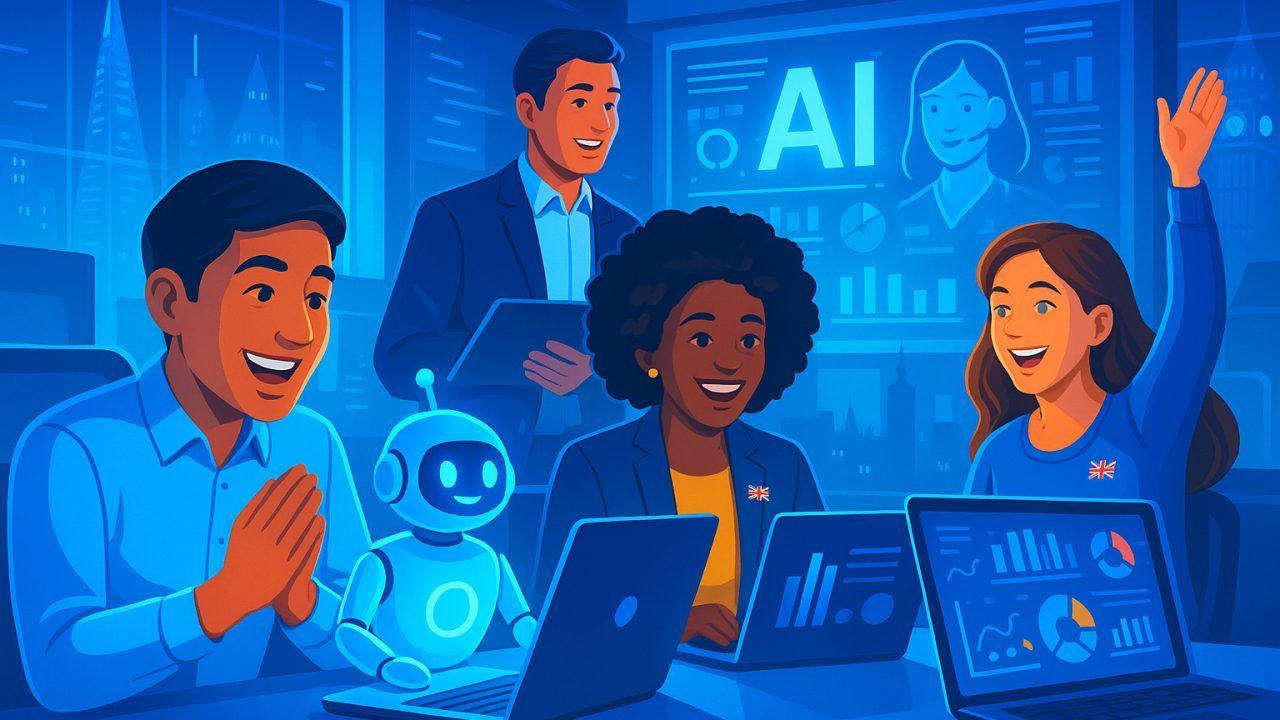
Artificial Intelligence has broadened its scope beyond data scientists and engineers. During the last few years, AI has quietly embedded itself into business decisions spanning marketing, finance, HR, operations, and much more. Most professionals, who viewed AI as merely a “tech-only” domain, are now becoming aware of its influence within their roles and functions.
This makes the taking of an applied AI course one of the wisest career bets made available to non-tech professionals seeking to remain competitive, adaptive, and ready for the future.
The Spread of AI Across All Sectors
In a recent 2024 McKinsey Global Survey, of all the companies surveyed, 65% stated that they had made AI part of their functions, as compared to merely 20% in 2017. The difference is that AI is no longer a hypothesis. AI is no longer a hypothesis. The AI is operational.
Knowing AI is no longer a niche expertise, but rather an expectation across all industries.
- In marketing, AI is used to predict customer behaviour and automate marketing strategies.
- In finance, AI models assist in fraud detection and revenue forecasting.
- In HR, AI tools streamline recruitment processes and enhance employee engagement.
- In operations, AI tools are used to enhance supply chain processes.
Why Non-Tech Professionals Need Applied AI Skills
1. To Make Data-Driven Decisions
Various business roles in today’s age require intelligent insight derived from large amounts of data. One of the ways to accomplish this is by using AI. However, professionals equipped with AI tools may inappropriately interpret results.
Applied AI courses help learners understand the different concepts of AI, as well as how to interpret the results to help improve the quality of decision-making.
2. To Collaborate Better with Tech Teams
In modern-day functional teams, marketers, analysts and managers are beginning to work closely with data scientists and AI developers. Understanding AI, in particular, its models, limits and results helps non-technical professionals to articulate their ideas concisely, and set achievable goals.
3. To Automate Routine Work
While many people often associate AI with more complex algorithms, the reality is that it is mostly about automation. Routine tasks such as report generation, keeping track of emails, and monitoring trends can be done by AI systems.
Applied AI courses arm professionals with the knowledge to spot automation possibilities, saving every week. Automating work gives professionals the space to work on more crucial tasks, like strategising.
AI Outside of Technology: Real-Life Cases
Marketing
Tools like HubSpot and Salesforce Einstein analyse customers’ data and suggest personalised campaigns. Applied AI marketing professionals gain the ability to interpret model results, allowing them to better adjust control variables of the campaign—creativity and budget—more effectively.
Human Resources
Recruiters use AI for resume parsing, sentiment analysis, and predicting employee retention and attrition. AI-savvy HR Professionals can ensure model compliance with ethical standards and proportionate discrimination mitigation.
Finance
Analysts apply fraud detection AI and predictive analytics to financial datasets. Applied AI literacy enables professionals to validate the model and confidently integrate its results into the business plan.
Operations
Demand forecasting and route optimisation AI tools are revolutionising logistics and manufacturing. AI-savvy Operations managers interpret model results to reduce costs and improve outcomes.
The Skills You Develop in an Applied AI Course
Participants in applied AI courses graduate with skills in:
- Data Literacy — Understanding data as an asset that powers the AI system. Basics of machine learning, especially supervised and unsupervised learning.
- AI Tools: Practical experience with tools like ChatGPT, DataRobot, or TensorFlow.
- Ethical AI: Addressing the challenges of bias, transparency, and accountability in automated decisions.
- Business cases: AI applications in marketing, HR, finance, etc.
You do not need to know Python or any coding to take these non-programmer courses.
Flexibility of Learning
For most working professionals, the flexibility of the programs is most important.
A number of prestigious institutions and providers of applied AI training now offer courses where professionals can learn flexibly and remain in their current roles.
Structured programs, virtual live seminars and team projects that focus on contemporary challenges in business are offered by leading providers. Having these newly acquired skills, students are able to help their employers by adding value in their current roles.
Career Advancement
Crossing the divide between business and technology is an important skill that employers are looking for. Gartner estimates that by 2026, 75% of organisations are expected to demand some level of AI knowledge from their employees.
Professions that continue to learn by developing new skills are positively positioned for careers with longevity in the future. Understanding applied AI will:
- Improve your ability to offer innovative solutions.
- Make you a key contributor to strategic business conversations.
- Make you more likely to secure senior roles or even positions at the helm of data-driven organisations
How To Select The Best Applied AI Course
All courses are not the same. A good applied AI course should have the following:
- Industry Alignment: The courses should be developed with real business use cases.
- Hands-On Projects: A capstone project is good for determining whether you have mastered the knowledge.
- Expert Faculty: The instructors should be experienced in AI applications.
- Flexible Format: The courses should be available online and be of good quality.
- Certification Recognition: The certificates should be recognised and valued by employers in various countries.
These characteristics ensure that you will have theoretical knowledge and real practical skills.
The Future: AI Literacy is The New Business Language
PowerPoint and spreadsheets became indispensable in the 2000s. A business’s primary language will be AI in the 2030s. Non-tech professionals who use AI to derive outputs, critique, and make decisions will be able to manage a team better.
A finance lead who uses predictive analytics for budgeting is not a futuristic example. Neither is a marketing head that uses clustering algorithms for customer segmentation. These are current examples.
Final Thoughts: From Awareness to Application
Thinking about the future of work, it isn’t about the fear of being replaced by AI, but rather about embracing the work and being driven by it. If you’re in marketing, HR, finance, or management, understanding applied AI is just as necessary as learning Excel or Power BI in the past.
To take your skills and learning to the next level, completing an applied AI course will allow you to embrace your drive and innovate, automate, and lead with ease and confidence. There are flexible online programs, and it’s the best time to future-proof your skills by being part of the AI-driven workforce and impacting the future generation of business.
