



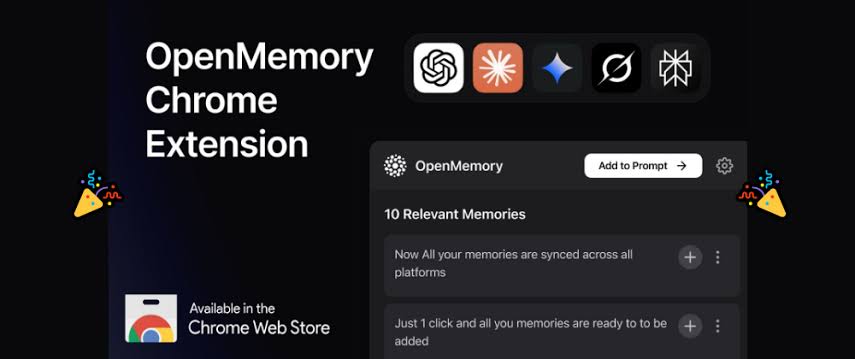
Most developers running multiple AI tools in parallel accumulate memory fragmentation as a side effect of normal use. ChatGPT retains one set of preferences and project context, Claude holds another, and Cursor operates without either. OpenMemory addresses this directly by running a local memory server that all three tools connect to through the Model Context Protocol, so context established in one application persists into the others without manual re-entry or session stitching at every new conversation.
What OpenMemory Is and What It Is Not
This is an open-source, local-first implementation of Mem0’s memory infrastructure, built to run entirely on the developer’s machine via Docker. It does not route memory data through external servers, which makes it appropriate for workflows where privacy constraints or organizational policy prohibit cloud memory dependencies. The MCP integration is the mechanism that enables cross-application memory sharing: each connected AI tool queries the same local memory server rather than maintaining isolated context stores.
The relevant architectural distinction is that this is not a plugin for any individual AI application. It operates as an infrastructure layer positioned between the applications and the memory store, with MCP serving as the transport protocol. Connected applications do not need to know about each other. Each one only needs a reference to the locally running MCP endpoint, and memory written by one becomes readable by the others from that point forward.
Setup requires Docker and active installations of the target AI clients. The process begins with pulling the Docker image and starting the container, which initializes both the memory storage backend and the MCP server in a single operation. The local dashboard becomes accessible at localhost:3000 and provides a real-time view of stored memory records, active connections, and memory operations as they occur.
Connecting Claude Desktop requires editing its configuration file to point at the local MCP server address. Cursor follows the same pattern, with the server URL added to the editor’s context settings. ChatGPT Desktop uses a different integration path through its own MCP support, but the endpoint it references is the same locally running server. Once all three are connected and confirmed operational, memory written during a Claude session is retrievable during a Cursor session. A project constraint, a naming convention, a recurring task pattern — any structured fact that one client encodes becomes available to the others without manual transfer or prompt injection into a new conversation window.
Memory Operations and the OpenMemory Dashboard
The dashboard surfaces memory operations that remain invisible inside individual AI clients. Users can inspect every stored record, identify the source application that created it, edit or delete specific entries, and observe access patterns across all connected clients. Two operational uses follow from this visibility that are not achievable through any individual AI client’s interface alone.
The first is memory hygiene. Records that were accurate at creation but have since become outdated continue to surface at inference time unless they are explicitly removed. A project constraint that no longer applies, a user preference that has changed, an agent task pattern that was superseded by a revised workflow — these records silently degrade retrieval quality until they are cleared. The dashboard makes that maintenance possible without reconfiguring any connected AI client individually. The second use is development verification: when building on top of OpenMemory’s local infrastructure, the dashboard is the observable layer that confirms whether the correct records are being written and whether retrieval is returning the expected context for a given query, rather than leaving developers to infer memory behavior from model output alone.
Namespace Handling and Local Data Boundaries
The local-first architecture means the memory store does not leave the host machine unless the user explicitly configures external storage. For workflows involving proprietary code, confidential system designs, or data subject to privacy obligations, the Docker container can be configured to restrict network access to localhost only. The MCP server handles all reads and writes within that boundary, and no memory operation requires an outbound connection to function.
Within the memory store, user-level namespace separation ensures records created in one user context are not retrievable in another. For individual developers managing memories across multiple projects or clients on a single machine, this separation prevents cross-project contamination in retrieval results. For small teams evaluating the tool for shared local infrastructure, namespace isolation is the mechanism that maintains context integrity when multiple users interact with the same memory server during testing.
Where This Fits in a Broader Memory Architecture
OpenMemory is scoped to local deployment, which positions it accurately as a personal productivity and development tool rather than a production memory layer for multi-user applications at scale. The Docker-based setup does not natively support horizontal scaling, and the local storage backend is not designed for the query volumes and concurrent access patterns that production AI applications generate.
For teams evaluating this as a first step toward Mem0’s managed memory infrastructure, the local deployment serves a specific function. The MCP integration pattern, the memory distillation behavior, and the namespace isolation model present locally are consistent with Mem0’s production API. Running the local version first produces a concrete, observable proof of concept for what cross-application persistent memory looks like in operation, which reduces the ambiguity in production architecture decisions before cloud infrastructure commitments are made.
Conclusion
OpenMemory closes the memory fragmentation problem that affects any developer running multiple AI tools against separate, unconnected context stores, and it does so through infrastructure rather than workflow changes. The MCP abstraction means connected applications share memory without requiring direct integration between them, and the local-first model keeps every memory operation within the user’s own machine. The constraint is equally structural: OpenMemory’s local deployment model bounds the viable use case to individual and small-team workflows, and teams that need multi-user, multi-instance memory sharing at production volume will reach the architectural limits of local deployment well before they reach the limits of what the underlying memory model supports.


