



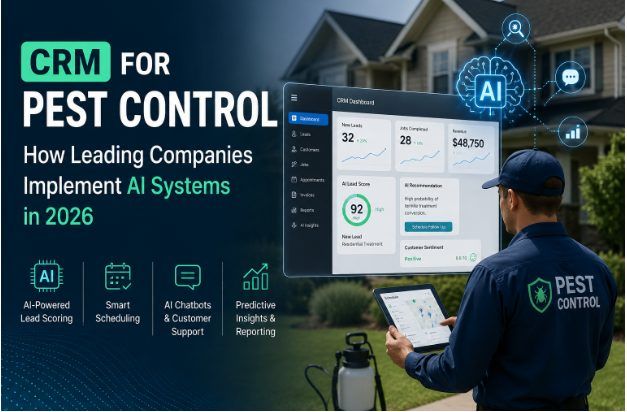
A CRM for Pest Control is no longer just a system for storing customer data. It has become the operational layer that connects scheduling, routing, technician performance, and customer retention. In 2026, leading operators are not choosing software based on features alone. They are focused on how systems are implemented across real workflows using AI.
This shift explains why businesses are moving toward integrated platforms that combine CRM capabilities with AI-driven decision making. The difference is not theoretical. It shows up in how jobs are scheduled, how technicians move, and how customers are retained over time.
Why Implementation Matters More Than Features
Most discussions around Pest control CRM software 2026 focus on feature comparisons. That approach misses the real challenge.
The problem is not whether a platform has routing, scheduling, or automation. The problem is whether those features actually work together in daily operations.
For example, a company may have:
- A scheduling tool
- A routing tool
- A customer database
But if these systems do not communicate effectively, teams still rely on manual coordination. This creates inefficiencies that no feature list can solve.
Leading companies approach CRM for Pest Control differently. They treat it as a system that drives decisions across the entire service lifecycle.
Step 1: Centralizing Operational Data
The first step in implementing a CRM for Pest Control is consolidating all operational data into a single system.
This includes:
- Customer profiles and service history
- Technician schedules and availability
- Property-specific treatment details
- Billing and payment information
Without this centralization, AI cannot function effectively. AI tools for pest control companies depend on clean, connected data to generate accurate recommendations.
A fragmented system leads to fragmented decisions.
Step 2: Connecting Scheduling with Real Constraints
Scheduling is where most inefficiencies occur.
Traditional systems assign jobs based on availability alone. This ignores real-world constraints such as:
- Travel time between locations
- Technician skill levels
- Job complexity
- Customer time preferences
AI tools for pest control businesses improve this by evaluating multiple variables simultaneously.
Instead of assigning jobs manually, the system builds schedules that maximize technician productivity while reducing travel time.
This is where implementation depth matters. If scheduling is not tightly integrated with CRM data, the system cannot make accurate decisions.
Step 3: Integrating Routing with Scheduling
Routing is often treated as a separate function. This creates misalignment between planned schedules and actual execution.
In a properly implemented CRM for Pest Control, routing is not an afterthought. It is built into the scheduling process itself.
This allows the system to:
- Cluster appointments geographically
- Adjust routes in real time
- Reduce idle travel between jobs
Industry insights from Authority Inc pest control intelligence highlight that companies with integrated routing and scheduling systems consistently outperform those using disconnected tools.
The key difference is coordination. When routing and scheduling operate as one system, efficiency improves across the board.
Step 4: Automating Customer Communication
Customer communication is often overlooked during CRM implementation.
Manual follow-ups create delays and inconsistencies. Customers may miss appointments or cancel services due to poor communication.
AI tools for pest control businesses automate this process by:
- Sending appointment reminders
- Confirming service windows
- Notifying customers of delays
This improves reliability without adding workload for office staff.
More importantly, it creates a consistent customer experience that supports retention.
Step 5: Using AI for Continuous Optimization
Implementation does not end after setup.
AI systems improve over time by learning from operational data. This includes:
- Job duration patterns
- Technician performance
- Customer behavior
For example, the system may identify that certain service types require more time than initially estimated. It can then adjust future schedules accordingly.
This continuous optimization is what separates modern Pest control CRM software 2026 from older systems.
Step 6: Aligning CRM with Business Goals
A CRM for Pest Control should not operate in isolation. It must align with broader business objectives such as:
- Increasing technician utilization
- Reducing missed appointments
- Improving customer retention
This requires clear metrics and reporting.
Leading companies use CRM data to track:
- Jobs completed per technician
- Travel time vs service time
- Customer churn indicators
These insights allow managers to make informed decisions rather than relying on assumptions.
Step 7: Choosing the Right Platform for Implementation
Not all platforms support this level of integration.
When evaluating options, companies should look for systems that combine CRM and AI capabilities rather than relying on multiple disconnected tools.
Platforms like Solea AI focus on unifying customer management, scheduling, and routing within a single system. This simplifies implementation and reduces operational friction.
The goal is not to adopt more tools. It is to create a system that works cohesively.
Common Implementation Mistakes
Even with the right platform, implementation can fail if approached incorrectly.
Treating CRM as a Static System
Some companies set up the system once and expect immediate results. In reality, CRM for Pest Control requires ongoing refinement as data accumulates.
Ignoring Field Team Adoption
Technicians are the primary users of the system. If mobile workflows are not simple and efficient, adoption drops quickly.
Overcomplicating Initial Setup
Trying to customize every workflow at the start delays deployment. It is more effective to launch with core functionality and optimize over time.
The Real Impact of Proper Implementation
When implemented correctly, a CRM for Pest Control becomes a decision engine rather than a record-keeping tool.
It enables:
- Faster and more accurate scheduling
- Better route efficiency
- Consistent customer communication
- Data-driven operational improvements
These outcomes are not driven by features alone. They are the result of how systems are implemented and integrated into daily operations.
Conclusion
The evolution of Pest control CRM software 2026 is not about adding more features. It is about building systems that connect data, automate decisions, and improve execution across the business.
AI tools for pest control companies and AI tools for pest control businesses are only effective when they are implemented within a unified CRM framework.
Companies that focus on implementation depth rather than surface-level features are the ones that see real improvements in efficiency and customer retention.


