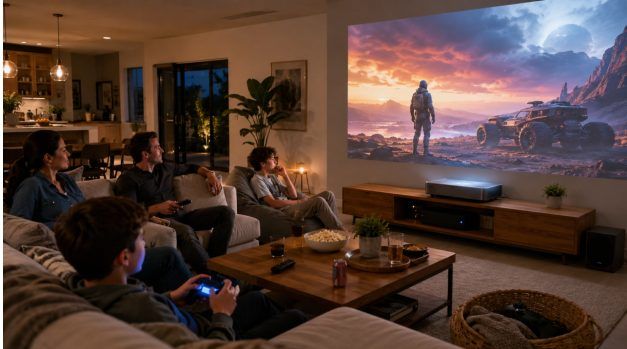
Most households do not use the living room for one kind of entertainment anymore. A single screen may host a prestige drama, a live match, a console game, a workout class, and a family movie within the same week. That variety makes the room more valuable, but it also makes planning more important.
The best entertainment setup is not optimized for one perfect demo. It is built for change. It can handle different lighting, different seating patterns, different sound needs, and different levels of attention. Sometimes people are fully immersed. Sometimes the screen is part of the background while life continues around it.
Make Source Switching Simple
Streaming devices, consoles, cable boxes, and audio systems can create unnecessary friction. If switching from a show to a game requires digging through menus or swapping cables, people will use the room less. A clean input plan makes the space feel modern and easy.
Labeling helps too. The people who use the room should know how to find the streaming device, game console, and live sports source without asking for help. A setup becomes more valuable when it is easy for the whole household, not just the person who installed it.
Choose a Display Plan for Mixed Content
Films reward contrast and detail. Sports reward motion clarity and size. Games reward responsiveness and immersion. Streaming rewards convenience and consistency. A 4K RGB laser UST projector can support a room that needs a large image without turning the layout into a technical project.
Placement is part of that value. When the projector can stay near the screen wall, the room can remain open for seating and movement. That matters in a multipurpose space where furniture cannot be arranged for one activity only.
Think About Streaming Quality Beyond Resolution
Resolution matters, but premium streaming also depends on stable internet, good app support, color performance, and sound. A sharp image can still disappoint if the stream buffers or the room lighting makes dark scenes hard to see. The full chain matters.
For viewers who care about movie nights and high-quality series, a projector for premium streaming should be considered as part of a larger system that includes Wi-Fi strength, source quality, screen choice, and audio clarity.
Give Each Activity a Room Mode
One room can serve many purposes if it has simple modes. Movie mode may mean dim lights and focused seating. Sports mode may mean brighter lamps and more chairs. Game mode may mean a different seating distance and easy controller access. Workout mode may require open floor space.
These modes do not need to be automated or expensive. They can be as simple as a few saved picture settings, a basket for controllers, movable chairs, and lamps that can be dimmed. The goal is to make transitions easy.
Keep the Space Human
Technology should not make the room feel tense. People should be able to put down a drink, invite a friend over, move a chair, or watch casually without worrying about the setup. Durable furniture, hidden cables, and accessible storage make the room easier to live with.
It also helps to avoid overcomplication. A room with too many devices, remotes, and settings can feel impressive at first but tiring later. The best setups hide complexity behind simple daily use.
Build for the Week, Not the Demo
A great entertainment room proves itself over time. It works on a quiet Monday night, a crowded Sunday afternoon, and a Friday gaming session. It does not require perfect conditions to feel worthwhile.
That is the advantage of planning around real screen time. When streaming, sports, games, and casual viewing all have a place, the room becomes more than a home theater. It becomes a shared space that supports the way people actually relax, gather, and enjoy media today.
A Shared Screen Should Support Shared Habits
The most successful entertainment rooms are shaped around the people who use them. If one person cares about films, another about sports, and another about gaming, the setup should not make one use case feel like an afterthought. It should give each activity a clear, simple path.
That might mean storing controllers near the seating area, keeping streaming apps on the first screen, saving a brighter picture mode for daytime sports, and choosing lighting that can shift quickly. These small choices make the room feel welcoming to everyone. When the setup supports shared habits, the screen becomes a reason to gather rather than another device competing for attention.
It is worth reviewing the room every few months as habits change. A new console, a new streaming service, or a different sports schedule can shift what the setup needs to do. Flexible rooms adapt without requiring a complete redesign.
That adaptability is the real value of a multipurpose entertainment space. The screen is not limited to one kind of content or one kind of viewer. It supports the week as it actually happens: quiet nights, loud games, solo sessions, family choices, and the occasional event that fills the room.