



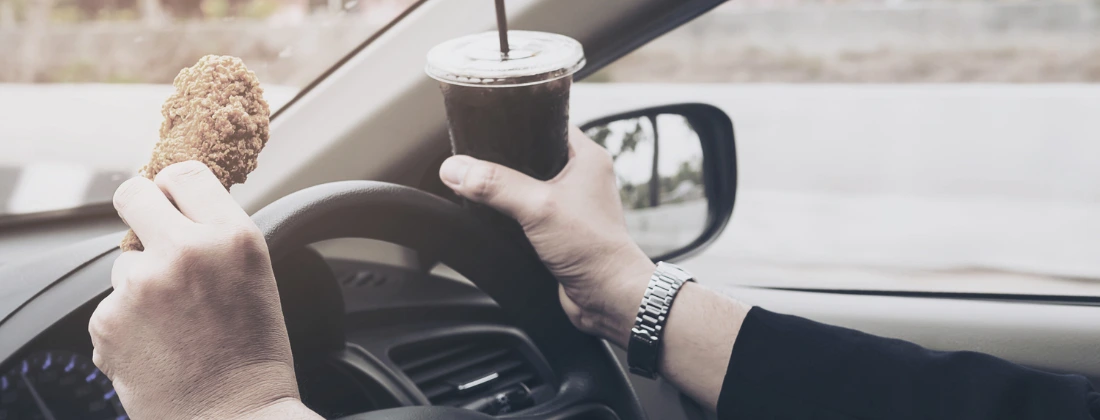
Distracted driving is one of the most pressing safety issues on American roads today. According to the National Highway Traffic Safety Administration (NHTSA), more than 3,100 people lost their lives in distracted driving incidents in 2019 alone. That same year, roughly 424,000 people sustained injuries tied to driver inattention.
Many drivers assume that distracted driving only refers to texting or talking on a phone. However, everyday habits like eating behind the wheel can also create serious dangers and, in some cases, legal consequences.
Is It Illegal to Eat and Drive in California?
One of the most common questions motorists ask is: Is it illegal to eat and drive in California? The straightforward answer is no, not explicitly. There is no specific statute in the California Vehicle Code that names eating and driving as a standalone offense.
However, that does not mean a driver is free from any legal risk. Officers have tools at their disposal to cite drivers who appear reckless, even when no single law names the exact behavior.
How Existing Laws Apply
California law does address distracted driving in broader terms. Section 22350 of the California Vehicle Code prohibits driving at speeds or in a manner that endangers others. If an officer observes a driver eating in a way that compromises vehicle control, a citation under this provision is entirely possible.
A ticket under this law can carry a fine of around $150. The officer’s judgment plays a significant role in whether a stop occurs at all.
When Eating Crosses a Legal Line
Police officers look for observable signs of recklessness. A driver using a fork to eat pasta, unwrapping a meal, or reaching across the seat to grab food may attract a traffic stop. These actions involve both manual and visual distractions that take attention and control away from the road.
On the other hand, simply sipping a coffee or taking a bite of a doughnut is unlikely to result in a citation on its own. Officers generally need to witness some form of unsafe behavior before initiating a stop.
The Three Types of Driver Distraction
Understanding why eating behind the wheel is risky requires a look at how distractions are categorized. There are three main types that apply to any distracting activity, including eating.
Manual Distractions
These occur when a driver takes their hands off the steering wheel. Unwrapping food, handling a utensil, or reaching for a drink are all examples. Without both hands available, a driver loses the physical ability to respond quickly to road conditions.
Visual Distractions
These happen when a driver takes their eyes off the road. Glancing down at a meal, checking a sauce packet, or reading a label while driving can cause a vehicle to drift or miss critical signals ahead.
Cognitive Distractions
These are more subtle and occur when a driver’s mental focus shifts away from driving. Deep concentration on something other than the road, such as thinking about a task or craving while eating, can significantly reduce reaction time.
Eating while driving can trigger all three types of distraction simultaneously, which is what makes it more dangerous than it may seem.
Why Eating and Driving Is More Dangerous Than It Looks
The casual nature of eating on the go makes it easy to underestimate the risk. Many drivers do it daily without incident. However, unpredictable moments arise quickly.
Hot liquids can spill, causing a driver to jerk the wheel. A dropped water bottle can roll under the brake pedal. Reaching across the seat for a bag can shift body position and reduce steering control. Any of these situations can unfold in seconds and lead to a serious accident.
The Real-World Consequences
The consequences of a distracted driving accident extend well beyond the incident itself. Victims may face significant medical bills, lost income, and long recovery periods. The at-fault driver may face increased insurance premiums, traffic fines, and the potential loss of driving privileges.
If the behavior is deemed negligent in a legal context, the driver could also face civil liability. This is especially relevant when eating and driving contribute to a crash that injures another person.
California’s Cell Phone Laws and Distracted Driving Enforcement
While eating and driving is not explicitly banned, California does have strict laws targeting other forms of distracted driving. Section 23123.5 of the California Vehicle Code prohibits the use of hand-held cell phones and other electronic wireless communication devices while driving.
A first offense under this provision results in a $20 fine, while a repeat offense carries a $50 fine. Hands-free devices remain legal under California law.
How Officers Use Discretion
Law enforcement officers in California have some discretion in distracted driving enforcement. If a driver is eating but maintaining proper lane position, appropriate speed, and full awareness of surrounding traffic, an officer is unlikely to intervene.
The threshold for a citation rises when the eating behavior combines with visible recklessness. Officers are trained to identify whether a driver’s overall conduct creates a meaningful risk to others on the road.
How an Experienced Attorney Can Help
If you have been injured in an accident caused by a distracted driver, navigating the aftermath can be overwhelming. Medical treatment, insurance claims, and legal procedures all demand time and attention when you may already be dealing with significant physical or emotional strain.
An experienced car accident attorney can step in immediately to protect your interests. They will ensure that law enforcement reports accurately capture the cause of the accident, including whether distracted driving, such as eating behind the wheel, was a contributing factor.
Your attorney can gather evidence, consult with accident reconstruction experts, and build a case that demonstrates the other driver’s negligence. This is essential when pursuing compensation for medical bills, lost wages, and pain and suffering.
Acting Quickly Matters
Evidence in distracted-driving cases can disappear quickly. Surveillance footage may be overwritten, and witness memories fade. The sooner you consult with a personal injury law firm, the stronger your position will be.
Working with a knowledgeable legal professional gives you the best chance of receiving fair compensation and holding the at-fault driver accountable. Do not wait to get the legal support you deserve.


