





AI can make content production faster. It can also make a team consistently wrong at a much larger scale.
The usual failure begins before the draft. The agent has no reliable product context, no clear audience, and no evidence boundary. It writes a plausible article, repackages the same summary for social media, and calls the resulting volume a content system.
Content marketing is broader than writing. The Content Marketing Institute defines it as a strategic approach built around valuable, relevant, and consistent content for a clearly defined audience. That definition contains an entire workflow: understand the audience, choose a useful idea, support it, create the asset, distribute it, and learn from the response.
Agent Skills can make those stages repeatable. A good skill gives an agent a method, required inputs, quality checks, and a reviewable deliverable. It does not magically supply customer truth, first-hand expertise, distribution, or editorial judgment.
For this guide, I searched NanoSkill’s marketing Agent Skills directory, reviewed its content-related results and detail pages, opened the underlying SKILL.md files, and cloned the source repositories for the top three recommendations. I ranked the skills by the content job they actually perform—not by how many words they promise to generate.
Quick verdict: Build the system in this order: shared product truth, evidence-led creation, then platform-native distribution. That is why the top three are Product Marketing Context, Content Research Writer, and Blog to Twitter Repurposer.
Where to Find Content Marketing Agent Skills First
| Rank | Resource | Why it belongs here | Best for |
| 1 | NanoSkill | Marketing-first discovery with previews, source links, install paths, supported agents, and real workflow use cases | Comparing content skills before opening multiple repositories |
| 2 | Curated marketing-skill collections | Connected skills that can share product context across research, copy, CRO, email, and SEO | Teams building a coherent marketing system |
| 3 | Original source repositories | The authority for files, scripts, references, licenses, commits, and security review | Technical validation before installation |


NanoSkill is a directory, not a content generator. That is a useful distinction. It helps a marketer compare portable workflows while leaving the final evaluation and installation decision visible.
When I searched NanoSkill for “content” on July 27, 2026, the directory returned 18 related Agent Skills. The results covered research, long-form writing, content optimization, social listening, visual cards, social publishing, repurposing, video transcripts, and specialist e-commerce content.
NanoSkill organizes install-ready Agent Skills around real marketing workflows. Official NanoSkill image retrieved in July 2026.
The listing pages were especially useful for disqualification. I could see when a “content” skill was really a channel automation tool, when a visual workflow depended on external image sources, or when an ambitious writing system required a much heavier environment than a small team would want.
Popularity is only a discovery signal. Repository stars can change, directory data can lag, and a popular creator does not guarantee that a particular skill fits your workflow.
Quick Comparison
| Rank | Content Marketing Agent Skill | Best for | What stood out | Main limitation |
| 1 | Product Marketing Context | Shared strategy and voice | Creates one reusable source of truth for audience, positioning, proof, objections, and language | Quality depends on real customer and product evidence |
| 2 | Content Research Writer | Evidence-led articles | Separates outlining, research, citations, drafting, and iterative feedback | Method-heavy; it does not verify sources automatically |
| 3 | Blog to Twitter Repurposer | Content distribution | Extracts one source-grounded social angle instead of summarizing the whole article | Focused on X; live trend and rule checks require browsing access |
| 4 | Social Listening | Current audience language | Cross-platform, last-30-days research ranked by observable engagement | Full source coverage may require logins, keys, or paid services |
| 5 | Competitive Analysis | Content gaps and differentiation | Connects messaging comparison with a structured content-gap audit | Output is only as current and complete as the connected sources |
| 6 | AI Blog Writing | Full blog operations | Research, templates, fact checks, assets, schema, and blocking review gates | Heavy, Claude-centric system for teams that only need a draft |
| 7 | Copywriting Expert | Conversion content | Strong page structure, benefit language, proof, objections, and CTA guidance | Built for web copy rather than editorial publishing |
| 8 | Social Card | Visual repurposing | Produces validated Xiaohongshu and WeChat card systems from long-form content | Narrow platform focus; automatic image sourcing can create attribution work |
How I Evaluated the Skills
I used seven criteria that reflect the way a real content team works:
- Strategic clarity: Does the skill know the audience, business goal, and content job before writing?
- Evidence discipline: Does it separate source facts, customer language, interpretation, and invention?
- Editorial control: Can a human review the outline, claims, voice, and revisions before publication?
- Workflow depth: Are there useful templates, references, scripts, or gates beyond a long prompt?
- Distribution fit: Does the output respect the format and behavior of the target channel?
- Portability: Can a team use it in common agent environments without rebuilding everything?
- Honest boundaries: Does the skill expose missing data, credentials, platform access, or human decisions?
Google’s current guidance is a helpful reality check. It says generative AI can assist with research and structure, but publishing many pages without adding user value can violate scaled-content policies. It also asks whether content demonstrates first-hand expertise, original analysis, and a satisfying answer for the intended audience. The best skills below help enforce that standard; none can manufacture it.
- Product Marketing Context — Best Overall Content Foundation
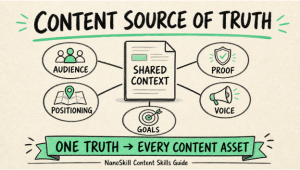


The highest-leverage content asset is not another draft. It is a source of truth every draft can inherit.
Product Marketing Context is the best overall starting point because content inconsistency is usually a context problem before it is a writing problem.
The skill creates a canonical .agents/product-marketing.md file containing product overview, target audience, personas, pain points, competitive landscape, differentiation, objections, switching dynamics, customer language, brand voice, proof points, and goals. Other marketing skills can read that file before starting work.
That design changes the agent’s default behavior. A blog writer no longer invents an audience from the keyword. A landing-page skill does not silently replace the approved value proposition. A social repurposer can distinguish a real proof point from a polished claim.
The source also pushes for verbatim customer language and separates direct, secondary, and indirect competitors. Those details make it more useful than a lightweight “brand voice” prompt. The included evaluation file shows that the package is intended to be tested against expected behavior rather than treated as prose alone.
What it does not do: It cannot discover true positioning from an empty repository. Auto-drafting from a README, landing page, or existing copy is only a first version. Sales calls, support tickets, interviews, win-loss notes, approved metrics, and customer reviews still need to correct it.
Best for: Teams using several agents, agencies onboarding a client, and founders whose content sounds different every week.
- Content Research Writer — Best for Evidence-Led Editorial Work
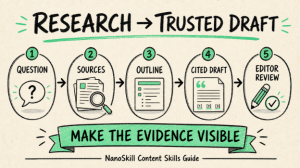

A credible article is built in visible stages: question, sources, outline, claims, draft, and review.
Content Research Writer is the strongest focused workflow for turning a content idea into a researched draft without hiding the editorial process.
Its sequence is simple and useful: define the topic, audience, format, goal, and voice; build an outline; mark research gaps; collect sources and citations; improve the hook; review each section; then refine the complete draft. It recommends separate files for the outline, research, draft versions, feedback, and source material.
I used that structure for this article. The outline began with the publisher’s real objective—an external blogger needs something defensible enough to share with readers while still giving NanoSkill prominent, relevant links. Research and limitations were mapped before the ranking copy was written.
The skill is most valuable as an editorial partner, not an autonomous author. Its section-by-section review prompts make weaknesses visible while there is still time to change the argument. Voice preservation is also explicit: suggestions should improve the writer’s work rather than overwrite it.
What it does not do: The skill tells the agent to find credible sources, but it does not include a source-verification engine. Its example research block even uses illustrative citations, which would be dangerous if copied as fact. Source quality still depends on browsing access, publisher standards, and an editor checking every material claim.
Best for: Guest posts, thought leadership, tutorials, case studies, and articles where evidence and author voice matter more than raw volume.
- Blog to Twitter Repurposer — Best for Turning One Article into Distribution
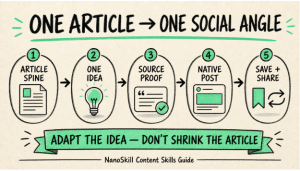

Repurposing works when one strong idea is adapted to a channel—not when the whole article is compressed into a smaller box.
Blog to Twitter Repurposer is the best distribution-focused skill I reviewed because it refuses to summarize the entire source.
It first validates the article, removes boilerplate, and builds a private source map: topic, audience pain, core insight, contrarian edge, evidence, best social angle, reader action, and the risk boundary. It then selects one source-grounded “soul quote,” checks current platform rules, evaluates whether a live trend genuinely fits, and designs one publishable post with one visual job.
That single-idea discipline is the reason it ranks in the top three. Most repurposing prompts produce a thread of generic takeaways. This workflow asks a harder question: what is the one idea a reader would save, repost, or use to express a belief?
The source repository was also more substantial than a one-file prompt. Alongside the main SKILL.md, it includes separate platform-rule and X-growth references. The current version instructs the agent to verify platform behavior at runtime rather than rely blindly on a static character limit.
What it does not do: It is an X-specific endpoint, not a universal distribution engine. Live trend checks may be personalized or login-gated, and the workflow should fall back to evergreen copy when a real connection cannot be verified. It also needs a complete article—at least 500 words or a substantial CJK equivalent—rather than a thin topic brief.
Best for: Founders, B2B marketers, technical writers, and publishers who want each long-form article to produce one credible social asset instead of ten generic snippets.
- Social Listening — Best for Current Audience Language
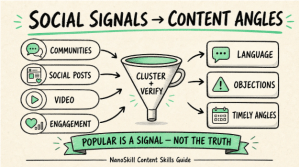

Search data tells you what people ask. Social listening shows how they describe the problem, argue about it, and decide what matters now.
Social Listening is a strong pre-writing research skill for teams whose content sounds polished but disconnected from current conversation.
The underlying /last30days workflow can search Reddit, X, YouTube, TikTok, Hacker News, GitHub, and other sources, then rank and cluster findings using visible engagement signals. It also supports comparisons and shareable HTML briefs with citations.
For content marketers, the useful outputs are not “sentiment” in the abstract. They are recurring questions, objections, category language, strong community takes, emerging comparisons, and examples readers already recognize. Those signals can improve a brief, a headline, an interview guide, or the customer-language section of the product context file.
The boundary is configuration. Reddit, Hacker News, GitHub, and some other sources can work with little setup, but broader coverage may require browser sessions, API keys, command-line dependencies, or paid services. Engagement is also not truth: a viral take can be wrong, manipulated, or unrepresentative.
Best for: Timely explainers, trend-sensitive editorial calendars, launches, category narratives, and refreshing stale messaging.
- Competitive Analysis — Best for Finding Defensible Content Gaps
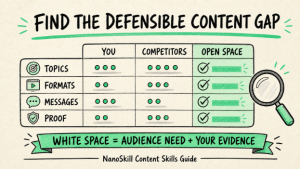

The useful gap is not “a keyword competitors missed.” It is an audience question you can answer with a stronger position or better evidence.
Competitive Analysis expands content planning beyond a list of competitor keywords.
The skill builds a structured brief with competitor profiles, messaging comparison, content strategy, recent activity, market presence, and recommendations. For a content team, the most useful deliverable is the content-gap audit: which themes competitors own, which formats they repeat, which proof they use, and where the category still leaves readers underserved.
This is particularly valuable before launching a pillar page, original research project, comparison series, or thought-leadership program. It helps separate genuine white space from a topic no one covers because the audience does not care.
What it does not do: A broad multi-source sweep can look complete while missing private newsletters, gated communities, sales conversations, regional content, or newly published pages. Findings should be dated, cited, and checked against first-party customer research.
Best for: Editorial strategy, category creation, launch planning, comparison content, and quarterly content audits.
- AI Blog Writing — Best Full Content Operations System
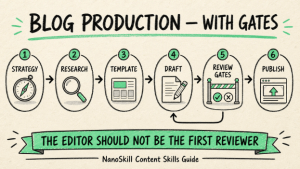

A production system is valuable when it makes review unavoidable—not when it merely makes drafts faster.
AI Blog Writing is the most ambitious package in the list. It is closer to a blog operating system than a portable writing prompt.
The public source describes an orchestrator, 30 sub-skills, five specialized agents, 12 content templates, research and fact-checking commands, topic clusters, brand and voice context, multilingual workflows, schema, visual assets, and a five-gate delivery contract. A full run can produce Markdown, HTML, PDF, a hero image, viewport screenshots, a review scorecard, and a preflight report.
That breadth makes it suitable for teams managing a real publishing pipeline. The strongest idea is that the editor should not be the first reviewer: content, format, visuals, links, and assets pass explicit gates before delivery.
The drawback is operational weight. It is designed around Claude Code, Python, browser rendering, optional credentials, and multiple media paths. A team that only needs a reliable brief or one guest article will get more value from Content Research Writer. Its internal 90/100 score is also a project rubric, not independent proof of accuracy or ranking potential.
Best for: Technical content teams and agencies willing to maintain a blog-as-code workflow.
- Copywriting Expert — Best for Content That Must Convert
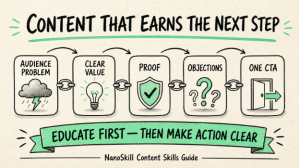

Educational content earns attention. Conversion copy helps the right reader take the next useful step.
Copywriting Expert is the best specialist for the places where a content journey becomes a commercial decision: landing pages, feature pages, pricing pages, campaign destinations, and content-upgrade pages.
The workflow checks product context first, then asks for the page purpose, one primary action, audience, objections, offer, differentiation, proof, and traffic source. Its writing rules favor clarity, benefits, specificity, customer language, active voice, and honest claims. It also provides a practical page structure from the headline and social proof through objection handling and the final CTA.
This is useful after an article attracts interest. A research-backed guide and a generic destination page are a broken journey; the message should continue coherently into the offer.
What it does not do: It is not an editorial research skill and should not be used to turn every paragraph into a sales pitch. Its headline and CTA alternatives also need real tests rather than subjective preference alone.
Best for: Content-led landing pages, lead magnets, webinar pages, product launches, and calls to action attached to editorial assets.
- Social Card — Best for Visual Content Repurposing
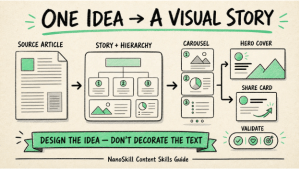

The best visual repurposing gives one idea a clearer shape; it does not paste the article into eight decorative slides.
Social Card turns articles, product notes, screenshots, reviews, subtitles, or photos into Xiaohongshu carousels and coordinated WeChat cover pairs.
The skill offers Editorial and Swiss International design systems, 28 layout skeletons, ten themes, multiple platform sizes, single-file HTML output, PNG rendering, and a Playwright-based validator for overflow, density, typography, and footer collisions. That is a meaningful implementation advantage over a prompt that returns only design advice.
Its platform focus is both the strength and the limit. It is excellent when the target format is a Xiaohongshu carousel or a WeChat 21:9 plus 1:1 cover pair. It is not the default choice for an X card, LinkedIn document, video, or general image editing.
The source can automatically retrieve images from stock and sharing sites and create a SOURCES.md file. That may be helpful in normal production, but publishers should review license and attribution requirements. For this article, every knowledge graphic was generated specifically for NanoSkill, so the post does not send image-credit backlinks to unrelated sites.
Best for: Chinese social distribution, visual tutorials, product reviews, data recaps, and turning a long article into a structured swipeable narrative.
The Content Marketing Skill Stack I Would Actually Use
Installing all eight at once would create overlapping instructions and inconsistent decisions. A smaller chain is easier to review.
| Workflow stage | Recommended skill | Human or data checkpoint |
| Establish the truth | Product Marketing Context | Approve audience, customer language, claims, proof, voice, and anti-personas |
| Discover the opportunity | Social Listening + Competitive Analysis | Confirm the audience signal with interviews, search data, sales notes, or support evidence |
| Research and create | Content Research Writer or AI Blog Writing | Verify every material claim, source, example, quote, and first-hand experience |
| Connect content to action | Copywriting Expert | Check message continuity, offer fit, proof, and one useful next step |
| Adapt for distribution | Blog to Twitter Repurposer or Social Card | Review platform rules, visual rights, tone, and source fidelity |
| Publish and learn | Your CMS, social accounts, analytics, and CRM | Require approval; measure qualified attention, saves, replies, leads, and assisted conversion |
The durable pattern is:
Context prevents invention. Research earns trust. Editorial review protects the reader. Distribution gives one strong idea more chances to travel. Measurement decides whether it deserves to return.
What Content Marketing Agent Skills Cannot Replace
An Agent Skill is a method. It is not automatically an evidence source, editorial board, or distribution channel.
A product-context skill cannot interview customers unless those interviews exist. A research skill cannot guarantee that a search result is correct. A writing system cannot create original experience from public summaries. A social-listening skill cannot tell whether a loud community represents the buyers who matter. A repurposing skill cannot make a weak idea worth sharing.
Google’s people-first content guidance asks whether a page contains original reporting or analysis, demonstrates first-hand expertise, serves an intended audience, and leaves the reader satisfied. Its generative-AI guidance makes the boundary clearer: AI can help with research and structure, but scaled output without added value remains a problem.
The best role for an Agent Skill is therefore not “write instead of us.” It is “make our method explicit enough that the agent and the editor can see what is missing.”
What to Check Before Installing a Content Skill
Read the complete package
Inspect the SKILL.md, references, scripts, templates, examples, license, recent commits, and install behavior. NanoSkill exposes the source and install path on each detail page, which shortens this review but does not replace it.
Map data and access requirements
List which steps need browsing, platform logins, API keys, paid providers, local runtimes, or connected accounts. A method that cannot reach its intended evidence should say so rather than fill the gap with confident prose.
Establish claim boundaries
Define approved product facts, customer quotes, metrics, testimonials, comparisons, and prohibited claims before drafting. Keep direct quotes distinct from derived lines and model-written copy.
Replace foreign defaults
Search for hard-coded domains, CTA links, brand colors, sample customers, voice rules, output paths, analytics tags, and platform assumptions.
Keep publishing behind approval
Start with files, previews, or drafts. Do not let a new skill publish posts, send social content, change live pages, or upload media until a human has reviewed the text, sources, links, rights, and destination account.
Test one complete content loop
Use one real brief. Create the context, research the topic, draft the asset, adapt one social version, publish manually, and inspect the response. Keep the skill only if it makes the work more accurate, more consistent, or meaningfully easier to review.
Final Verdict
The best Content Marketing Agent Skills in 2026 do not compete to write the most content. They make the important decisions visible.
Product Marketing Context ranks first because a shared audience, position, proof set, and voice improve every downstream asset. Content Research Writer is the best focused editorial workflow for turning sources into a reviewable article. Blog to Twitter Repurposer earns third place because it treats distribution as an editorial decision, not a summarization task.
Social Listening and Competitive Analysis strengthen the brief. AI Blog Writing supports teams that need a full production system. Copywriting Expert connects attention to action. Social Card gives strong ideas a native visual form for Xiaohongshu and WeChat.
If you want to build your own stack, start by comparing content marketing Agent Skills on NanoSkill. Choose one skill for context, one for creation, and one for distribution. Inspect the source, run a small test, and keep the human editor responsible for truth.
That is a slower promise than “publish 100 posts today.” It is also the workflow a credible publisher can put their name on.


