



Jordan Peterson, the famous Canadian psychologist, is known to advise people on making their bed first thing in the morning for better productivity. The task itself is not extraordinary by any means, but it certainly builds momentum for the rest of the day. Again, less is more, right?
Minimalism seems to be the highlight of the upcoming generations. Drew Barrymore, the American actress and producer, recently shared life-changing advice she once received. She stated, “Your head is as messy as your room is. Someone said that to me, and it changed my life forever.”
Well, when we connect her statement to that of Mr. Peterson’s advice, the concept of cleanliness, and most importantly, minimalism, surfaces. You intentionally focus on what is valuable and remove the rest (distractions). The philosophy is most commonly referred to in terms of interior design, which is perhaps why the global minimalist furniture market is booming.
Growing steadily at the rate of 7.7% between 2025 and 2030, it is expected to reach $81.1 billion. Even the corporate world has embraced minimalism with open arms as of late. In fact, minimalism may have become the default commercial aesthetic. This article will explore three primary reasons why and what businesses have to gain from it.
Corporate Design Is Enjoying Its Content Creator Era
If a business in today’s time has no digital presence, does it even exist at all? Well, given how digitization is ruling the landscape, such a brand will surely not stay afloat for long. This also means that modern businesses are as experienced through pixels as in person.
An office can easily become a part of Zoom meetings, LinkedIn announcements, recruitment videos, and investor presentations. So, it isn’t just a nice place for employees and clients to visit. Today’s offices have literally become visual branding assets.
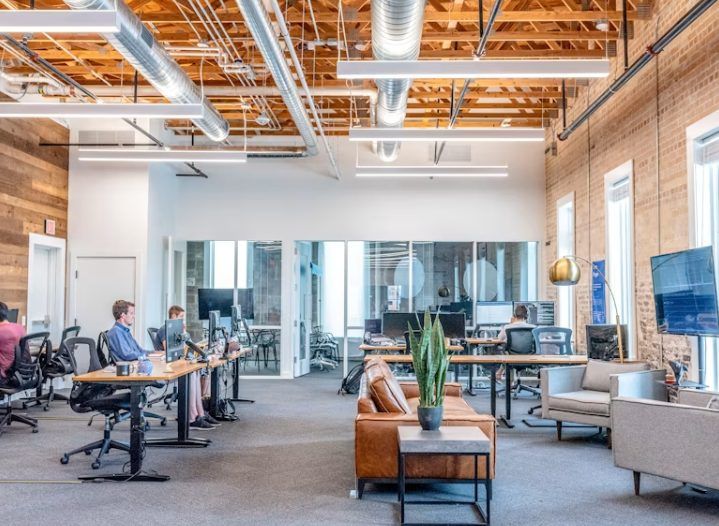
Basically, the corporate world is now busy ensuring that the office aesthetic looks appealing for cameras, livestreams, and screenshots. The answer to never going wrong in this area is minimalism. Office spaces designed on this philosophy naturally perform better due to the following reasons:
- The area appears to be clearer on screen.
- Visual distractions are minimal to nil.
- The company is able to create a stronger first impression.
- The brand comes across as modern and highly organized online.
In contrast, if too much is going on in the backdrop, it looks like a mess, especially when compressed into a laptop screen. Anything that competes for attention is a no-go, including clutter, harsh lighting, and complex layouts. This shows how modern office aesthetics is woven into workplace culture and employee experience.
As per a 2024 study, 81% of employers had already redesigned or planned to redesign their workspaces within 24 months. 83% admitted that any workspace enhancements that focused on collaboration helped attract and retain talent.
Customers Associate Minimalism With Trust and Professionalism
The human brain, despite being complex, enjoys clarity and order. Plus, as mentioned previously, ‘too much going on’ in a physical space indicates clutter and chaos in one’s mind. When combined, it makes sense why customers think of minimalism as trustworthy and competent.
Back when businesses exuded their premium essence through maximalist decor, there was a constant need to be mindful of contrast, hierarchy, and composition rules. Since first impressions are truly instantaneous in commercial settings, why not take the safer route?
From the lighting to the space’s layout and colors, everything contributes to making it appear organized, professional, and trustworthy. The psychological response of customers to minimalism is also a major reason why businesses lean towards this aesthetic. Here’s how it happens:
- Clean, uncluttered spaces, being processed easily by the brain, create immediate trust.
- Customers feel calm and not overstimulated due to fewer elements that require mental processing.
- Simplicity creates the impression that the company invests in a few but high-quality elements.
- Since there are fewer distractions, customer attention naturally moves to service quality, staff interaction, and the product itself.
Across industries, simplicity now communicates professionalism rather than extravagance. This is particularly evident in fast-paced commercial hubs where competition is intense in terms of customer experience and workplace appeal.
Bellevue, Washington, is one place that has experienced tremendous commercial expansion in recent years, mainly due to technology firms. As per a 2025 report highlighted by The Seattle Times, Amazon alone added 3,300 employees to its Bellevue offices in 2024. It also has long-term plans to expand further within this city.
Such commercial growth also creates more demand for modern workspaces that feel cohesive and polished. Many increasingly prioritize refined and subtle aesthetics in lieu of over-the-top interiors. The process involves collaboration with architects, interior designers, and even a reliable painting company in Bellevue.
On one side, the focus is on aesthetics, but the other aspect of minimalism, which is functionality, is not lost in translation. As EA Pro Painters shares, interior painting also plays a crucial role in protecting surfaces from wear and tear, moisture, and other damaging factors. Clean and well-preserved interiors become a way to preserve professionalism and customer confidence.
Quiet Luxury Has Made a Comeback
In every decade, businesses have desired to showcase their value and prestige, but the means of displaying them have undergone some drastic changes. At one point, a boring and soulless beige palette seemed to represent that. Then, ostentation and extravagance stepped in with highly dramatic executive rooms, oversized logos, and gold or marble-oriented decor.
The two looked more like extremes rather than antitheses of each other. Today, the ‘logomania fatigue’ has made luxury quiet again. It’s the resurgence of the old money aesthetic characteristic of the 18th and 19th-century European aristocracy.
Before you wonder, quiet luxury in its comeback era is anything but flat or dull. That’s mainly because this trend is being used as a clever branding strategy. Here’s what quiet luxury in business spaces looks like:
- Neutral or muted color palettes rather than loud and bright hues
- Soft, calm lighting that avoids any dramatic visual impact
- High-quality natural materials presented in an understated way
- Clean reception areas with subtle branding
- Elegant furniture chosen for texture and comfort, not extravagance
What’s the point? These features communicate qualities like stability, professionalism, and long-term thinking. One example would be a luxury hotel lobby featuring hues of grays and whites along with natural materials, strategically placed plants, and soft lighting. This is a whole different world compared to a lobby full of glossy marble, giant chandeliers, and gold accents.
CNBC shared in 2024 that quiet luxury not only emerged as one of the biggest viral luxury trends in fashion, but it also influenced investor behavior. Companies practicing quiet luxury outperformed their peers who relied on being loud and in your face.
FAQs
Why has corporate minimalism become so popular in modern commercial settings?
The reason behind the popularity of corporate minimalism lies in the way modern businesses operate. Offices now function as both physical workplaces and digital backdrops for Zoom calls, social media, and branding. This calls for cleaner and simpler aesthetics that have a stronger visual impact. It also communicates a stable brand identity.
How does minimalism design influence customer trust and perception?
Customers tend to draw a direct connection between minimalist settings and professionalism. This has to do with the fact that the human brain prefers order and clarity over chaos. Naturally, the business is perceived as more organized, reliable, and high-quality. Such a psychological response has encouraged businesses to choose simplicity over visually complex interiors.
Is corporate minimalism only a design trend, or is there a functional purpose involved?
Corporate minimalism is both a design trend and a functional strategy. Beyond aesthetics, it improves adaptability, supports digital branding, and simplifies long-term maintenance. Spaces are intentionally designed to improve productivity and meet the unique needs of the digital economy.
Important Data on Corporate Design and Minimalism
| Global minimalist furniture market projected growth | Between 2025 and 2030, the market is growing at a CAGR of 7.7%, expected to be valued at $81.1 billion |
| 2024 report on employers who had already redesigned or were planning to redesign their workplaces in the next 24 months | 81% |
| 2025 publication in Seattle Times on the number of employees Amazon added to its Bellevue office | 3,300 |
| 2024 report on employer sentiments regarding workspace enhancements | Enhancements that focused on collaboration helped attract and retain talent |
| CNBC coverage on quiet luxury in 2024 | Besides being one of the most viral fashion trends, it has also influenced investor behavior |
On the surface, corporate minimalism may be understood as a design movement, which it is. However, upon closer look, its popularity speaks volumes about modern life itself.
Life has become too rushed and chaotic these days. Be it online or offline, customers are bombarded with aggressive advertising efforts by brands competing for attention. Amid all this, calm and minimalist commercial spaces behave as a much-needed salve.
That is perhaps the reason why minimalist aesthetics are spreading across industries. Spectacle won’t allow a business to be taken seriously today. The question of the hour that businesses must ask themselves is whether they are walking in line with the changing times.


