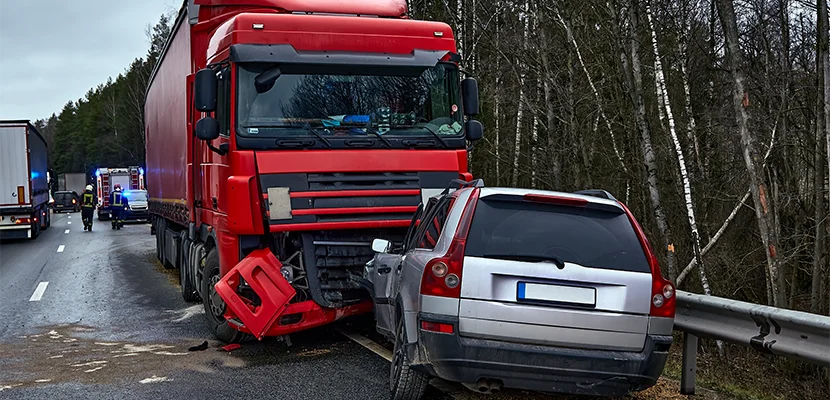
When people picture a deadly semi-truck crash, they often imagine a congested urban freeway or a densely trafficked city interchange. But new research released by DeMayo Law Offices reveals that rural America bears a disproportionate share of the nation’s large truck crash burden — and that the states where freight moves fastest are also the states where it kills the most.
The study, based on federal traffic safety data spanning 2021 to 2025, found that 56% of all large truck crashes in 2023 occurred in rural settings — 3,002 rural crash involvements compared to 2,359 in urban areas — despite the fact that rural roads carry a fraction of the overall traffic volume.
“Rural communities are often the forgotten victims of America’s trucking crisis,” said a spokesperson at DeMayo Law Offices. “Lower traffic doesn’t mean lower risk. In many ways, it means higher risk — because when something goes wrong at highway speeds in a rural area, help is farther away and the consequences are often irreversible.”
The Rural Crash Paradox
The concentration of large truck crashes on rural roads defies the intuitive assumption that more traffic equals more danger. Instead, the data reveals that several characteristics specific to rural freight routes amplify crash severity in ways that urban environments do not.
Higher posted speed limits on rural interstates and state routes mean that when a crash occurs, the forces involved are dramatically greater. Long, uninterrupted stretches of highway can breed a dangerous sense of monotony, increasing the likelihood of driver fatigue or inattention. Poor lighting, limited road markings, and the absence of physical medians on many rural corridors all raise the stakes when a truck drifts out of its lane or needs to stop suddenly.
Perhaps most critically, rural crashes are subject to significantly delayed emergency response times. In urban areas, first responders can often reach a crash site within minutes. In rural freight corridors, that window may stretch to 20 minutes or more — a difference that can be fatal for anyone involved in a high-impact collision with a 40-ton commercial vehicle.
Texas, Georgia, and the Southern Freight Corridor
At the state level, the data reveals a clear geographic pattern: the South and Midwest dominate the nation’s large truck fatality rankings.
Texas leads all states by a commanding margin, recording 538 large-truck-related fatalities — nearly three times the count of second-place Georgia (180) and California (175). Ohio, Tennessee, Florida, Illinois, and Oklahoma also rank among the top ten states for fatal large truck crashes.
In 2025, Texas also led the nation in total large truck crash involvements with 17,436 — far outpacing California (9,484), Georgia (8,663), and Pennsylvania (6,608). The presence of multiple Southern and Midwestern states across both the crash and fatality rankings reflects the role that major freight corridors — including I-10, I-20, I-40, and I-75 — play in concentrating commercial vehicle activity and, with it, crash risk.
These corridors are the backbone of American commerce, moving goods from ports to distribution centers to consumers across the country. They are also, by definition, shared spaces: the same interstates that carry 80,000-pound tractor-trailers also carry commuters, families on road trips, and drivers with no awareness of just how close they are traveling to a vehicle that can end their lives in an instant.
Nearly 24,800 Deaths in Five Years
The human cost embedded in these geographic and rural patterns is stark. Between 2021 and 2025, nearly 767,000 fatal and non-fatal crashes involving semi-trucks were reported across the United States, involving more than 823,600 vehicles. Those crashes resulted in approximately 362,400 reported injuries and nearly 24,800 deaths — an average of more than 4,400 fatal crashes involving semi-trucks every single year.
Van and enclosed box trucks were involved in more fatal crashes (1,569) than any other cargo type, reflecting both their sheer prevalence on American roads and their frequent operation in high-conflict environments where passenger vehicles, cyclists, and pedestrians share limited road space. Flatbed trucks, dump trucks, and cargo tank vehicles also feature prominently in fatal crash records, each associated with specific environmental hazards — unsecured cargo, construction zone proximity, and rollover risk, respectively.
The Case for Targeted Rural Investment
For DeMayo Law Offices, the data makes the case for a fundamental shift in how transportation safety resources are allocated. The conventional focus on urban road design and metropolitan enforcement strategies, while important, leaves a significant and lethal gap in rural America.
“The states and communities that sit along major freight corridors carry a safety burden that is not proportional to their population or their political weight”. “Targeted investments in rural road infrastructure, rest stop access, emergency response capacity, and commercial driver fatigue monitoring could save hundreds of lives each year. The data shows us exactly where to start.”