Global supply chains in 2026 demand speed, resilience, and localized production. Additive manufacturing (AM) has evolved well beyond its prototyping origins to become a legitimate manufacturing strategy embedded across industries. According to the Wohlers Report 2026, the global AM market reached $24.2 billion in revenue, with printing services alone accounting for 48% of the total market share. [1] Notably, companies in the Asia-Pacific region reported an average revenue growth of 19.8%, outpacing both the Americas (12.6%) and Europe (9%). [1] The report characterizes the current landscape as one where value creation is increasingly concentrated in production and service delivery rather than new hardware sales—a clear signal that the 3D printing supply chain is maturing from experimentation to execution.
Nowhere was this shift more visible than at TCT Asia 2026, held March 17–19 at the National Exhibition and Convention Center in Shanghai. With over 55,000 square meters of exhibition space, 550+ exhibitors, and a confirmed 44,519 unique visitors—a 42% increase year-over-year [2]—the event offered the most comprehensive snapshot of how additive manufacturing is being deployed at scale across Asia and beyond.
Scaling Up: Industrial Metal AM Reaches New Heights
One of the most prominent additive manufacturing trends at TCT Asia 2026 was the continued push toward large-format, high-throughput metal production. Heavy industries—aerospace, automotive, energy—are increasingly shifting from physical warehouses to digital inventories, using AM to produce end-use parts on demand and reduce supply chain vulnerability.
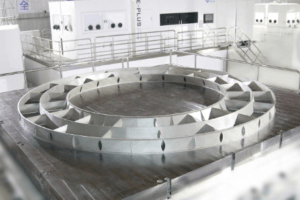
Chinese powder bed fusion manufacturer Eplus3D exemplified this trajectory by unveiling the EP-M3050, a next-generation metal system that ships with 100 lasers as standard and can be configured with up to 256. With X and Y axes each reaching 3,050 mm and forming speeds of 1,500–3,500 cm³/h, it represents one of the largest laser powder bed fusion platforms ever announced. [3] On the show floor, the company displayed an imposing 2.8-meter casing printed in 316L stainless steel to demonstrate the system’s build capacity. Eplus3D also introduced the EP-M300L alongside a Production-Ready Automation Line designed for continuous and batch production, targeting sectors such as 3C electronics, tooling, and aerospace. [3]
They were far from alone. Across Hall 7.1—the dedicated metal AM zone—industry leaders like Farsoon Technologies, BLT (Bright Laser Technologies), and HBD were demonstrating multi-laser synchronization and large-format build capabilities. Farsoon displayed a hypersonic precooler concept at its booth [4] and launched the FS1311M-U, a large-format system featuring a 1,310 × 1,310 × 1,650 mm build volume and 16-laser configuration with proprietary beam-shaping technology. [10]
As one international observer noted, these Chinese OEMs are no longer positioned as low-cost alternatives; they are actively setting the pace in industrial metal additive manufacturing. [4] BLT, for example, has expanded its large-format metal LPBF portfolio to support batch production of aerospace and industrial components. [5]
Scaling Out: The Rise of the 3D Printing Farm
While industrial metal systems command attention, an equally significant shift is happening at the other end of the spectrum. Desktop AM has officially graduated from the hobbyist’s garage to the industrial 3D printing supply chain. The concept of the 3D printing farm—clusters of high-speed, multi-material desktop printers operating as distributed micro-factories—is now a viable strategy for agile, low-volume production.
Hall 8.1 at TCT Asia 2026 was the epicenter of this movement. Major desktop and prosumer brands including Bambu Lab, Creality, Snapmaker, Elegoo, and Raise3D filled the polymer and innovation hall, each presenting systems optimized for speed, reliability, and scalable deployment. [6] Beyond the trade floor, over 5,000 makers, designers, and creative practitioners attended through the dedicated Fans of Creative program, underscoring the depth of the desktop ecosystem. [6]
Perhaps the strongest validation of this trend came from the event organizers themselves. TCT Asia announced that for its 2027 edition—relocating to the Shanghai New International Expo Centre (SINEC)—a dedicated N5 hall will be exclusively reserved for desktop and consumer-grade 3D printing. [2] When a 3D printing farm warrants its own exhibition hall at Asia’s flagship AM event, the message is clear: desktop manufacturing has arrived as a serious supply chain tool.

Closing the Loop: Automation and Digital Workflows
For AM to truly function as a reliable node in the broader 3D printing supply chain, the bottleneck of post-processing and quality assurance must be addressed. The true cost constraint in additive manufacturing is often not printing itself, but the manual labor required for powder removal, surface finishing, inspection, and validation.
Several exhibitors at TCT Asia 2026 demonstrated meaningful progress on this front. HBD unveiled its P400 automated production line, featuring a centralized powder management system capable of serving five printers simultaneously, AGV-based automatic build cylinder exchange, and the AMES X intelligent management platform for full-process data traceability. [7] Eplus3D’s Production-Ready Automation Line, designed for continuous batch output with minimal human intervention, reinforced the same theme. [3]
Quality assurance is also becoming increasingly data-driven. BLT showcased an AI-powered powder bed inspection system trained on over 100,000 defect samples, capable of detecting anomalies such as insufficient powder coverage or surface protrusions in real time and autonomously flagging areas for re-coating. [5] On the software side, established players like Materialise and Siemens demonstrated end-to-end digital workflow solutions encompassing simulation, process monitoring, and intelligent production scheduling. [8]
New entrants are also contributing to this ecosystem. Synacore, a digital twin specialist that emerged as one of the notable newcomers at the show, represents the growing convergence of AM with data-driven manufacturing intelligence. [4] Multi-color and multi-material capabilities are advancing as well: Sailner demonstrated its WJP platform for producing detailed medical and educational models, with plans to begin international hardware sales next year. [9] These developments collectively point toward an industry that is building the infrastructure for true “lights-out” additive manufacturing.

Looking Ahead: A Supply Chain Built on AM
Whether scaling up with industrial metal systems or scaling out with desktop 3D printing farms, TCT Asia 2026 demonstrated that additive manufacturing is ready for series production at a global level. The convergence of larger build volumes, faster throughput, smarter automation, and mature digital workflows is eliminating the traditional barriers between AM and mainstream manufacturing.
The additive manufacturing trends on display in Shanghai reflect a broader reality: the 3D printing supply chain is no longer a niche parallel to conventional manufacturing. It is becoming an integral, scalable layer within it.
The conversation continues at TCT Shenzhen 2026(October 14–16, 2026), and next year’s TCT Asia moves to a larger venue—the Shanghai New International Expo Centre—on May 27–29, 2027, expanding to five dedicated halls. [2] For professionals navigating the evolving AM landscape, these events remain essential touchpoints for sourcing, benchmarking, and strategic planning.
Works Cited
[1] Davies, Sam. “Wohlers Report 2026: Additive Manufacturing Revenues Reach $24.2 Billion.” TCT Magazine, 17 Feb. 2026, www.tctmagazine.com/wohlers-report-2026-additive-manufacturing-revenues-reach-24-2-billion/.
[2] TCT Asia. “TCT Asia 2026 Post-Show Wrap-Up.” WeChat Official Account, 19 Mar. 2026, https://mp.weixin.qq.com/s/Q0e2NQF-nkshtiHQIa_E_w .
[3] Davies, Sam. “Eplus3D Teases New Metal Additive Manufacturing System with 256 Lasers.” TCT Magazine, 18 Mar. 2026, www.tctmagazine.com/eplus3d-teases-new-metal-additive-manufacturing-system-with-256-lasers/.
[4] S., Kety. “TCT Asia 2026: Different World, Different Rules (Part 1).” 3D ADEPT Media, 18 Mar. 2026, 3dadept.com/tct-asia-2026-different-world-different-rules-part-1/.
[5] “A Closer Look at Exhibitors and Cutting-Edge Products at TCT Asia 2026.” Wevolver, 2026, www.wevolver.com/article/a-closer-look-at-exhibitors-and-cutting-edge-products-at-tct-asia-2026.
[6] “TCT Asia 2026 Now Returns to Shanghai Bigger Than Ever.” 3D Printing Industry, Mar. 2026, 3dprintingindustry.com/news/tct-asia-2026-now-returns-to-shanghai-bigger-than-ever-249912/.
[7] “TCT Asia 2026.” HBD, en.hb3dp.com/event-calendar/tct-asia-2026/.
[8] Team TCT Asia. “Inside TCT Asia 2026: Exploring a Full-Chain Additive Manufacturing Platform.” 3DPrint.com, 2 Feb. 2026, 3dprint.com/323521/inside-tct-asia-2026-exploring-a-full-chain-additive-manufacturing-platform/.
[9] Davies, Sam. “Sailner Exhibits Multi-Colour and Multi-Material 3D Printing Capabilities at TCT Asia.” TCT Magazine, 2026, www.tctmagazine.com/sailner-mulit-colour-material-3d-printing-tct-asia/.
[10] Laura Griffiths. “Farsoon launches 16-laser 3D printer for metre-scale metal components” TCT Magazine, 2026, www.tctmagazine.com/farsoon-launches-16-laser-3d-printer-for-metre-scale-metal-components/.