



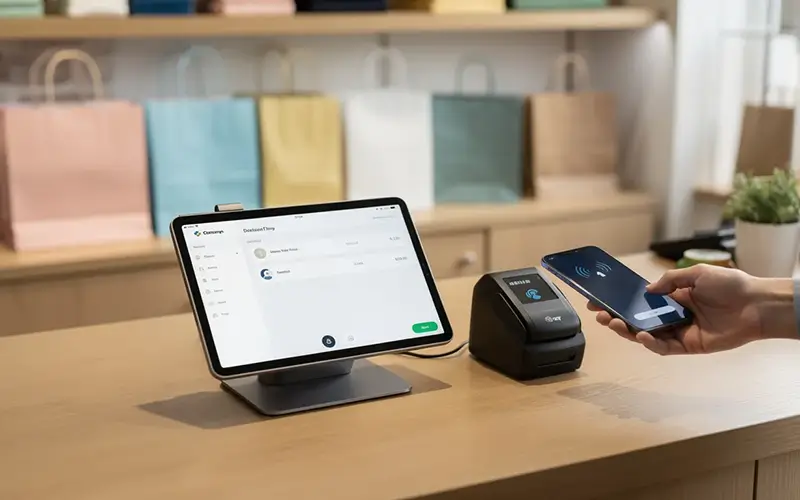
The retail POS market has expanded considerably over the past few years. What was once a straightforward category – take payments, track stock – now covers cloud infrastructure, omnichannel selling, supplier integrations, and real-time analytics. For retailers evaluating their options, that breadth makes comparison harder, not easier.
This guide focuses on five platforms that appear consistently across the retail POS landscape, with a brief breakdown of what each is best positioned to do.
1. Vibe Retail POS
Best for: Independent and growing retail businesses
Vibe Retail POS is a cloud based pos system for retail built for independent retailers and growing multi-site operations. It covers the core requirements of day-to-day retail – sales processing, inventory management, staff management, and reporting – from a cloud-native platform designed to scale without adding operational complexity.
A few things are notable about Vibe Retail’s positioning in this space:
- Inventory management is built around real-time stock tracking, variant management, and purchase order workflows – suited to product retailers managing a meaningful SKU count
- Multi-location support is a core part of the platform rather than a higher-tier add-on, with centralised reporting, stock transfers between locations, and a unified customer database
- Pricing starts at $19/month, which is notably accessible compared to platforms that charge per-terminal or lead with enterprise pricing
- Cloud-based throughout – reports, stock levels, and sales data are accessible remotely without a VPN or server dependency
- Staff management and reporting are included as standard, covering the operational needs of stores with multiple staff members or changing schedules
For independent retailers who want a system that handles the fundamentals well and supports growth to multiple locations, Vibe Retail is a practical option to put on a shortlist. To further streamline day-to-day operations, businesses can also benefit from using a receipt maker to create professional transaction records, improve organization, and provide customers with clear proof of purchase.
2. Square for Retail
Best for: Small and early-stage retailers
Square is among the most widely used retail POS platforms in the US, primarily because of its low entry point and integrated payment processing.
- Free plan available – no monthly software fee, pay processing fees only
- Paid plans from $49/month (Plus) or $149/month (Premium) per location
- Inventory management, purchase ordering, and vendor management available on paid tiers
- Interface is generally considered accessible for staff to learn, reducing training overhead
- A harder fit at higher complexity – retailers with deep inventory structures or strong multi-location needs may find the platform is geared more toward simplicity than advanced functionality
- Hardware options include countertop terminals, card readers, and kiosk configurations
For small or early-stage retailers who want to get up and running quickly without a significant upfront commitment, Square is a widely recognised starting point in the market.
3. Lightspeed Retail
Best for: Established retailers with complex inventory requirements
Lightspeed is a well-established platform with a strong presence among mid-market and specialty retailers, particularly in verticals with high SKU variability such as apparel, sporting goods, and outdoor retail.
- Plans from $89/month (Basic), $149/month (Core), or $289/month (Plus), billed annually
- Lightspeed is most commonly cited for inventory management depth – purchase order workflows, supplier management, landed cost tracking, and detailed product matrices
- Omnichannel capabilities allow the same inventory pool to serve both physical and online sales channels
- Reporting and analytics sit at the more detailed end of the mid-market range
- Onboarding can be more involved than simpler platforms, and the higher price point means businesses with straightforward needs may find themselves paying for capabilities they don’t use
For established retailers whose operations have outgrown simpler systems, Lightspeed’s inventory depth and omnichannel tooling make it a commonly considered option at the mid-market level.
4. Shopify POS
Best for: Ecommerce retailers adding a physical presence
Shopify POS is a natural consideration for retailers whose primary channel is online and who are extending into physical retail – whether a permanent store, pop-up events, or market selling.
- Basic in-person selling included with all paid Shopify plans (from $39/month)
- POS Pro available at $89/month per location for businesses with high foot traffic, larger staff teams, or extensive product catalogues
- The unified inventory model is a commonly cited strength – stock levels, customer records, and order data are shared across online and in-store channels without manual syncing
- Less of a natural fit for retailers whose primary channel is in-store; some features that matter more to physical-first retailers are less of a focus than in dedicated retail POS platforms
- Hardware – card readers, cash drawers, receipt printers – available directly from Shopify
For retailers already operating on Shopify’s ecommerce platform, Shopify POS is a natural extension into physical selling rather than a separate system to manage.
5. Clover
Best for: Retailers who want hardware and software from a single provider
Clover is a hardware-led platform that bundles its software with a range of terminal hardware – countertop stations, handheld devices, and compact card readers.
- A dedicated app market extends base functionality with add-ons for loyalty programmes, inventory management, employee management, and third-party integrations
- Hardware is largely proprietary, meaning the terminals are designed to work within Clover’s ecosystem
- Distributed through financial institutions and independent sales organisations – pricing varies by reseller, so a direct quote is the only reliable way to get an accurate cost
- A common choice for retailers who prefer a single-supplier relationship for hardware and software
For retailers who prioritise simplicity of vendor management and want hardware and software handled by the same provider, Clover is among the more established options in that category.
How to choose a Retail POS
The right retail POS for a given business depends on where that business is now and where it’s heading. The right fit varies depending on business size, complexity, and growth trajectory.
For independent retailers looking for a cloud-based system with solid inventory management and accessible pricing, Vibe Retail POS is worth an early look. For retailers already built on Shopify’s ecommerce infrastructure, Shopify POS is a natural consideration for extending into physical selling. For operations with complex inventory at scale, Lightspeed’s inventory depth is its most commonly noted differentiator. Square offers a low-commitment entry point for smaller or newer businesses. And for those who prefer a single-supplier hardware and software relationship, Clover is among the more established options in that category.
Most platforms offer free trials or demo accounts, which means the shortlisting process doesn’t have to be theoretical – you can put them in front of your actual workflows before committing to anything.
Pricing and feature information sourced from each provider’s official website. Always verify current pricing and plan inclusions directly with the provider before making a purchasing decision, as terms can change.


