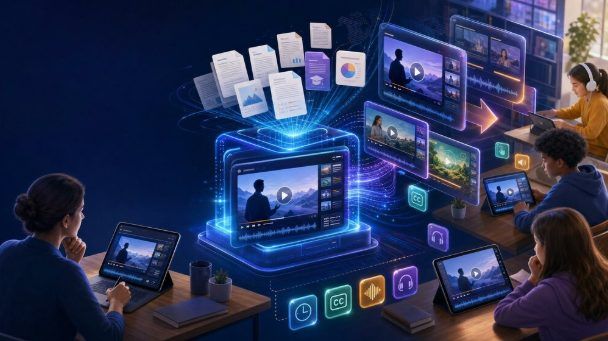
Education is experiencing the most significant technology shift since the introduction of the internet into classrooms. But unlike previous waves of educational technology — interactive whiteboards, tablet programs, learning management systems — the current wave is not asking educators to learn complex new tools or fundamentally change their teaching practice. AI learning video generators work with the materials educators already have and the expertise they already possess.
This article makes the practical case for why AI learning video generators belong in every educator’s toolkit, regardless of their institution size, technical comfort level, or subject area.
The Tool That Meets Educators Where They Are
Most educational technology requires educators to learn new systems, new workflows, and new ways of thinking about content delivery. AI learning video generators do the opposite — they start with what educators already have. Your lecture notes? They become a narrated video. Your study guide? It becomes a visual tutorial. Your curriculum document? It becomes a series of learning modules.
The learning curve is measured in minutes, not weeks. Upload a document, configure basic settings (language, tone, detail level), and generate a video. The AI handles every aspect of production that traditionally required specialized skills: narration, visual design, scene composition, and presenter animation.
Leadde exemplifies this approach — an AI learning video generator designed specifically for educators, supporting 88 languages and offering over 200 AI presenter options. The platform converts documents into structured learning videos that look and sound like they were produced by a professional team.
Five Reasons to Add This Tool to Your Toolkit
Reason 1: Your Students Already Prefer Video
This is not speculation — it is consistently demonstrated by research. Studies across K-12 and higher education show that students engage more deeply with video content than with text-based materials. Completion rates for assigned video content are significantly higher than for assigned readings. Information retention from video exceeds retention from text by measurable margins.
These findings are not surprising when you consider how students spend their time outside of educational contexts. They watch YouTube tutorials, TikTok explainers, and Instagram reels. Video is their native content format. Delivering educational content in this format is not pandering to short attention spans — it is meeting learners where they are most comfortable and most receptive.
Reason 2: You Already Have the Content
The biggest misconception about educational video is that it requires creating new content. It does not. You have already created the content — it exists as your lecture notes, your PowerPoint presentations, your study guides, your handouts. AI learning video generators do not ask you to create new material. They ask you to upload the material you already have and let the AI handle the format conversion.
This distinction is critical. The barrier to educational video has never been content quality — educators possess deep expertise. The barrier has been production capability. AI removes the production barrier while preserving the content expertise.
Reason 3: It Saves Time on Repetitive Explanations
Every educator has topics they explain the same way, to the same level of detail, multiple times per year. Prerequisite concepts that every new cohort needs. Common misconceptions that arise predictably. Complex procedures that require step-by-step guidance. Creating a video version of these recurring explanations frees up class time for higher-value activities — discussions, problem-solving, individual support — that benefit from live interaction.
This is not about replacing teaching with video. It is about delegating the repetitive explanatory components to video so that the educator’s live time is spent on the interactive, responsive aspects of teaching that no video can replicate.
Reason 4: It Supports Diverse Learning Needs
Every classroom contains students with different learning needs. Some process information quickly; others need more time. Some learn best from reading; others learn best from listening and watching. Some speak the language of instruction natively; others are learning through a second language.
AI-generated videos address multiple dimensions of learning diversity simultaneously. Students can pause and rewatch at their own pace. The visual and auditory channels support different learning preferences. Multilingual versions serve students whose native language differs from the language of instruction. Auto-generated subtitles provide text support for auditory content.
Reason 5: It Builds a Compounding Resource Library
Every video you create becomes a permanent resource that serves students year after year. Unlike live explanations that are consumed once and forgotten, videos can be accessed, rewatched, and shared indefinitely. Over time, your video library grows into a comprehensive learning resource that complements your live teaching.
The compounding effect is significant. In year one, you might create 20 videos covering key topics. In year two, you add 20 more while your year-one videos continue serving students. By year three, you have 60 videos covering the majority of your curriculum — a resource library that took you a total of perhaps 30 hours to create but provides hundreds of hours of learning value to your students annually.
Getting Started: A Practical First Step
Start with a single lesson — the topic your students find most challenging. The one that generates the most questions during office hours. The one where assessment scores are consistently lowest. Convert your teaching materials for that topic into a video, share it with your students, and observe the impact.
If the result is positive — and for the vast majority of educators who try this, it is — expand to the next most challenging topic. Then the next. Build your video library one topic at a time, starting with the content where the learning impact is greatest.
Addressing Common Concerns
“Will AI replace me?”
No. AI handles the production mechanics of video creation — narration, visual design, rendering. Your irreplaceable contributions — subject matter expertise, pedagogical judgment, student relationships, real-time responsiveness — remain entirely human and entirely essential. AI is a production tool, not a teaching replacement.
“Is the quality good enough?”
For the vast majority of educational use cases, yes. AI-generated videos are not indistinguishable from studio-produced content, but they are professional, clear, and engaging. The quality has crossed the threshold where the content value outweighs any production imperfections — and the quality continues to improve with each platform update.
“I’m not technical.”
You do not need to be. If you can upload a file and click a button, you can create an AI-generated video. The platforms are designed for educators, not video engineers. The learning curve is genuinely minimal.
The Bottom Line
AI learning video generators represent a rare convergence: a technology that is genuinely useful, easy to adopt, and directly aligned with how students prefer to learn. The cost of trying is a few minutes of your time. The potential upside — better student engagement, more effective use of class time, and a growing library of reusable learning resources — is substantial and compounding.
For educators who have been waiting for a practical reason to add video to their teaching toolkit, the wait is over. The tools are ready. The starting point is the content you already have.