

Industrial OEMs operating UV sterilization units, infrared heating assemblies, and high-temperature process equipment face a common operational challenge: unplanned downtime. Whether caused by material degradation, thermal shock, optical instability, or dimensional drift, component failure in heat-intensive systems directly impacts production continuity, maintenance cost, and contractual performance guarantees.
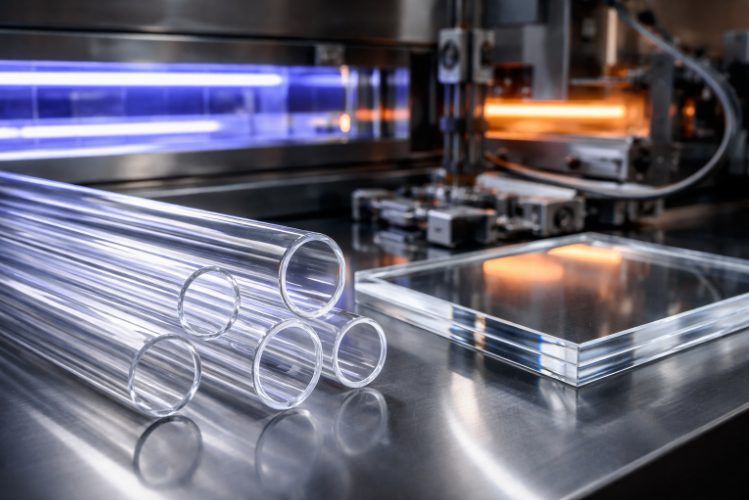
In UV and thermal processing environments, component reliability is not only a matter of structural integrity but also optical transmission stability and thermal compatibility. Many OEM engineers are increasingly evaluating precision fused silica tubes for industrial UV and thermal processing systems as part of a broader reliability strategy rather than treating quartz parts as commodity consumables.
This shift reflects a deeper understanding of lifecycle engineering. Instead of selecting materials purely on upfront cost, forward-looking manufacturers analyze how dimensional tolerance control, impurity content, and thermal expansion behavior influence long-term system uptime.
Below are four strategic approaches industrial OEMs use to reduce downtime through informed quartz component selection and integration.
1. Engineering for Thermal Shock Resistance Rather Than Nominal Temperature Limits
The Hidden Downtime Driver: Thermal Cycling
Many UV reactors and IR heating systems do not fail at maximum temperature. They fail during rapid temperature changes.
Thermal shock occurs when:
- External heating is uneven
- Cooling is abrupt
- Wall thickness varies
- Mounting constraints induce stress
Fused silica (high-purity quartz glass) exhibits an extremely low coefficient of thermal expansion (CTE), typically:
| Material | Coefficient of Thermal Expansion (×10⁻⁶ /K) |
| Fused silica | ~0.5 |
| Borosilicate glass | ~3.3 |
| Alumina ceramic | ~7–8 |
| Stainless steel (304) | ~17 |
Data derived from ASM Handbook and NIST material property references.
Lower CTE translates directly into:
- Reduced internal stress under rapid heating
- Higher thermal shock tolerance
- Lower crack initiation probability
Strategic Implementation
OEMs reduce downtime by:
- Specifying wall thickness uniformity within tight tolerance ranges
- Avoiding sharp geometric transitions in tube or sleeve designs
- Selecting high-purity fused silica over borosilicate in high-cycle UV applications
Instead of designing around failure, they design around stress distribution.
2. Maintaining Optical Transmission Stability in UV-C Environments
UV-C Performance Degradation: A Long-Term Risk
In UV sterilization systems (typically 254 nm), material transparency is mission-critical.
Over time, some materials:
- Yellow under prolonged UV exposure
- Develop surface contamination
- Accumulate microfractures affecting transmission
Fused silica typically demonstrates >90% transmission at 254 nm (depending on grade and thickness), while borosilicate glass absorbs significantly more UV-C radiation.
| Wavelength (nm) | Fused Silica Transmission | Borosilicate Transmission |
| 254 nm | >90% | <20% |
| 300 nm | >92% | ~70% |
| 400 nm | >93% | >90% |
Values compiled from SPIE optical material databases and manufacturer-neutral material literature.
Strategic Implementation
OEMs reduce downtime by:
- Selecting UV-grade quartz tubes with verified transmission data
- Specifying impurity thresholds (especially hydroxyl content where relevant)
- Designing replaceable sleeve systems to isolate lamp housings
By preserving transmission stability, systems maintain sterilization efficacy without premature component replacement.
3. Controlling Dimensional Tolerances to Prevent Mechanical Stress Accumulation
Why Dimensional Stability Matters
In automated UV or thermal assemblies:
- Tubes may interface with metal end caps
- Quartz sleeves may sit inside stainless steel housings
- IR emitters may rely on precise concentric alignment
If quartz components deviate in:
- Outer diameter
- Wall thickness
- Straightness
- Concentricity
Mechanical stress builds at contact points.
This stress accumulation often manifests not as immediate fracture, but as:
- Gradual crack propagation
- Seal leakage
- Microfracture under vibration
Strategic Implementation
OEMs increasingly:
- Require CNC-finished quartz components
- Specify tight OD/ID tolerances (±0.1 mm or tighter depending on system scale)
- Inspect straightness over full length in large-diameter tubes
Dimensional consistency reduces mechanical constraint-induced failures — one of the most overlooked downtime triggers in modular UV and heating systems.
4. Managing Radiative Heat Load with Optically Stable Quartz Plates
Not all failures originate in tubular components. In IR heating assemblies and optical exposure chambers, flat quartz elements are often used as:
- Radiation windows
- Protective shields
- Optical isolation barriers
If these plates warp, crack, or lose optical flatness:
- Energy distribution becomes uneven
- Sensor readings drift
- Process repeatability degrades
OEMs increasingly specify optical-grade quartz plates engineered for high-temperature radiation environments when thermal radiation exposure exceeds what borosilicate or tempered glass can reliably handle.
Engineering Considerations
Key design factors include:
- Surface flatness tolerance
- Thickness uniformity
- Edge finishing quality
- Stress-relieved machining processes
Quartz plates exhibit:
- High softening point (~1665°C)
- Excellent IR transmission
- Resistance to devitrification when properly processed
Strategic integration reduces distortion-driven downtime in precision heating or photonic systems.
Lifecycle Perspective: From Component Replacement to Reliability Architecture
Industrial OEMs that reduce downtime successfully do not treat quartz components as consumables. They treat them as part of reliability architecture.
Key lifecycle metrics include:
- Mean Time Between Failure (MTBF)
- Transmission stability over exposure hours
- Thermal cycle tolerance
- Dimensional stability under mounting load
Instead of asking:
“What is the lowest-cost tube?”
They ask:
“What is the cost of system interruption?”
Downtime in industrial UV water treatment or thermal process lines may include:
- Production halts
- Contractual penalty exposure
- Emergency labor costs
- Unplanned part procurement
When evaluated under Total Cost of Ownership (TCO), material precision becomes economically rational.
Failure Modes Commonly Observed in Inferior Quartz Integration
Understanding failure mechanisms further supports strategic material selection.
1. Devitrification
- Caused by contamination or prolonged high temperature
- Leads to opacity and structural weakness
2. Surface Microcracking
- Often due to machining-induced stress
- Exacerbated by rapid thermal cycling
3. Mechanical Constraint Fracture
- Occurs when quartz expansion is restricted by rigid metal interfaces
4. UV-Induced Transmission Loss
- Associated with impurity levels and surface degradation
Mitigation requires:
- Controlled annealing processes
- Clean-room compatible handling (for high-sensitivity applications)
- Precision machining with stress-relief protocols
Strategic Takeaways for Industrial OEMs
Reducing downtime in UV and thermal systems requires a shift from reactive replacement to proactive engineering control.
Strategic Pillars
- Thermal Expansion Compatibility
- Optical Transmission Stability
- Dimensional Precision
- Radiative Load Management
Quartz components, when properly engineered and specified, support all four pillars simultaneously.
The result is not just longer component life — it is improved system predictability.
Conclusion
Industrial OEMs operating in UV sterilization, infrared heating, and high-temperature processing environments face increasing performance expectations. Downtime is no longer a maintenance inconvenience; it is a strategic liability.
By integrating thermally stable fused silica tubes and optically resilient quartz plates into system design — with attention to tolerance control, impurity management, and lifecycle data — manufacturers convert material science into operational stability.
Engineering-led material selection is no longer optional. It is a core strategy for uptime assurance in heat-intensive industrial systems.
