Light Bulb Security Camera for Porch, Garage, and Rental Homes
Search “light bulbs with security cameras,” and you will see two completely different product types side by side, priced in a similar range, described with similar phrasing. One screws into a lamp socket and leaves no mark when you take it out. The other requires AC wiring behind the wall and a junction box. Mixing them up is easy before you buy and frustrating afterwards.
Neither type is better in the abstract. The socket version is portable and asks nothing of the wall. The hardwired version is brighter, more capable outdoors, and generally more reliable for continuous recording. Which one fits depends on what your installation and lease actually allow.

Table of Contents
- What a screw-in light bulb camera actually is
- What a hardwired floodlight camera adds
- Coverage at the porch, garage, and ceiling height
- WiFi signal at high-mount locations
- Renter and homeowner considerations
- Conclusion
What a screw-in light bulb camera actually is
The core constraint is simple. The camera goes where the socket already is. If the only overhead socket in the room points at the ceiling fan rather than the front door, the field of view follows. That is not a spec issue. It is a geometry problem, and no feature list on the product page changes it.
What the screw-in type does well is power and portability. It fits a standard E26 or E27 base, the same thread found in most North American and European household fixtures, which is why many listings still group these models under the security camera light socket label. The socket supplies continuous power, so there is no battery to manage. Most models connect to WiFi and offer roughly 360-degree horizontal coverage with pan and tilt, which makes a central ceiling position useful for watching a wide room.
The limits show up at the edges of that convenience. A socket buried inside a deep recessed fixture can cut into the camera’s antenna range and reduce its effective viewing angle below the fixture lip. Heat is another factor some people miss. When a model runs both a bulb element and camera electronics in a small enclosed housing, temperature builds up. In a fully enclosed fixture, that matters enough that you should check the environmental rating and any temperature limits before you buy.
Unscrew the camera, pack it, and move. That is the practical case for this type if you rent or move often.
What a hardwired floodlight camera adds
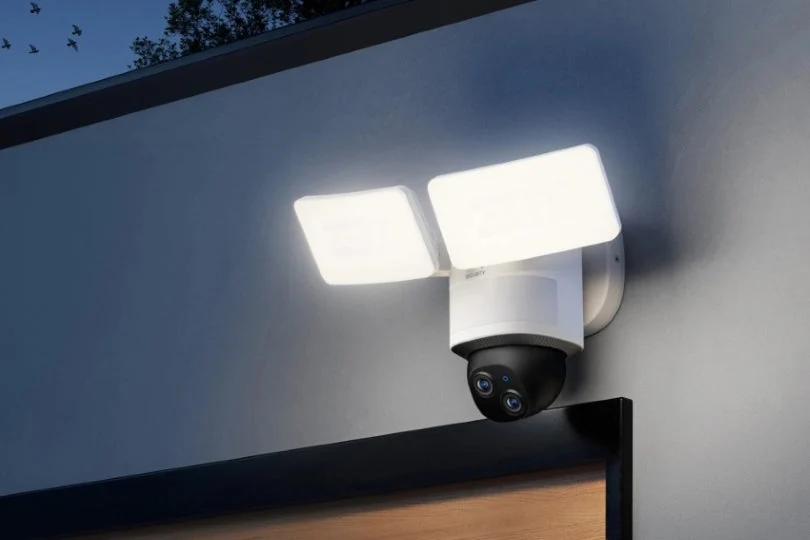
The wiring is what most people notice last and regret first. A hardwired floodlight camera connects to AC power at the wall through a junction box, which means the mounting spot needs existing outdoor wiring, the replacement of an existing wall light, or a new circuit run by an electrician. There is no avoiding that step.
What you get in exchange is considerably more output. Floodlights at the 2,000-lumen range illuminate a driveway, garage apron, or backyard in a way a socket camera cannot. The motion-activated light also does something the camera alone cannot. It changes the scene. Someone approaching in the dark sees the area go bright, which is a different situation than being recorded in infrared.
Dual-camera configurations are common in this category. One lens covers the wide scene while the other zooms or tracks. That combination requires the power and housing space that AC wiring and a wall-mount bracket provide. In a socket-type housing, fitting two independent camera systems with separate optics is not realistic.
The installation is permanent in a practical sense. Once the wiring is done and the bracket is mounted, most people leave the unit in place. Some floodlights can be removed and reinstalled at a new address if the bracket type matches, but it requires the same wiring work at the new location.
Coverage at the porch, garage, and ceiling height
A light bulb camera indoor layout on a central eight- or nine-foot ceiling matches the straight-down geometry you get from a porch socket overhead, only without weather in the frame.
A socket camera in a porch ceiling fixture, say 8 to 10 feet up, points straight down at the area directly beneath it. Wide-angle coverage at that height can catch the full porch surface and part of the approach. The trouble is that a straight-down ceiling mount in a typical housing makes face identification harder once someone is more than a few feet away. The camera captures the tops of heads well. That is not always what you need.
Wall-mounted at the same height, a floodlight camera can be angled to capture a longer approach. The bracket lets the installer adjust the tilt, something a ceiling socket will not allow. At a garage corner, mounting the floodlight 8 to 10 feet up on the wall can cover both the door and the exterior apron without the straight-down problem a ceiling fixture creates.
Height helps both types when it comes to tamper risk. Anything mounted above easy reach is harder to interfere with, and that applies regardless of which camera type is in use.
WiFi signal at high-mount locations
Ceiling height is not where WiFi is strongest in most homes. Routers typically sit on a desk, a shelf, or a low cabinet, and signal tends to move sideways better than it travels straight up toward the ceiling. A camera near the top of the room, especially in a far corner or near an exterior wall, often sees a noticeably weaker signal than a phone tested at counter height in the same space.
A deep recessed fixture makes it worse. The metal housing around the socket partially blocks the camera’s antenna. Before you install a socket-type camera inside a recessed can light, run a WiFi speed test from that spot with your phone. If the phone signal drops noticeably, the camera will too.
Hardwired floodlights on exterior walls face a different version of the same problem. Thick masonry or concrete between the camera and the router attenuates the signal. Models that support both 2.4 GHz and 5 GHz give some flexibility. The 2.4 GHz band usually travels farther through walls, while 5 GHz offers faster throughput at a shorter range. If the exterior location is far from the router, a mesh node or WiFi extender placed near the mounting wall tends to help more than switching bands.
Renter and homeowner considerations
Renters are mostly limited by what the lease says about modifications. A socket camera sidesteps that question. It uses the existing wiring the landlord already installed, leaves no visible trace when removed, and travels with you at the end of the lease. Coverage is limited to where sockets already exist, but for basic indoor monitoring in an apartment or rented house, that constraint is manageable.
Outdoor coverage is a harder problem for renters. Most socket cameras lack a weather rating for exposed outdoor use. A covered porch in mild weather is sometimes fine; a fully exposed outdoor fixture through a wet winter is a different calculation. The product page for any specific model should list its rated environment, and that is worth checking before you assume it works outside.
The situation changes if the landlord has approved modifications, or if you own the property. A hardwired floodlight over the garage door or at the side entrance adds real brightness and continuous recording, and the installation pays off over time if you stay in the property. For a porch or driveway that has existing outdoor wiring from a previous wall light, replacing it with a floodlight camera is a natural swap rather than a major project.
If the landlord has approved the swap and the junction box is already there, the eufy Floodlight Camera E340 is a practical option for a porch or garage wall. Official materials describe a 3K wide-angle camera paired with a 2K telephoto camera, 360-degree horizontal pan with vertical tilt, about 2,000 lumens across two light panels, and dual-band WiFi 6. It needs AC hardwiring, so match the manual, local electrical rules, and your lease to the existing box before you buy.
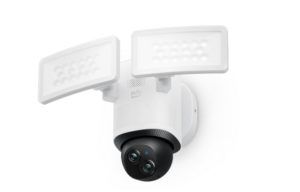
eufy Floodlight Camera E340

Conclusion
Socket cameras and hardwired floodlights answer different versions of the same problem. One is portable and non-committal. The other requires commitment up front and returns more in output and reliability. For many households, bulb camera home security starts with the screw-in path before they weigh a hardwired floodlight. Renters tend to land on the socket type by default, not always because it is the best fit for the location, but because it is the only option that does not require a landlord conversation.
For anyone still comparing options across both types, the eufy light bulb security camera collection lists floodlight-style models with power type, weather rating, and storage specs, which makes it easier to narrow the list to what the location actually supports.