


Quick question: what do you reckon is the trickiest part of running a crypto exchange?
Delivering a quality user experience? Maintaining liquidity? Or keeping crypto listings up-to-date?
These are all worthy mentions; however, staying on the right side of the regulatory frameworks is right at the top of that list.
You see, in recent times, anti-money Laundering (AML) has become the make-or-break factor for survival. Fail here, and you risk fines, lawsuits, and lost banking partners. Succeed, and you earn trust, legitimacy, and growth.
So, how do you navigate this tricky landscape as a smart executive?
In this guide, we’ll break down:
- What AML really means for crypto exchanges
- The global regulatory landscape
- Core AML requirements
- How to build a smart AML framework
- And how to manage risk effectively
Let’s dive in.
What is Anti-Money Laundering (AML)?
Anti-Money Laundering (AML) refers to a set of legally recognized rules, processes, and technologies that are designed specifically to detect and prevent the transformation of fraudulent funds into legitimate income.
In a nutshell, it is all the processes that are set up to make sure that users don’t launder money through all these day-to-day operations, especially in a crypto exchange. These processes also help to limit the possibilities of other financial crimes, such as identity theft and tax evasion.
So, what do these “processes” entail? Some of these include:
- Monitoring customer transactions for suspicious activity
- Reporting transactions in a timely manner
- Verifying customer identities
- Executing customer due diligence
Wondering why all these things are necessary?
Because cryptocurrencies move fast, across borders, and often without intermediaries like banks. They’re especially common in models such as a decentralized crypto exchange, where users trade peer-to-peer without a central authority. That makes them attractive not only to innovators but also to bad actors. Regulators know this, which is why every AML-compliant exchange today must have robust safeguards in place.
And here’s where the importance of KYC and AML for crypto exchanges really comes into play. KYC (Know Your Customer) makes sure you know who’s on your platform. AML makes sure you know what they’re doing. Together, they’re the foundation for staying compliant, keeping regulators satisfied, and, frankly, keeping your business alive.
The Global AML Landscape Every Crypto Exchange Must Understand
One thing you need to know about the current AML landscape is that regulatory landscapes are not leaving the implementation of these rules and processes to chance. If you want to operate an AML approved crypto exchange, you’ll need to understand not only your home country’s rules but also how global frameworks overlap.
So, what are these global frameworks?
The most notable ones include:
- Financial Action Task Force (FATF): The Financial Action Task Force (FATF) is the global watchdog for combating money laundering and terrorist financing. As such, the institution issues AML guidelines such as the popular ‘Travel Rule’, which mandates that exchanges must share information regarding the sender and recipient of cryptocurrency transactions for transparency.
- The Markets in Crypto-Assets Regulation (MiCA): MiCA is a European Union framework that defines crypto-assets, how they are regulated, who can regulate them, requirements for any non-fungible token, and provides crypto products and services.
- Financial Crimes Enforcement Network (FinCEN): FinCEN is the organization responsible for devising laws that financial institutions must comply with to prevent money laundering, including identity verification and regulatory reporting in the US.
Other regulatory bodies you should look out for include the SEC, CFTC, and the upcoming AMLR. As such, the existence of these different AML-focused regulatory bodies means crypto exchanges like yours must run a thorough crypto exchange AML check before launching in a new market.
Core AML Requirements For Crypto Exchanges
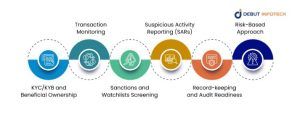 So, let’s say we want to start aligning with these crypto exchange AML regulatory frameworks. What are some key requirements that crypto exchanges like yours should consider?
The following are some of the most vital ones:
1. KYC/KYB and Beneficial Ownership
KYC stands for Know Your Customer, while KYB means Know Your Business. Both these terms represent the standard processes for ensuring your crypto exchange verifies the identities behind every account and actually discovers who’s in control of the account.
With that insight, it becomes relatively easier to stop shell companies or anonymous wallets from manipulating funds without being detected. This functionality marks the vital importance of KYC and AML for crypto exchanges as regulators now expect a high level of discipline.
2. Transaction Monitoring
Once you have onboarded users onto your crypto exchange platform (with KYC/KYB checks), you need to start monitoring their activity on the platform.
This involves tracking all transactions, including deposits, withdrawals, and suspicious transfers. It’s relatively easier to keep up with all these if you use designated flagging lists and regulatory body-approved alert triggers to stay on top of all rising situations.
3. Sanctions and Watchlists Screening
Furthermore, you must implement systems that automatically screen users actively against international lists such as the UN Sanctions List, the EU Consolidated List, and OFAC (US). It is important for every AML crypto exchange to do this to ensure that they can pick up on flagged users before they start executing any transactions on your platform. Ignoring a sanctioned entity is a nightmare for your reputation in addition to being a compliance failure.
4. Suspicious Activity Reporting (SARs)
In the event that any unusual money laundering activity were to happen on your crypto exchange, it is essential to be able to document it and report it to the appropriate regulatory authority in record time.
Regulators expect to know if anything seems amiss. Therefore, SARs must be completed on time, in detail, and with documentation. Too many transactions have been penalized for improperly reporting harmful actors rather than for failing to identify them.
5. Record-keeping and Audit Readiness
While reporting these suspicious activities, it is vital to maintain a traceable paper trail between your crypto exchange and the regulatory body. Doing this ensures that the appropriate bodies have enough evidence and hard facts to follow up on the auditing process.
So, what does record-keeping and audit readiness entail? It generally involves keeping customer onboarding, transaction, and internal investigation records for a number of years, usually five to ten. You will need to demonstrate that everything can be traced when auditors arrive.
6. Risk-Based Approach
No matter how careful you might try to be, the truth is that not all transactions or users are equally risky. As a result, regulators anticipate that you will give higher-risk cases, such as those involving politically exposed individuals, cross-border flows, or trades conducted on a p2p crypto exchange, more attention. This is where a robust crypto exchange AML check framework becomes essential. This check allows you to manage the risks associated with each situation accordingly, minimizing the margins for error.
How to Build a Smart AML Framework for Maintaining AML Exchange Compliance and Risk Management
Now, we know what is required for the modern-day AML crypto exchange.
But how can executives actually put this into practice?
Implementing these vital actions can help you develop an AML approved crypto exchange in no time:
1. Prioritize Governance and Accountability
Every serious AML crypto exchange starts with clear leadership. You should do the same by appointing a dedicated compliance officer who maintains board oversight. This signals to investors that the exchange is serious about taking responsibility.
2. Implement Robust Policies and Internal Controls
Apart from having clear leadership that maintains general oversight, it is also important to have robust policies and internal controls baked into daily operations. In practice, this means having standard onboarding workflows for flagging high-risk users, having clear escalation paths for suspicious activities, and creating truly functional internal reporting lines.
3. Leverage Technology and Automation
Implementing and maintaining regular checks to ensure alignment with these new AML regulations can be quite demanding. That’s why smart exchanges employ automated monitoring systems that operate around the clock, machine learning to identify anomalous activity patterns, and blockchain analytics tools to track wallets. These solutions reduce false positives and satisfy regulators by streamlining the crypto exchange AML verification procedure.
4. Incorporate Staff Training and Culture
A framework is only as strong as the people using it. Everyone, from customer support to compliance staff, requires regular training on identifying red flags, reporting protocols, and regulatory updates. Building a compliance-first culture reduces human error and keeps your exchange credible.
5. Maintain Strategic Partnerships
Want access to banking rails, payment processors, or institutional investors? Then you need a reputation for compliance. Banks in particular will only work with an AML approved crypto exchange — so view AML as your ticket to these partnerships, not just a legal burden.
Conclusion
There you have it: if you’re looking to launch a crypto exchange capable of building trust, securing partnerships, and scaling globally, then you have to take AML seriously. Whether you’re exploring a decentralized crypto exchange, planning a p2p crypto exchange development, or considering a white label crypto exchange to speed your launch, compliance must be built in from day one.
From OTC crypto exchange development to decentralized exchanges, we at Debut Infotech specialize in crypto exchange development, helping enterprises develop secure, scalable, and fully compliant platforms.
We believe that AML compliance can become a competitive advantage when paired with the proper partner. Let’s prove it to you today.
Get in touch.
