

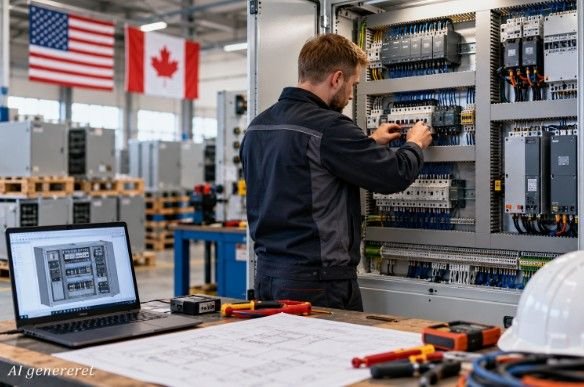
Getting your equipment approved for the North American market is entirely manageable, if you understand which requirements apply and where most European manufacturers run into problems. The biggest obstacles are rarely technical. They arise when there is a misunderstanding of what UL certification actually requires, and who is responsible for meeting those requirements.
CE marking is not enough in North America
One of the most costly misconceptions is the belief that CE marking automatically opens the door to the US and Canada. It does not. CE covers European directives, and the North American markets have their own, separate requirements under the UL standards.
In practice, a panel that is fully compliant for installation in Denmark may be rejected at a US inspection if it lacks the correct UL marking. For a European manufacturer, the goal is not to add an extra stamp to a finished product. The goal is to have the panel built by a certified panel builder from the start.
That is why the choice of panel builder is a key step towards market access. SystemTeknik builds UL panels for both the US and Canadian markets. Without that certification behind the panel, even a technically sound product is not sellable on the other side of the Atlantic.
UL 508A and UL 891 do not cover the same thing
Many European manufacturers treat UL as a single, unified thing. In reality, there are two standards relevant to electrical panels, and they cover very different situations.
UL 508A applies to industrial control panels, the standard you encounter when a panel controls machinery, automation or processes. UL 891 covers switchboards used for power distribution in an installation at low voltage up to 600 V. Put simply, a UL 508A panel controls something, while a UL 891 panel distributes power.
UL 508A is the more frequently required of the two, and it is often a direct contractual requirement when you export control systems to North America.
Before a panel can carry the UL 508A mark, it must meet specific requirements covering wiring and conductor sizing according to North American rules, clearance distances between live parts and other components, component placement and sound mounting practice, electrical safety testing with documented conformance, correct labelling with the required data, and complete electrical documentation for the finished solution. Choosing the wrong standard means building a panel certified for something other than its actual application. Always clarify the panel’s function before discussing certification.
UL certification cannot be self-declared
This is a widespread and expensive misconception. Several European manufacturers believe they can read the standards, adapt their production and then call their panel UL-certified. That is not how it works.
The UL mark can only be applied by a panel shop that participates in UL’s certification program and is subject to ongoing UL surveillance. A manufacturer without that certification can build a technically correct panel and still have no market access, because there is no certified party behind the product.
The mistakes that typically arise when trying to work around this requirement are predictable. Components are selected from European datasheets rather than UL-listed models. Labelling is done in Danish or is missing entirely. And documentation does not follow the format a US inspector expects.
The result is delayed deliveries and panels that need to be rebuilt.
Both Canada and the US require certification
Another assumption that often causes problems is the belief that a UL certification for the US automatically applies in Canada, or vice versa. That is not always the case.
Standards such as UL 508A and UL 891 can cover both markets, but the coverage must be stated explicitly in the certification itself. Check whether the certification covers the US only or both the US and Canada before you plan a sale that crosses the border between the two countries.
Documentation and labelling are not optional extras
Many export projects are delayed by the same mistake: the assumption that documentation and labelling can be sorted at the end. That is a costly assumption.
UL certification does not work that way. Documentation and labelling are an integrated part of the process and must accompany the panel as part of the finished delivery. If the paperwork is missing or the label is incorrect, an inspector will stop the installation regardless of how well the panel is built.
This is also why a complete delivery from a single certified source has a practical advantage. When design, production, documentation and labelling come from the same certified hand, all the parts fit together from the start. With more than 70 years of experience and certifications covering both ISO 9001 and ISO 14001, SystemTeknik delivers documentation and labelling as part of the finished panel.
