

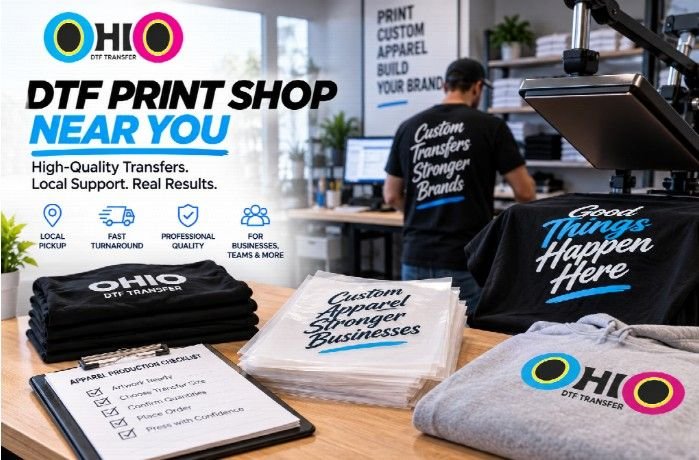
Finding a nearby DTF provider is easy to treat as a distance problem: search, compare locations, place an order. For an apparel business, however, the more useful test begins after the shop has been found. Can that provider fit into the way an actual job moves from approved artwork to a finished garment?
A print shop may be conveniently located and still create friction if artwork requirements are unclear, transfer formats do not match the job, or the ordering process adds unnecessary decisions. A better way to evaluate a DTF print shop near you is to trace one realistic production order from beginning to end and see whether the service supports each stage.
Start With the Job You Actually Need to Produce
Instead of comparing DTF shops in the abstract, define a real production scenario.
For example, imagine that you need 36 shirts with one full-front design, 12 hoodies with a larger version of the same artwork, and six staff shirts that also require a small left-chest logo. That single project immediately reveals more about what you need from a printer than a general list of features.
You now need to know whether the provider can handle multiple transfer sizes, separate artwork versions, different quantities, and a production schedule that keeps the pieces easy to identify when they reach your heat press.
The closer the ordering process matches the structure of the real job, the less reorganization you may need to do later.
Check How Artwork Moves Into Production
A DTF order begins with the file, so the artwork handoff should be easy to understand.
Before choosing a provider, determine how you will submit the artwork and what information needs to accompany it. A finished graphic may still require a defined width, quantity, placement purpose, or version name before it is production-ready.
If one logo will be used at several sizes, label the files or order details clearly. A left-chest version and a full-back version can look almost identical on screen while serving completely different roles during pressing.
A useful DTF print shop should fit a workflow where the approved artwork can move into the order without repeated guessing about which version belongs to which garment.
Match the Transfer Format to the Order Structure
Not every production run is best handled with the same ordering format.
Some jobs consist of a single design repeated at one size. Others contain many small graphics, several customer designs, or different placements. The way the transfers are ordered should reflect those differences.
For a straightforward job, individual transfers by size may keep quantities easy to track. For a project containing multiple designs, a gang sheet approach may make more sense depending on how the artwork is prepared and how the transfers will later be separated.
The important point is not to choose a format because it sounds familiar. Choose it because it reduces work between ordering and pressing.
Evaluate Turnaround in the Context of Your Press Schedule
A fast transfer order does not automatically create a fast finished apparel order.
Once the transfers are available, someone still has to organize the blanks, match designs to garments, press each placement, inspect the finished pieces, and prepare the order for the customer.
That means turnaround should be evaluated backward from the date the finished apparel is required.
If the shirts must be packed on Thursday evening, receiving the transfers late Thursday leaves almost no production buffer. A better schedule gives the press operator enough time to complete the remaining work without treating every delay as an emergency.
When comparing print shops, think about where transfer production sits inside your total workflow rather than looking at printing time alone.
Decide Whether Pickup or Shipping Fits the Job
Proximity can be valuable, but only when it supports the production plan.
A nearby shop may be useful when pickup fits naturally into the schedule. For another order, shipping may be simpler because no one needs to leave the production floor. The correct option depends on the deadline, order size, staff availability, and what still needs to happen after the transfers arrive.
This is why “near me” should not be interpreted only as physical distance. The practical question is how easily the provider connects to the rest of your workflow.
Use Repeatability as a Quality Test
The first order tells you whether a shop can produce transfers. A repeat order tells you whether the process can become dependable.
Keep records of the details that worked:
- approved artwork version
- transfer dimensions
- quantity by design
- intended garment and placement
- ordering format
- internal job name or reference
If the same customer returns a month later, those details should help you recreate the order without rebuilding it from memory.
This matters especially for apparel businesses handling recurring staff shirts, repeat customer logos, ongoing merchandise, or designs that remain active across several production runs.
Look Beyond the First Order
A useful DTF partner should support both simple orders and the possibility that your production needs become more complex.
A small order may later develop into several sizes, more artwork variations, or recurring batches. A print shop that fits the original order but becomes difficult to work with as the project grows may create unnecessary operational changes later.
Before committing to a provider for repeat work, consider whether the ordering options give you room to handle different quantities and artwork structures as your jobs change.
Choose the Shop That Creates the Cleanest Handoff
The most useful DTF print shop is not necessarily the one with the shortest distance from your business. It is the one that creates a clean handoff from your artwork to your press.
Take one real job and follow it through the entire process. Confirm how files are submitted, how transfer sizes are defined, which ordering format fits the artwork, how the transfers reach you, and how easily the same specifications can be used again.
Businesses and apparel decorators evaluating their options can review available DTF ordering formats through DTF Transfer Ohio and choose the approach that best fits the way their production is organized.
When those pieces fit together, searching for a DTF print shop near you becomes more than finding a nearby printer. It becomes a way to find a production partner that helps the job move cleanly from approved design to finished apparel.
