

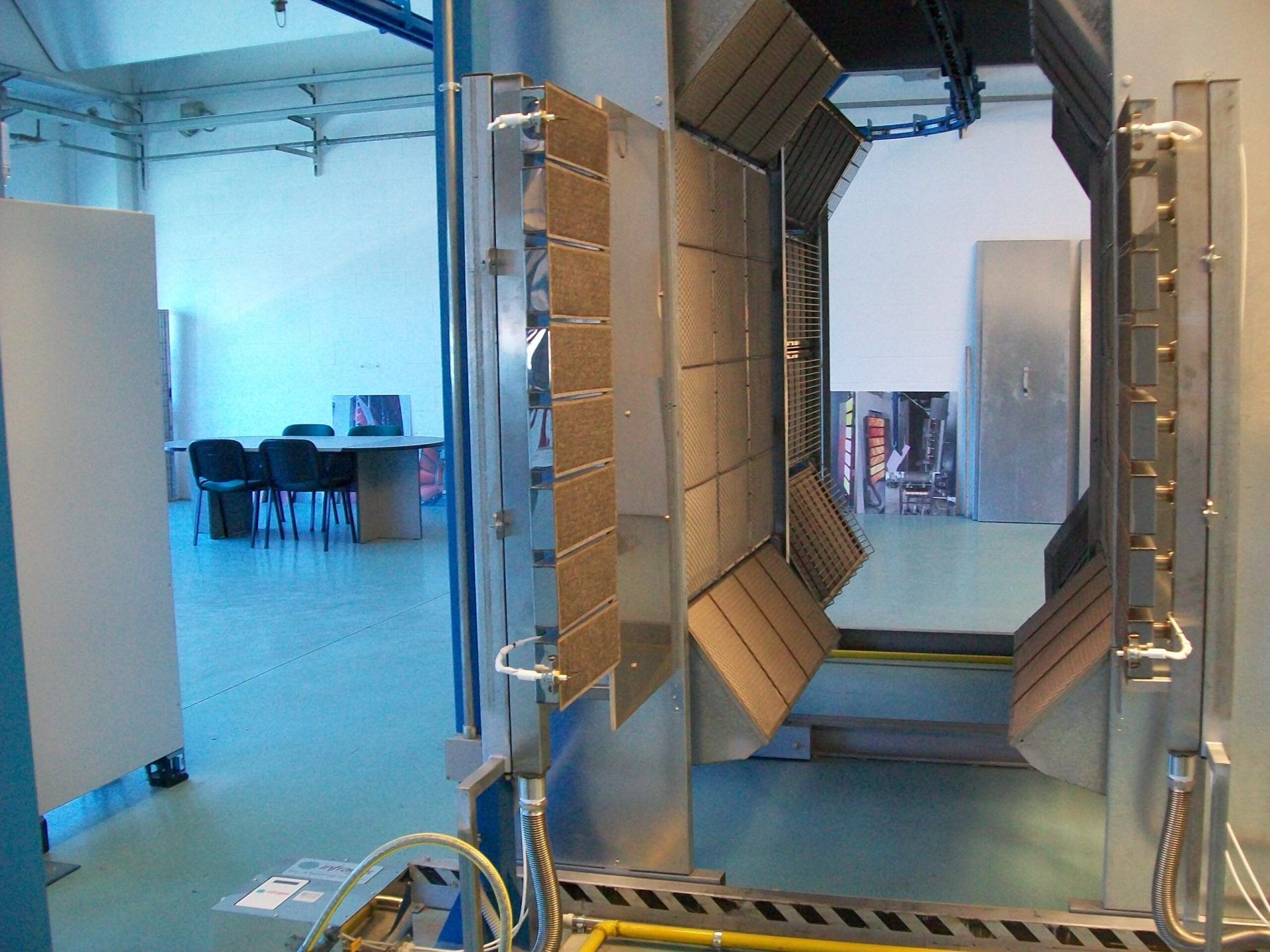
The acceleration of energy transition, pressure on industrial margins and the need for more compact production lines are transforming the way factories think about heat. In this scenario, industrial infrared heating panels are rapidly emerging as a strategic component for drying, curing, pre-heating and thermal conditioning processes, replacing or integrating traditional convective systems.
Per manufacturers, plant managers, process engineers and energy managers in small and medium-sized industries, understanding the real potential of infrared technology is no longer a niche topic. It has direct implications on energy efficiency, plant layout, product quality, time-to-market and, increasingly, on compliance with environmental and decarbonisation targets.
The evolution of industrial heating: from bulky ovens to compact infrared systems
Industrial heating has traditionally been dominated by large convective ovens and furnaces: robust, reliable, but space-consuming and often rigid in operation. For decades, rising fossil fuel costs were absorbed by margins, while energy efficiency remained a secondary design criterion compared to throughput and robustness.
Over the last 10–15 years, several converging trends have pushed companies to question these paradigms. According to analyses by the International Energy Agency, industry accounts for roughly a quarter of global final energy consumption, and a major share of this energy is used to generate process heat. At the same time, industrial electricity prices in many European countries have shown significant volatility, forcing companies to reconsider both the sources and the uses of energy within plants.
Within this context, infrared technology has moved from being perceived as a specialised solution for specific applications (such as paint curing or surface finishing) to a more versatile and modular option for a broader range of processes: drying of coatings and inks, pre-heating of metals and plastics, curing of composites, activation of adhesives, and controlled thermal conditioning before forming or assembly operations.
What distinguishes industrial infrared heating panels is their ability to deliver radiant energy directly to the product or material, substantially reducing the need to heat large volumes of air. This change of paradigm opens the path to more compact thermal systems, often integrated directly into production lines, replacing large, stand-alone ovens with modular, scalable heating stations.
How industrial infrared heating panels work and why they enable compact systems
Industrial infrared heating panels emit electromagnetic radiation in the infrared band, typically in the short-wave, medium-wave or long-wave spectrum. When properly matched to the absorption characteristics of the target material, this radiation is efficiently converted into heat directly within the product, rather than primarily heating the surrounding air.
Several physical and engineering features contribute to system compactness and process efficiency:
- Direct energy transfer: radiant heat is transferred directly to the product surface, reducing dispersion and enabling shorter heating paths.
- High power density: panels can deliver significant thermal power per surface unit, allowing shorter ovens or heating zones.
- Fast response time: many infrared systems reach operating temperature rapidly, minimising start-up times and enabling on-demand heating.
- Directional control: radiation can be focused where needed, reducing unnecessary heating of surrounding components.
In practical terms, this translates into more compact thermal sections along production lines. Instead of a single, large convective oven occupying tens of metres, a series of infrared modules can be integrated upstream or downstream of other processing stations, or even embedded within multi-step machines. This modularity is particularly relevant for small and medium-sized enterprises, which often operate in space-constrained facilities and require flexible layouts to adapt to changing product mixes.
Market data, energy trends and industrial adoption
Although precise global data on infrared process heating are fragmented, several trends are clear. According to recent analyses on industrial energy efficiency, process heating and cooling account for a substantial share of energy use in sectors such as chemicals, food and beverage, automotive, metalworking and manufacturing of construction materials. Within this macro-area, technologies able to reduce energy intensity per unit of output are a central focus of investment.
A report by the International Energy Agency highlighted that in advanced economies, improvements in industrial energy intensity over the last decade have been increasingly linked to technology upgrades in process equipment, including more efficient heating systems. Infrared technology is cited among the emerging options, especially where low and medium temperature processes (up to a few hundred degrees Celsius) are involved.
At European level, industrial companies are also responding to regulatory drivers. The tightening of emissions criteria and the growing emphasis on electrification of heat, often combined with on-site renewable electricity or high-efficiency cogeneration, have drawn attention to electric infrared systems as part of decarbonisation strategies. In several manufacturing sectors, companies report reductions in specific energy consumption per unit of product after retrofitting conventional ovens with targeted infrared modules in key process steps.
Industry surveys performed by sectoral associations show a growing adoption of infrared solutions in applications such as paint curing for automotive and metal components, powder coating, drying of coatings in packaging and printing, and thermal treatment of composite parts. In many of these cases, companies report both energy savings and qualitative improvements (more uniform curing, reduced defects, shorter cycle times), which in turn justify the capital investment.
From a geographical perspective, adoption is more advanced in sectors operating under strong cost and quality pressure: automotive suppliers, high-value metal processing, advanced materials, and high-throughput packaging. However, smaller manufacturers are progressively discovering the technology thanks to the availability of standardised panel systems that can be integrated without redesigning entire lines.
From drying to pre-heating: key applications across industries
One of the strengths of industrial infrared heating panels lies in their versatility across sectors and production phases. The same fundamental technology can support different objectives, depending on material, temperature range and line configuration.
Drying of coatings, paints and inks
Drying and curing of surface layers are among the most established applications. In automotive and metal finishing, infrared panels are used to accelerate the curing of paints and powder coatings, often in combination with convective airflows to optimise both surface and in-depth drying. In the printing and packaging industry, IR systems are used to dry inks and varnishes on paper, cardboard, plastics and flexible films, reducing the length of dryers and improving register stability by limiting substrate deformation.
Infrared radiation is particularly effective when the target layer absorbs efficiently at the emission wavelength. This enables rapid drying, lower air temperatures and reduced risk of surface skinning (when the outer layer dries too quickly, trapping solvents or moisture underneath). As a result, lines can be operated at higher speeds or with more compact drying sections, improving productivity per square metre of factory space.
Pre-heating of metals and plastics
Pre-heating is another area where infrared technology has a strong impact. Before forming, bending, coating or assembling, many metallic and plastic components must be brought to a specific temperature range. Traditional solutions rely on large furnaces, long conveyor ovens or hot air tunnels.
Infrared panels make it possible to establish localised, rapid and controllable pre-heating zones. For example, metal sheets or profiles can be heated just before forming or roll-coating, reducing thermal inertia and start-up wastes. Plastic parts, particularly those with thin walls or complex geometries, can be pre-heated selectively to facilitate forming or joining operations, with less risk of overheating surrounding areas.
In continuous processes, this often translates into shorter lines and fewer handling steps. In batch processes, infrared pre-heating can be integrated directly into workcells, limiting the need to move parts in and out of separate ovens and simplifying logistics.
Curing of composites and advanced materials
In sectors such as aerospace, wind energy, sporting goods and high-performance automotive, composite materials require carefully controlled thermal cycles for curing resins or adhesives. While autoclaves and large ovens remain standard for many parts, infrared panels are increasingly used for local curing, repairs, prototyping and lower-volume production.
The ability to fine-tune power and distribution of radiation over complex shapes enables targeted heating of specific zones, reducing the need for large enclosures. This is particularly valuable for large components, where curing the entire volume in an oven would be energetically inefficient and logistically complex.
Other emerging uses
Apart from these established applications, industrial infrared heating panels are appearing in processes such as activation of hot-melt adhesives, shrink-wrapping and thermoforming of packaging, pre-heating of cables and profiles before insulation, and controlled moisture removal in food processing lines (within the limits allowed by food safety and quality requirements). Each of these use cases benefits from the same core properties: compactness, responsiveness, controlled energy delivery and integration into existing layouts.
Design implications: towards more compact and flexible production lines
The integration of infrared heating changes not only energy efficiency, but the very architecture of thermal systems and production lines. Several design implications deserve attention from engineers and plant managers.
First, system compactness: by reducing the length of heating paths and enabling higher power densities, it becomes possible to shorten or even eliminate large oven sections. This frees up floor space for additional processes, storage or logistics, and may allow plant expansions without relocating or acquiring new premises.
Second, modularity: industrial infrared heating panels can be installed as clusters or arrays, each controlled individually or in groups. This modular approach supports phased investments—adding panels as production grows or as more thermal steps are converted from conventional to infrared heating. It also facilitates maintenance and upgrades, since modules can be isolated without shutting down entire lines.
Third, process flexibility: with appropriate control systems, infrared panels can adjust power almost in real time in response to line speed, product type, thickness or colour. This is particularly relevant in multi-product environments where the same line must handle different SKUs with varying thermal requirements. Instead of dimensioning ovens for worst-case scenarios, the system can dynamically adapt, improving both energy use and product quality.
Fourth, integration with digitalisation: modern infrared systems can be easily coupled with sensors, PLCs and supervisory systems. Infrared temperature measurement, line cameras and power metering enable closed-loop control of heating profiles, statistical process control and traceability of thermal histories for quality assurance and regulatory compliance.
Risks and challenges when adopting infrared heating solutions
Despite the advantages, the transition from traditional ovens to infrared-based systems is not trivial. Several technical and organisational risks must be carefully managed to avoid disappointing results.
One of the main challenges lies in matching the spectrum of the infrared source to the absorption characteristics of the material and coatings involved. An inappropriate choice of wavelength can lead to insufficient penetration, overheating of the surface or non-uniform temperature distributions. This risk is particularly relevant for multilayer systems or materials with strongly varying emissivity and absorption coefficients.
Another critical aspect is process integration. Installing infrared panels in isolation, without rethinking upstream and downstream operations, may generate bottlenecks or quality issues. For instance, if line speed is increased thanks to faster drying but inspection or packaging stages remain unchanged, the net productivity gain may be limited. Similarly, inadequate control of ventilation and exhaust systems can compromise the stability of temperature and atmosphere around the product.
Thermal safety and worker protection also require attention. Although infrared panels can be designed with appropriate shielding and distance from operators, the presence of high radiant fluxes imposes design measures to avoid the risk of burns, glare or overheating of adjacent equipment. Appropriate standards and norms, as well as proper training, are crucial.
On the organisational side, there is the risk of underestimating the need for process characterisation. Transitioning to infrared often necessitates trials, measurement campaigns and fine-tuning of parameters (distance, angle, power, exposure time). Companies that approach the change only as an equipment replacement, without dedicating resources to process engineering, may not achieve the expected savings or quality improvements.
Finally, financial evaluation must be realistic. While many case studies show substantial reductions in specific energy consumption and cycle times, the return on investment depends on factors such as utilisation rate, energy prices, maintenance costs and potential qualitative benefits (fewer defects, reduced rework). A careful total-cost-of-ownership analysis is necessary, rather than relying solely on nominal efficiency figures.
Opportunities and strategic advantages for SMEs
For small and medium-sized enterprises, the adoption of industrial infrared heating panels can become a lever for competitiveness on several fronts, provided that the technology is integrated into a broader process and business strategy.
From an operational standpoint, energy efficiency is often the most immediate benefit. By targeting heat where it is needed and reducing losses, infrared systems can cut energy consumption per unit of product. In contexts where energy expenditures account for a significant portion of production costs, even single-digit percentage reductions can have a visible impact on margins.
Product quality is another major area of opportunity. More precise control of heating profiles helps to avoid defects such as blistering, incomplete curing, colour variations, warping or residual stresses. In sectors where customer requirements are stringent, being able to demonstrate stable and traceable thermal processes can become a differentiating element in commercial negotiations.
Time-to-market and production agility also benefit. Infrared systems typically require shorter warm-up periods than large conventional ovens, which allows more frequent start-stop cycles without excessive energy penalties. This is particularly important in environments with frequent product changeovers or where production volumes are variable and demand-driven.
From a strategic viewpoint, investment in more compact and efficient thermal systems supports long-term positioning in terms of sustainability. As supply chains increasingly require information about the carbon footprint of products, being able to document lower energy intensity and the use of efficient heating technology can become part of the company’s environmental and social governance narrative.
Moreover, plant-level flexibility gained through modular infrared systems can ease future technological transitions. For example, the electrification of heat through infrared makes it easier to integrate on-site renewable power, energy storage or advanced energy management systems, reducing exposure to fossil fuel price volatility and potential regulatory constraints.
Regulatory and policy framework: energy efficiency and decarbonisation
Industrial infrared heating panels are not directly subject to a specific, stand-alone regulation in most jurisdictions, but they are affected by a broader set of energy and environmental policies that shape investment decisions.
In many advanced economies, regulations and guidelines on energy audits for large enterprises and, increasingly, for smaller companies, encourage the identification of cost-effective energy efficiency measures, including improvements in process heating. Infrared solutions often emerge among the recommended options where technical feasibility is confirmed.
Policies aimed at reducing greenhouse gas emissions—such as emission trading schemes, carbon taxes or voluntary carbon accounting frameworks—indirectly increase the attractiveness of technologies that reduce specific energy consumption or facilitate electrification. Infrared panels, when powered by low-carbon electricity, can help lower the overall emissions intensity of production processes.
Technical standards on machinery safety, electromagnetic compatibility and worker protection provide the framework within which infrared systems must be designed and installed. Compliance with norms covering surface temperatures, accessible hot parts, visibility of radiant sources and maximum permissible exposure to infrared radiation is essential to ensure safe operation.
Support schemes for energy-efficient equipment, such as tax incentives, accelerated depreciation or grants for process optimisation and digitalisation, can further improve the business case for retrofitting or implementing infrared-based solutions. Companies considering such investments should examine whether their projects align with the eligibility criteria often linked to measurable energy savings and clear documentation of performance.
Practical guidelines for integrating infrared panels into industrial processes
Adopting infrared heating technology requires a structured approach that combines technical, economic and organisational considerations. There are several practical guidelines that can help companies, particularly SMEs, manage this transition effectively.
First, start from the process, not from the equipment. A detailed mapping of current heating steps, energy consumption, cycle times and quality issues is essential. This includes measuring actual energy use of ovens and dryers, characterising temperature profiles and identifying bottlenecks or over-dimensioned systems. Infrared panels should then be evaluated as a means to optimise specific steps, rather than as a generic replacement for existing equipment.
Second, perform laboratory or pilot tests. Before full-scale implementation, it is advisable to conduct trials on representative materials and products, using infrared sources similar to those envisaged for the final installation. These tests allow adjustment of wavelength selection, intensity, distance and exposure time, and help to identify any potential issues related to material behaviour, adhesion, colour, deformation or surface finish.
Third, involve all relevant stakeholders early. Process engineers, maintenance personnel, quality managers, safety officers and operators will all be affected by the change. Their input is crucial for designing efficient and acceptable solutions, from layout and ergonomics to maintenance access and control interfaces.
Fourth, ensure robust control and monitoring. Infrared heating benefits greatly from precise regulation of power and integration with sensors (temperature, line speed, material identification). Designing the control system to log relevant process parameters also facilitates continuous improvement, troubleshooting and documentation for customers or regulators.
Fifth, plan training and change management. Operators and maintenance teams must understand the specific characteristics of infrared systems: fast response, sensitivity to surface conditions, importance of cleanliness of panels and reflectors, and potential safety precautions. Well-designed training reduces the risk of misuse, unplanned downtime or premature wear.
Finally, evaluate the project through a life-cycle lens. Beyond initial investment costs, consider energy savings, productivity gains, reduction of rejects, maintenance needs and potential impacts on product quality and customer satisfaction. Scenarios that combine rising energy prices, stricter regulations and competitive pressure often highlight the strategic value of transitioning to compact and efficient infrared-based thermal systems.
FAQ on industrial infrared heating panels
Are industrial infrared heating panels always more efficient than conventional ovens?
Infrared panels are often more efficient at delivering heat directly to the product, especially for surface-dominated processes such as drying and curing. However, overall efficiency depends on proper design: matching wavelength to material properties, optimising panel placement and ensuring good control. In some deep-heating or very high-temperature applications, other solutions may remain more suitable. A case-by-case technical evaluation is essential.
Can existing production lines be retrofitted with infrared panels without major redesign?
In many cases, yes. Infrared modules can be integrated upstream of, downstream of or even inside existing ovens to boost performance or reduce cycle times. Nevertheless, space constraints, safety requirements and airflow management must be assessed. For substantial process changes, partial reconfiguration of the line may be needed to fully exploit the benefits of the new heating technology.
How do infrared systems affect product quality and consistency?
When properly engineered, infrared solutions can improve uniformity and controllability of heating, reducing defects such as incomplete curing, warping or colour deviations. However, because infrared heating can be very fast and localised, poor configuration may lead to hot spots or uneven treatment. Quality outcomes depend strongly on process design, testing and control strategies.
Conclusion: rethinking industrial heat in the era of compact, efficient systems
The convergence of energy, regulatory and competitive pressures is pushing industrial companies to rethink how heat is generated, delivered and controlled within their processes. From drying to pre-heating, industrial infrared heating panels offer a powerful tool to make thermal systems more compact, responsive and efficient, integrating seamlessly into modern, flexible production lines.
For small and medium-sized enterprises, the opportunity goes beyond simple energy savings. Properly designed infrared solutions can free up valuable plant space, accelerate production, enhance product quality and support a credible path towards decarbonisation and technological modernisation. The key lies in treating infrared not as a plug-and-play gadget, but as an integral component of process engineering and strategic planning.
Companies that wish to explore this path should begin by analysing their existing thermal processes, engaging technical and operational teams, and considering pilot projects to validate both performance and economic returns. From there, a structured roadmap can guide progressive integration of infrared panels into critical process steps, turning compact, efficient heating into a lasting competitive advantage.
