

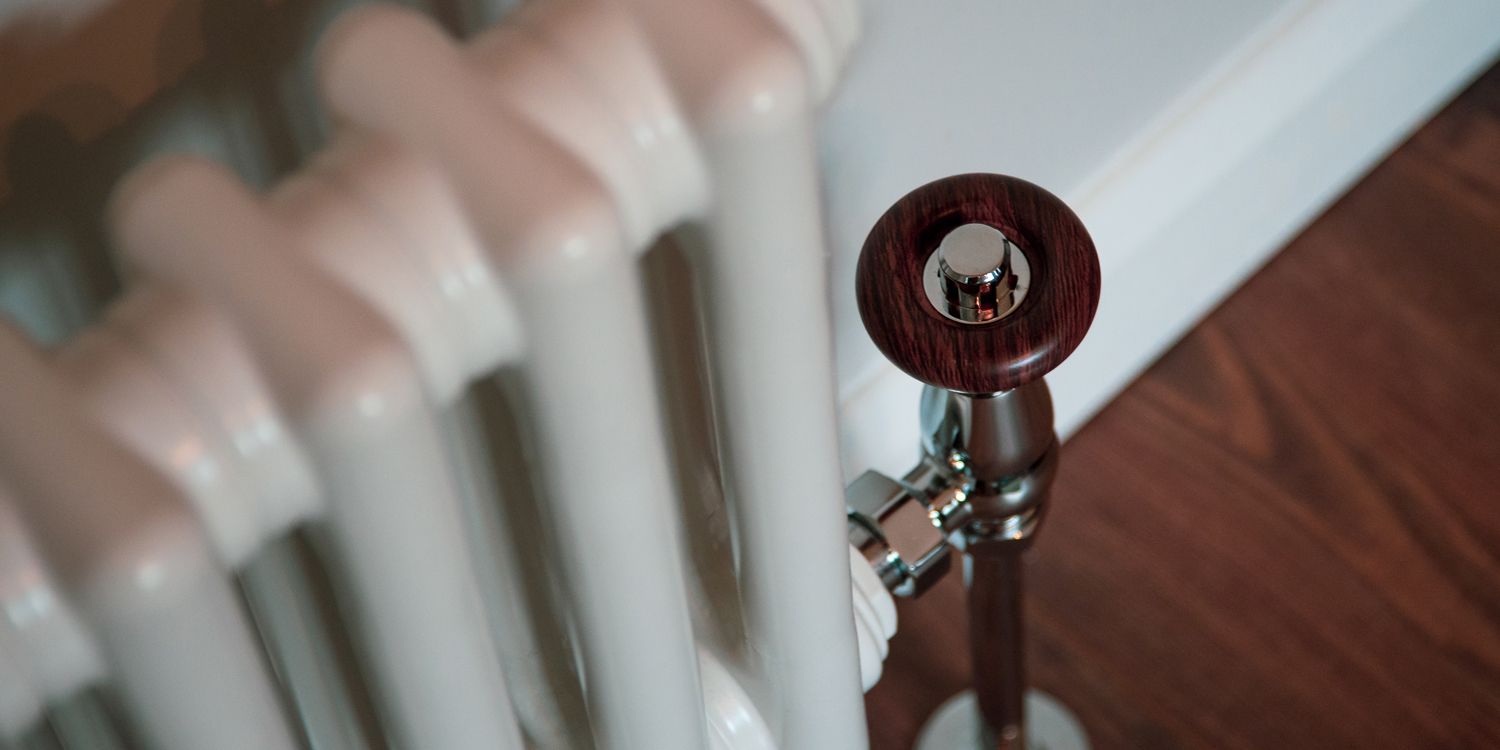
You know how the radiator looks simple, but the comfort (and the headaches) usually come down to the last 200mm of pipework?
In UK homes, getting traditional radiator UK right is what stops a beautiful column radiator from either roasting the room or never quite getting warm.
This guide covers the valve types, styles, finishes, and fitting basics for traditional column radiators. It also flags the practical extras that make an install look intentional, like pipe sleeves, wall ties and wall stays, plus a straightforward buying checklist using ranges you’ll see from Planet Radiators and retailers like Radiator Valves 4u.
Read on.
Key Takeaways
- Choose TRVs for room-by-room automatic temperature control, and manual valves for simple on-off or a fixed “set and leave” flow.
- Select valve orientation to match pipework: straight 29 models, angled 177, corner 92, 298 total options.
- Retailers like Planet Radiators list discounted models (e.g. Flatford £69, Jarrow £47.75) with price-match, 90-day returns and two-to-six-year warranties.
- Fit valves with the right tails/adapters, seal the radiator tail properly, balance with a lockshield, then finish with pipe sleeves and solid wall stays for a neat, secure traditional look.
Types of traditional radiator valves UK for traditional column radiators
Most radiators in the UK use two valves: one to control the flow in, and one to balance the return. That pairing is the difference between “all rads on full” and a system that heats evenly.
You can run a traditional column radiator on manual valves, or upgrade to thermostatic radiator valves (TRVs) for automatic temperature control. A BEAMA householder factsheet explains that control rules introduced for boiler replacements in existing homes (June 2022 in England and November 2022 in Wales) made TRVs a common, practical route to room-by-room control.
- Manual wheelhead + lockshield: Simple, traditional, and ideal where you do not need automatic room temperature control.
- TRV + lockshield: Set a temperature for the room and let the valve modulate flow as the room warms and cools.
- Specialist sets: Twin entry (H-block) valves tidy up pipework where both pipes rise together, often used with modern column radiators.
What are manual valves and how do they work?
A manual valve lets you control the water flow to each radiator. You turn a spindle or handwheel to open or close the flow, and you set heat by feel.
For traditional homes, the style matters as much as the function. Many period ranges lean into that look, from ornate RUFFORD styles to industrial WINKWORTH looks, and a traditional radiator valve with crosshead UK is a classic choice for Victorian and Edwardian rooms.
On sizing, most UK valve sets are sold as 15mm compression on the pipe side with a 1/2 inch BSP radiator connection, which is widely listed on UK valve specifications. If you are dealing with older or larger pipework, you may also come across 22mm options and 3/4 inch radiator bushes, so check before you order.
Winkworth Traditional Manual Angled Chrome Radiator Valves, T-MAN-064-AG-C-CU00, cost £21.95, RRP £40.46, a 42% saving.
Match the valve style to the radiator, then match the connections to your pipework, in that order.
You can buy angled manual valves for column radiator valves UK, and pair them with a lockshield and pipe sleeve for a neat finish. Winkworth Traditional Manual Angled Unlacquered Brass, T-MAN-064-AG-UB-CU00, is £26.95, RRP £47.14, 44% off, and the matching Winkworth Traditional Manual Angled Antique Brass sleeve is £50.87, 32% off.
One practical fitting point that saves a lot of leaks: the seal is different on each end. Use PTFE on the radiator tail thread that screws into the radiator, but do not rely on PTFE on compression joint threads because the olive is what makes the seal, as noted in UK plumbing training guidance and installer advice.
Warranties run to 6 years on Winkworth and Buckland models, and bulk buy discounts range from 4% for two, up to 15% for ten, so you can save on the best valves for traditional radiators UK when you’re doing a full house.
How do thermostatic radiator valves (TRVs) control temperature?
A TRV controls temperature using a thermostatic head that senses the air around it. As the room warms, the sensor expands and pushes a pin in the valve body to reduce flow, then opens again as the room cools.
TRVs work on each radiator, so they give room-by-room control in homes using different column radiator valve types UK. Many TRVs sold in the UK are listed as compliant with EN 215, which is the common performance standard for thermostatic radiator valves.
Flatford Traditional TRV Angled Chrome costs £69.00, down from £121.90, a 46% saving. Jarrow Traditional TRV Angled Brushed Satin Nickel is £47.75, RRP £88.80, 43% off. Flatford Traditional TRV Corner White is £69.00, RRP £123.84, 46% off.
Alfriston Traditional TRV Angled Antique Brass with sleeves is £115.98, RRP £171.48, 52% off. Jarrow Traditional TRV Corner Brass comes from Radiator Valves 4u. Models offer 2, 3, and 6 year warranties.
- Keep the head “breathing”: A local authority Danfoss TRV information leaflet warns that curtains or obstructions around the sensor can stop the TRV regulating properly.
- Use the frost setting, not fully off: Many heads include a frost-protection position intended to prevent pipes freezing in cold snaps.
- Set and wait: TRVs respond to room temperature, so you get better results by adjusting in small steps and letting the room stabilise.
You can choose finishes like Antique Brass, Brushed Satin Nickel, and Chrome, or go for a black radiator valve UK to suit a darker scheme. If you want the most traditional “period control” look, the crosshead style is still the go-to in many Victorian-style refurbishments.
Choosing the Right Valve Style
Start with pipework direction and clearance, then choose the control type. That sequence prevents the common mistake of buying a gorgeous valve set that simply does not line up with your pipes.
For a traditional radiator valve Victorian house UK install, think about what will sit around the valve (skirting boards, boxed-in pipes, curtains, and furniture), because those details decide whether you need angled, corner, or a specialist layout.
- Confirm your sizes before you order: 15mm pipe is common, but microbore systems can need reducers, and some older installs use 22mm or larger radiator bushes.
- Decide where you want control: TRVs suit bedrooms, home offices, and guest rooms where you want steady comfort without constant fiddling.
- Plan your “neat finish” parts: Pipe sleeves and cover plates can hide copper pipework and make the valve look built-in.
- Consider twin entry (H-block) valves: If both pipes rise from the floor close together, a twin entry body can keep the layout symmetrical and reduce visible pipework.
Use the right tools for the job. A decent adjustable spanner, a radiator bleed key, and a proper radiator tail key or internal spanner (for removing old tails) are the items that tend to make a DIY install feel controlled rather than stressful.
What are the differences between straight, angled, and corner valves?
Choose valve orientation to match pipe layout. In most UK retrofits, angled valves are the default because pipework often approaches from the wall or skirting line, but your room layout and pipe route should make the decision for you.
| Valve Type | Description | Best for | Models Available | Example Products and Prices | Notes |
| Straight | Valves that align with inline pipework. They let water enter directly. They fit horizontal or vertical runs into the radiator. | Pipework that rises straight from the floor and meets the radiator without needing a turn. | 29 models | Often paired with manual valves or TRVs for simple installs. | Compact fitting. Best for clean, linear pipe routes. |
| Angled | Valves that turn flow by 90 degrees. They attach where pipework approaches the radiator from the wall. They suit most UK installations. | Wallside connections and typical central heating layouts. | 177 models | Jarrow Traditional TRV Angled Antique Brass, £47.75, 46% off. | Most common choice. Broad range for thermostatic and manual control. |
| Corner | Valves made for right angle approaches. They fit tight corners and boxed pipe runs. They keep a neat finish where space is limited. | Installations where pipes meet the radiator at right angles. Useful where you are prioritising appearance in a tight spot. | 92 models | Jarrow TRV Corner Antique Brass, £39.91, 57% off; Flatford TRV Corner Pewter with Sleeves (T-TRV-020-CR-PEW-PIP), £86.92, RRP £147.36, 60.44% off; Flatford TRV Corner Chrome (T-TRV-020-CR-C), £69.00, RRP £123.84, 54.84% off; Jarrow TRV Corner Brushed Satin Nickel (T-TRV-069-CR-SN-CU00), £39.91, RRP £94.80, 57% off, 3-year warranty. | Often chosen for aesthetics. If you can route pipework cleanly, angled valves usually give you more choice. |
| Valve Control Types | Manual valves use a spindle and need manual adjustment. Thermostatic radiator valves, TRVs, sense room temperature and modulate flow. | Manual for fixed settings. TRVs for room-by-room temperature control. | Applies across straight, angled and corner orientations. | TRVs available in the listed product examples above. | TRVs add control, and they work best when the sensor is not boxed in by curtains or furniture. |
| Materials and Finishes | Brass, chrome, pewter and brushed satin nickel are common. Finishes match traditional column radiators for a period look. | Choice depends on decor and how “hands-on” you are with the valves. | Multiple finish options across the 298 total orientation models. | Antique brass, chrome, pewter, brushed satin nickel examples shown above. | Select a finish that complements the radiator and pipework. |
| Installation Tools and Concepts | Use a radiator key, adjustable spanner and the correct sealing method for each joint. Account for pipe alignment before fitting. Test for leaks after commissioning. | Essential for DIY and plumber installs. | Not model specific. | Pair TRVs with correct tails and adapters for a clean fit. | Match valve orientation to pipe approach, then fit the valve type that suits the room layout. |
What materials and finishes are available for traditional radiator valves?
You can pick from many finishes, Anthracite (62), Antiqued (114), Black (45), Brass (81), Brushed (118), Chrome (32), Copper (27), Grey (96), Nickel (69), Pewter (35), Polished (41), Satin Nickel (34) and White (8).
Unlacquered brass appears in variants such as Winkworth Manual Angled Unlacquered Brass, code T-MAN-064-AG-UB-CU00, priced £26.95, 42% off. Jarrow offers a TRV Angled Brushed Satin Nickel, T-TRV-068-AG-SN-CU00, at £47.75, 46% off.
Antique Brass and Antique Copper remain popular; Jarrow TRV Angled Antique Brass costs £47.75, 51% off, and Jarrow TRV Angled Antique Copper costs £42.76, 38% off. Flatford Traditional TRV Angled Brushed Brass shows a 47% reduction from its MSRP.
Several textured White and Textured Black options exist, for example Jarrow TRV Corner Textured Black, T-TRV-069-CR-TB-CU00, at £39.91, 57% off.
- Unlacquered brass: Many suppliers describe it as a “living” finish that naturally darkens and develops patina over time, which suits older properties where you want the metalwork to age in.
- PVD finishes: Some modern “brushed brass” valve sets use a PVD finish that retailers claim is designed to resist wear from years of handling, useful in busy family spaces.
- Powder-coated blacks and anthracites: A good match if you are pairing modern shades with traditional forms, especially if you want a black radiator valve UK that visually disappears against darker pipework.
If you fit a traditional radiator valve in a Victorian house UK, use matching pipe sleeves to hide copper piping, and add wall ties or wall stays for secure installation.
How do you install valves on a traditional column radiator?
Fit valves before you place the radiator, if your layout allows it. It is easier to seal tails and align pipework when you can still move the radiator slightly.
For heavier column and cast iron styles, prioritise support. An installation guide for multi-column radiators notes that the number of wall ties and feet typically increases with radiator length, and forcing threaded bushes can lead to leaks, so take your time lining everything up.
| Quick check | What you are confirming | Why it matters |
| Pipe size | Usually 15mm, sometimes 10mm microbore or 22mm | Determines whether you need reducers or a different valve inlet |
| Radiator connection | Commonly 1/2 inch BSP, with some older radiators using 3/4 inch bushes | Decides which tail or adaptor you need, and prevents cross-threading |
| Valve orientation | Straight, angled, or corner | Keeps pipework neat and avoids strain on compression joints |
- Shut the system down and let everything cool. Drain the radiator, then fit a compression inlet to suit 15mm or 22mm pipe.
- Seal the radiator tail thread that screws into the radiator using PTFE tape, then tighten the tail firmly. Do not use PTFE as a “fix” on compression nut threads because the olive makes the seal on that joint.
- Fit the main valve and a lockshield valve on the opposite tail to allow flow control and balancing. If you are replacing old valves, swap the tails too, because the new valve set will often include matching tails.
- Use the Jarrow TRV Corner Antique Brass with Sleeves (T-TRV-069-CR-AB-PIP-CU00) or similar TRV, fit the supplied sleeve over the copper pipe, then connect the TRV to control room temperature.
- Secure floor-standing cast iron radiators with matching wall stays, drill and fix to the wall and floor. This prevents strain on the valve joints and keeps the installation safe.
- Conceal exposed copper with 130mm pipe covers for a neat finish. Cut covers to length, slide them over pipes before final valve tightening for a tidy Victorian look.
- Pressure-test and check for weeps at compression joints. Bleed the radiator using a bleed key to remove trapped air, then warm the system back up and re-check joints once the metal expands.
- Balance the system with the lockshield valves so heat distributes evenly, especially if radiators closer to the boiler heat faster than the rest.
Conclusion
Pick a TRV for room control or a hand valve for simple shut-off, and keep a lockshield on the other side so you can balance the system.
Match finishes and order pipe sleeves, wall ties and wall stays for a neat fit. Radiator Valves 4u backs purchases with price match and a 90-day return policy, which adds peace of mind.
Choose traditional radiator valves UK that suit your traditional radiator valve Victorian house UK style, then you will get steadier heat without compromising the period look.
FAQs
1. What valves does a traditional column radiator need?
A typical setup uses two valves, a control valve and a flow control valve, plus an air vent. The control valve can be manual or thermostatic, the flow control valve balances the return.
2. Which valve suits a Victorian house in the UK?
Choose valves that match the period look, in brass or chrome, while keeping modern function. A thermostatic style in a classic finish works well for a traditional radiator valve in a Victorian house, UK.
3. Do I need a thermostatic valve or a manual valve?
A thermostatic valve saves energy and keeps rooms steady, so it is a smart choice for living spaces. Use a manual valve where you want simple on/off control or where a thermostat controls the whole zone.
4. What size and fitting type should I pick?
Most radiators use 1/2 inch BSP pipe, and you pick angled or straight valves to match the pipe run. Fit the valves correctly and have a qualified plumber check the work.
