



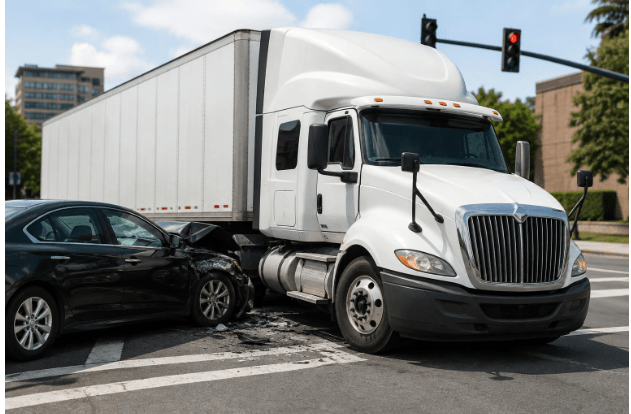
A collision involving a commercial truck can leave victims dealing with much more than vehicle damage. The size, weight, turning radius, and limited visibility of a tractor-trailer can make an intersection crash especially serious. A person in a passenger vehicle may have only seconds to react when a large truck begins crossing the roadway or swings through an intersection. The legal question is not always as simple as asking who had the green light. Investigators may need to examine traffic signals, lane positioning, visibility, speed, driver attention, road conditions, vehicle data, witness statements, and the truck’s operating records. In some cases, responsibility may extend beyond the person behind the wheel. That is why understanding how these crashes are investigated can make a meaningful difference when deciding what evidence to preserve and what questions to ask about a potential injury claim.
Why Left-Turn Truck Crashes Can Become Complicated
A commercial truck does not maneuver through an intersection like a passenger car. A tractor-trailer may need substantially more space to complete a turn, and the trailer can follow a different path from the tractor. This creates situations in which a vehicle, pedestrian, bicycle, or another road user may be placed in danger during the maneuver. Left turns can also involve several competing movements at the same intersection. A truck may be crossing opposing traffic, entering another roadway, changing lanes after the turn, or making a wide maneuver because of the trailer’s dimensions.
Research into left-turn conflicts involving heavy trucks and light vehicles has examined thousands of real-world left-turn-across-path scenarios, showing why the interaction between vehicle type, speed, position, and driver decisions deserves careful examination. A crash report may identify a basic traffic violation, but that does not necessarily answer every question about civil liability. A thorough investigation can look at what happened immediately before impact and whether another factor contributed to the collision.
The Most Common Factors Behind Serious Turning Collisions
Left-turn crashes can develop from several different circumstances. Sometimes the problem is a driver’s failure to yield. In other cases, fatigue, distraction, excessive speed, poor visibility, an unsafe route, or a mechanical problem may play a role.
Common contributing factors include:
- Failure to yield to approaching traffic.
- Misjudging the available gap before entering an intersection.
- Excessive speed for the turn or road conditions.
- Distracted or inattentive driving.
- Driver fatigue or violations involving hours-of-service requirements.
- Improper lane positioning.
- Inadequate observation of blind areas.
- Poorly planned routes or unsafe turning locations.
- Improperly maintained brakes, tires, lights, or steering components.
- Incorrectly loaded or secured cargo.
The circumstances surrounding each collision matter. A driver who had a green signal does not automatically have immunity from responsibility if other evidence shows that the maneuver was made negligently or without reasonable care.
How Fault Is Determined After the Collision
Determining fault usually requires more than looking at the final resting positions of the vehicles. Investigators may reconstruct the sequence of events using physical evidence, photographs, traffic-camera footage, electronic records, witness accounts, and accident reconstruction techniques. State negligence laws generally provide the foundation for determining civil liability, while federal and state trucking rules may provide additional evidence about whether a commercial driver or carrier followed required safety standards.
The investigation may consider questions such as where each vehicle was positioned, which signal was operating, how quickly the vehicles were traveling, whether the truck had enough space to complete the maneuver, and whether the driver could reasonably have detected the other road user. This distinction is important because an insurance company’s initial assessment is not necessarily the final determination of legal responsibility.
Evidence That Can Strengthen a Truck Accident Claim
Evidence can disappear quickly after a commercial vehicle collision. Traffic-camera recordings may be overwritten, vehicles can be repaired or moved, and witnesses may become difficult to locate. A careful investigation can therefore focus on preserving information before it becomes unavailable.
Potential evidence may include:
- Police reports and citations.
- Photographs and videos from the accident scene.
- Traffic-light and intersection-camera recordings.
- Dashcam or surveillance footage.
- Eyewitness statements.
- Vehicle inspection records.
- Electronic logging and driving records.
- Electronic data recorder information when available.
- Driver qualification and employment records.
- Maintenance and repair documents.
- Cargo loading and securement records.
- Cellphone or distraction-related records where legally obtainable.
- Medical records documenting crash-related injuries.
The importance of truck-specific evidence is one area where these cases differ from ordinary passenger-vehicle collisions. Competitor legal resources also identify driver logs, electronic data, cellphone records, eyewitness testimony, and expert evidence as potentially important sources.
Who May Be Responsible for the Crash
The truck driver is not necessarily the only party whose conduct should be examined. Depending on the facts and applicable state law, several parties may potentially share responsibility. A trucking company could face liability if its own conduct contributed to the collision. Examples may include inadequate supervision, improper hiring practices, or other failures connected with the driver’s operation.
A vehicle owner, maintenance provider, cargo loader, manufacturer, or parts supplier may also become relevant when a mechanical failure, defective component, or improperly secured load contributed to the crash. This is why identifying every potentially responsible party early can matter. A claim may involve more than one insurance policy, business entity, or source of evidence.
Where a Left-Hand Turn Truck Accident Lawyer Can Add Value
After a serious collision, the legal process can become difficult to manage while also dealing with medical treatment, missed work, transportation problems, and uncertainty about future expenses. A Left-hand turn truck accident lawyer can investigate the collision from a liability and compensation perspective rather than relying only on the initial police report.
The attorney may examine the driver’s conduct, trucking-company records, available vehicle data, witness testimony, photographs, medical documentation, and applicable regulations. In a disputed case, accident reconstruction or other qualified experts may also be considered. The purpose is not simply to prove that a truck was involved. The investigation must connect the available evidence to the legal elements of the claim and establish how the collision caused the claimant’s injuries and losses.
Injuries and Financial Losses After a Truck Collision
The consequences of a truck crash can extend well beyond emergency treatment. Depending on the circumstances, victims may experience fractures, traumatic brain injuries, spinal injuries, internal injuries, nerve damage, or other serious conditions.
The financial impact can also continue after the initial hospital visit. A claim may involve medical treatment, rehabilitation, medication, transportation expenses, lost wages, reduced earning capacity, property damage, and other legally recoverable losses depending on the applicable law. Medical documentation is particularly important. Records can help establish the connection between the collision, the diagnosed condition, treatment received, and expected future care.
Truck Crashes Often Involve More Than One Insurance Issue
Commercial trucking insurance can be more complicated than an ordinary personal auto policy. The parties involved may include a motor carrier, vehicle owner, leasing company, cargo-related business, or other commercial entity. An insurer may quickly contact an injured person after a collision.
That communication does not mean the insurer has accepted full responsibility for the claim. Statements made before the complete circumstances are understood can sometimes create unnecessary complications. It is generally sensible to preserve accident documents, photographs, medical records, bills, employment information, and correspondence related to the collision. The precise steps available to an injured person depend on the state and the facts of the case.
A Practical Comparison of Ordinary and Truck Turning Claims
| Issue | Passenger-Vehicle Crash | Commercial Truck Crash |
| Vehicle size | Usually smaller | Significantly larger and heavier |
| Turning characteristics | Generally shorter turning radius | Wide turns and trailer off-tracking can matter |
| Evidence | Police report, photos, witnesses | May also include carrier and vehicle records |
| Insurance | Often one primary auto policy | Commercial coverage may involve multiple entities |
| Potential defendants | Frequently one or two parties | The driver, carrier, owner, maintenance, or other parties may be involved |
| Investigation | Often relatively straightforward | May require specialized reconstruction and record review |
The difference does not mean every truck crash automatically produces a stronger claim. It means the investigation can involve a broader range of technical and commercial evidence.
What to Do After a Serious Intersection Collision
The first priority after any crash is safety and appropriate medical attention. Once immediate concerns are addressed, preserving information can become important. Consider keeping copies of the police report, photographs, medical paperwork, vehicle-damage records, insurance communications, and receipts connected with the collision. Avoid deleting photographs, videos, text messages, or other potentially relevant information.
If witnesses provided contact information, preserve it. If nearby businesses or properties may have security footage, that possibility should be identified quickly because recording systems do not necessarily retain footage indefinitely. Do not assume that a simple intersection diagram tells the complete story. Commercial truck collisions can involve turning geometry, visibility limitations, vehicle dimensions, and timing that are difficult to understand without a detailed reconstruction.
Conclusion
A serious truck-turning collision deserves a careful examination of what happened before, during, and after the impact. The visible damage may tell only part of the story. Driver decisions, traffic controls, turning geometry, vehicle condition, company practices, road conditions, and available records can all affect how responsibility is evaluated. For an injured person, preserving evidence and understanding the potential sources of liability can be important from the earliest stage of a claim. The right legal strategy will depend on the applicable state law and the specific facts surrounding the crash, so a qualified attorney can help determine what claims and evidence may be relevant.


