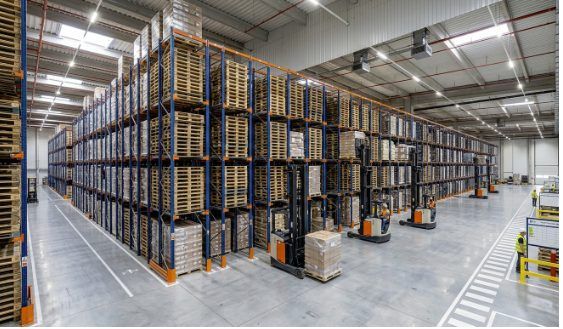
Inventory profiling is the bedrock of warehouse cost control in a $250 billion market, serving as the blueprint that prevents spatial waste before a facility ever breaks ground. Warehouse operators cannot manage long-term operational expenses effectively if their structural layout is based on guesswork rather than data. Misjudging product dimensions, order velocities, and storage requirements leads directly to bloated overhead, congested aisles, and expensive structural retrofits down the line.
Early-stage planning that prioritizes inventory profiling allows executives to build predictable, lean distribution networks. By analyzing Stock Keeping Unit (SKU) data during the design phase, companies align their physical square footage with actual transactional behavior. This deliberate alignment ensures that every square foot of vertical and horizontal space yields maximum utility, thereby driving down the total cost of ownership over the facility’s entire lifecycle.
The Costly Penalty of Misaligned Warehouse Space
Designing a warehouse around generic layout assumptions is an expensive gamble that backfires when real-world inventory arrives. When traditional layouts fail to account for specific SKU profiles, companies find themselves trapped in a cycle of paying for empty air. Industrial real estate spikes have driven warehouse construction costs up to $325 per square foot, making spatial efficiency a critical factor in mitigating capital and operational expenses.
Wasted vertical space is the most frequent byproduct of unprofiled storage environments. Facilities often use only 25% to 30% of their actual footprint when vertical cubic volume is ignored during early-stage planning. This massive systemic inefficiency forces businesses to lease additional overflow facilities or prematurely expand their current buildings, doubling their administrative and utility burdens.
Operational friction compounds these spatial financial losses. When inventory profiles do not match rack configurations, forklifts travel longer distances, labor hours climb, and honeycombing disrupts storage density. Profiling eliminates this by categorizing inventory based on physical dimensions, weight, and pick frequency before the physical infrastructure is purchased and anchored to the concrete floor.
Decoding SKU Profiles to Protect Bottom Line Margins
Effective inventory profiling relies on breaking down stock into distinct, predictable behavior patterns rather than treating all inventory as a uniform set of boxes. Executives must analyze the physical dimensions, stackability, and environmental requirements of each product category.
This structural assessment dictates whether a facility requires standard selective setups or high-density drive-in racking solutions to maximize pallet capacity. The relationship between SKU velocity and storage architecture represents a continuous balancing act between density and accessibility.
High-density systems excel at consolidating bulk, low-velocity stock, but applying them to highly volatile, fast-moving items can paralyze everyday picking operations. A mathematical tug-of-war exists between storage density and accessibility, meaning that profiling SKU velocity prevents operational congestion by matching product flow with the correct rack profile.
Dynamic slotting strategies based on product turnover behavior ensure that high-frequency items remain near shipping docks. This minimizes material handling equipment travel times and reduces wear on expensive machinery over multiple years of operation.
There are millions of hours of warehouse labor wasted every day due to poorly slotted inventory profiles that force workers to traverse inefficient paths. If your teams spend half their shifts traveling across the floor just to reach bulk stock, your labor budget is actively subsidizing layout errors. Real-world profiling ensures your highest-velocity items occupy the most accessible slots, instantly reclaiming lost productivity.
Building Predictability Into Long-Term Logistics Budgets
Early-stage inventory profiling provides supply chain leaders with the structural data necessary to forecast operational expenses with high accuracy, and can be achieved as part of an AI operations management overhaul. When storage configurations perfectly match product dimensions, facility managers can accurately project utility costs, maintenance cycles, and labor requirements. This structural predictability protects businesses from the volatile spot-market storage fees that plague unoptimized distribution networks.
Data-driven orchestration offsets volatile storage fees amidst unpredictable demand, allowing organizations to maintain lean operations even during macroeconomic shifts. Implementing a rigid layout without profiling forces an organization into reactive management, where every inventory surge requires expensive temporary fixes.
A disciplined profiling process establishes a baseline framework that accommodates future inventory shifts without requiring total structural overhauls. Warehouse operators achieve this balance by following specific structural steps during the initial design phase.
The baseline blueprint relies on specific foundational data points:
- Tracking historical SKU dimensional data across a minimum twelve-month operating cycle
- Categorizing product groups by seasonal velocity fluctuations rather than annual averages
- Correlating pallet stackability metrics with total ceiling clearance limitations
Mastering Layout Adaptability for Future Supply Chain Shifts
Warehouse environments must remain resilient against evolving product lines and shifting client demands. An infrastructure designed strictly for today’s inventory profile will inevitably bottleneck operations when product packaging or consumer trends change next year. True optimization requires building modularity into the initial layout so storage configurations can adapt without halting daily production.
Strategic profiling allows executives to engineer flexible zones within the facility that adjust alongside product lifecycles. By understanding the ratio of high-density bulk stock to fast-moving individual picks, companies can dedicate specific zones to scalable racking systems. This foresight protects the initial capital investment and ensures the building remains profitable across its entire lease or operational lifespan.
For more strategic insights to optimize your business and reduce overhead, explore our blog library of guides.