

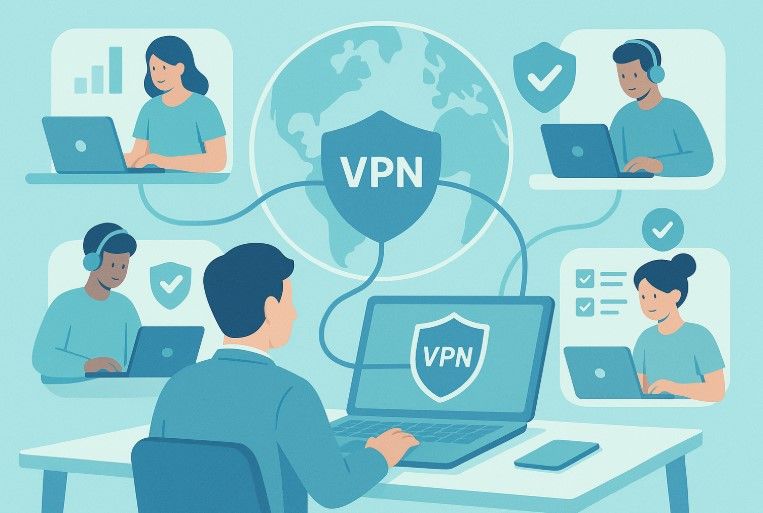
Startups are agile—but that flexibility often comes at the cost of security.
As more teams go remote, ensuring your company’s data is protected isn’t just IT’s job—it’s your responsibility as the CEO. One misstep—like a weak password or unsecured network—can lead to a breach that derails investor trust and operational momentum.
In this guide, you’ll learn the three essential strategies every startup CEO must implement to protect remote team data. From using a secure USA VPN to enforcing smarter password policies, these steps will help you secure your company without sacrificing speed.
1. Set the Foundation with a Remote Security Policy
Before deploying tools or hiring a CISO, your first move should be alignment. A clearly documented remote security policy keeps your team, your vendors, and even your investors on the same page.
Why it matters:
- Startups thrive on speed, but without guidelines, speed creates blind spots.
- Remote employees operate across different networks, devices, and even legal jurisdictions.
- A policy gives structure and reduces risk without needing to micromanage daily behavior.
What to include:
- Access Controls: Which tools require admin privileges? Who gets what access?
- Device Usage Rules: Can employees use personal laptops? What’s the minimum OS version?
- Data Storage Norms: Where is company IP stored? Dropbox? Notion? Is there version control?
- Toolstack Policy: What tools are company-approved and security-validated?
Pro Tip: Don’t make this a 30-page PDF. Instead, build a living, editable doc (like in Notion or Confluence) that grows with your team.
2. VPNs and Encrypted Connections Are Non-Negotiable
A USA VPN is often the first tool startup teams deploy to secure remote access. Whether you’re coding from coworking spaces or managing client data from abroad, a VPN (Virtual Private Network) encrypts your team’s traffic and protects every byte in transit.
Why VPNs are essential for startups:
- Encrypts traffic even on public or home networks
- Masks IP addresses to reduce tracking and location leaks
- Secures sensitive workflows when using third-party SaaS tools across borders
Startup Reality: One engineer in a café without a VPN can unknowingly leak your source code or expose credentials to packet sniffers.
Use Case: Why a USA VPN Matters
If your company is U.S.-based or works with U.S. clients, a USA VPN ensures:
- Low-latency access to domestic tools like AWS, HubSpot, etc.
- Seamless remote access to geo-restricted platforms
- A single encrypted route for your distributed team—even when operating abroad
Bold CEOs don’t wait for a breach. They mandate VPN use from day one.
3. Regularly Educate and Simulate
Security isn’t solved with software alone. Most breaches happen due to human error, not sophisticated cyberattacks. That’s why consistent education matters more than any tool you deploy.
Training isn’t optional—it’s foundational:
- Phishing Simulations: Fake attack emails to test employee awareness
- Incident Response Drills: What should your team do when something does go wrong?
- Onboarding Security Packs: Deliver a 10-minute security bootcamp for every new hire
Bonus: Turn mistakes into teaching moments
When an employee clicks a phishing link or shares access incorrectly, don’t just reprimand—document it, and make it a case study in your next all-hands.
Keep awareness alive:
- Slack Bots or Email Nudges: Weekly mini-reminders like “Have you updated your 2FA today?”
- Company-wide Security Scoreboards: Gamify improvement with non-intrusive KPIs
A trained team becomes your startup’s strongest security layer—faster, cheaper, and more adaptive than any firewall.
4. Strengthen Credential Hygiene Across the Team
Using a strong password generator is a fast way to eliminate weak links in your security chain. Weak passwords are like unlocked doors in a high-rise—they’re quiet risks until it’s too late. As your team grows, credential chaos multiplies. And attackers know startups are less disciplined here.
Common pitfalls in startups:
- Reusing personal passwords on work platforms
- Shared logins across Slack, Trello, AWS, etc.
- Using browser-saved passwords that are easily extracted
Best practices to enforce now:
- Require passwords with 12+ characters, mixed case, and symbols
- Ban password reuse across tools
- Rotate access credentials every 90 days (especially for external collaborators)
Need a fast, secure fix? Use this free password generator to create high-entropy, untraceable passwords for every team member. No storage, no tracking—just clean credential generation.
Don’t stop at generation—integrate with tools like 1Password or Bitwarden for safe storage.
5. The CEO’s Role in Leading a Security Culture
Culture is your startup’s operating system. And culture is built by what the CEO talks about, budgets for, and rewards.
If security is only discussed when things go wrong, your team sees it as a checkbox. But if it’s part of your leadership rhythm—it becomes part of your DNA.
How to lead by example:
- Include security in quarterly OKRs
- Ask security questions in roadmap meetings
- Allocate budget for tools, training, and audits
Real-World Tactics:
- When reviewing product features, ask: “What could go wrong if this gets leaked?”
- When hiring engineering managers, assess their security instincts
- Run a simple red-team exercise once per year—even if it’s just you and your tech lead
Culture is what you tolerate and what you celebrate. Start celebrating secure thinking.
Final CEO Checklist: Remote Security Basics
| Task | Status |
| Written, living security policy in place? | ☐ Yes / ☐ No |
| Team using USA VPN for all remote access? | ☐ Yes / ☐ No |
| Password hygiene enforced across platforms? | ☐ Yes / ☐ No |
| Regular phishing simulations conducted? | ☐ Yes / ☐ No |
| CEO-led messaging and budget alignment on security? | ☐ Yes / ☐ No |
Don’t try to do it all at once. But don’t wait until it’s too late either.
Final Thought: Security as a Growth Enabler
Startup success isn’t just about moving fast. It’s about moving securely, together.
Your remote team might span time zones, continents, and cultures—but your security posture has to be unified. As CEO, your job is to ensure the foundation is strong enough to support the velocity.
Don’t treat security as overhead. Treat it as brand equity, investor confidence, and operational durability.
Start today—start simple—but start secure.
