



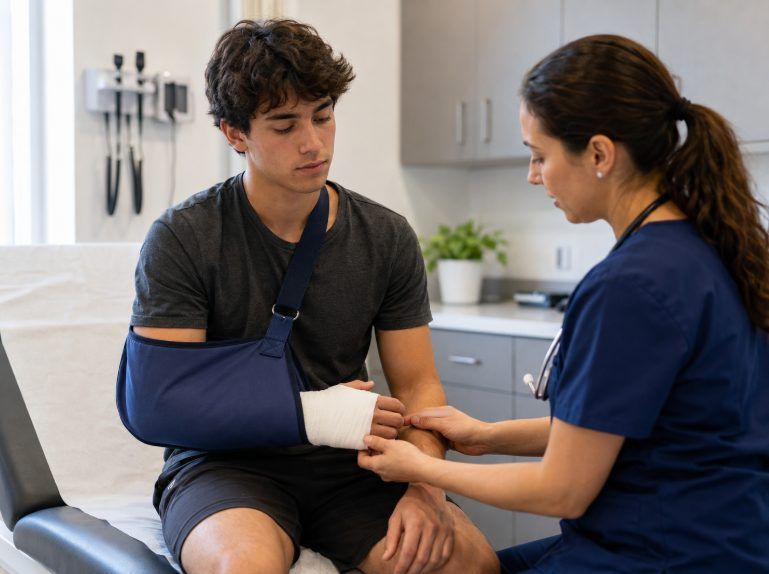
A guide for patients who need same-day treatment but also want to avoid starting over later. Covers what urgent care in Los Angeles handles, why onsite diagnostics matter, how injuries evolve after the first visit, and when a recovery plan connected to your initial care makes the real difference.
Getting seen fast is the obvious part
What happens after the visit when the swelling is down but something still feels off? Urgent care in Los Angeles, CA at Brentview Medical is built around both ends of that experience, with visit times averaging under one hour, onsite lab and X-ray, and rehabilitation services available in the same setting.
What Urgent Care Handles Well
Sprains, strains, minor fractures, lacerations, back pain, infections, and acute illness are all within urgent care scope and treated without an appointment. Onsite X-ray means a fracture can be confirmed or ruled out during the visit itself, which changes the treatment direction immediately rather than sending the patient elsewhere for imaging first.
The combination of speed and diagnostic capability is what separates a useful urgent care visit from one that just tells you to follow up somewhere else.
How Injuries Change in the First 72 Hours
Most soft tissue injuries feel more limiting two or three days later once the initial compensation the body uses to protect the area starts to wear off. A sprain that feels manageable on day one can restrict movement significantly by day three, and that progression is normal injury behavior, not a sign that the first visit missed something.
Normal X-Rays
X-rays are reliable for identifying fractures but do not capture everything. Soft tissue injuries, ligament damage, and certain early-stage conditions may not appear on imaging even when they are genuinely affecting function.
A clear result means no fracture was found, and that distinction matters for what comes next. Having lab work and imaging completed during the initial visit builds a more accurate starting point for treatment rather than leaving the picture incomplete.
The Space Between Better and Fully Recovered
Reduced pain is not the same as full recovery, and that gap is where a lot of injuries quietly become long-term problems. Patients often stop seeking care once the acute phase passes because things feel manageable, but strength has not returned, a specific movement still produces discomfort, or range of motion is still limited.
Connecting that next step to a provider with access to the original diagnosis and records is what makes rehabilitation faster and more targeted. Physical therapy in Brentwood, CA available through the same care setting means no starting over with someone who has no context for what happened.
When Rehabilitation Is Part of the Plan From the Start
For musculoskeletal injuries, neck and back issues, and hand and upper extremity problems, structured rehabilitation is often what determines whether full function comes back or the injury becomes a recurring limitation.
Starting physical therapy earlier in the recovery window, matched to the specific injury and baseline established at the initial visit, consistently produces better outcomes than waiting until pain becomes chronic before addressing it. A recovery plan built at the point of diagnosis is a different experience than one assembled weeks later from scratch.
Conclusion
The best urgent care visit is one that does not leave the patient figuring out what to do next on their own. For injuries and conditions that need more than a single visit, having treatment and recovery support in the same place removes the most frustrating part of the process. No repeated intake forms, no provider who lacks context, no gap between getting seen and getting better. A Brentwood health center like Brentview Medical handles both so recovery starts correctly and actually finishes.
FAQ
What types of injuries does urgent care in Los Angeles treat same day?
Sprains, strains, minor fractures, lacerations, muscle injuries, back pain, and acute infections are all handled without an appointment. Onsite X-ray means fractures can be confirmed or ruled out during the visit itself, which determines the treatment direction immediately rather than sending the patient somewhere else for imaging first.
How is urgent care different from an emergency room for injuries?
Emergency rooms are built for life-threatening situations and priced accordingly. Urgent care handles conditions that need attention today but do not require emergency level resources, with significantly shorter wait times and lower costs. For anything involving chest pain, difficulty breathing, severe head trauma, or signs of stroke, an emergency room is the right call without question.
Why does an injury sometimes feel worse two or three days after it happened?
Swelling and inflammation peak later than the moment of injury, and the body’s natural compensation patterns shift once the initial protective response fades. That delayed increase in stiffness and pain is normal injury progression.
Does urgent care provide documentation for work or insurance after an injury?
Every visit generates documentation covering the evaluation, diagnosis, and treatment provided. For workplace injuries or situations requiring records for insurance purposes, that documentation is part of the standard visit record.
When does an injury need physical therapy instead of continued rest?
When pain has reduced but function has not returned, rest has likely done what it can. Limited range of motion, persistent weakness, pain that returns with specific movements, or symptoms that have plateaued without improving are all signs that structured rehabilitation is the next appropriate step.


