

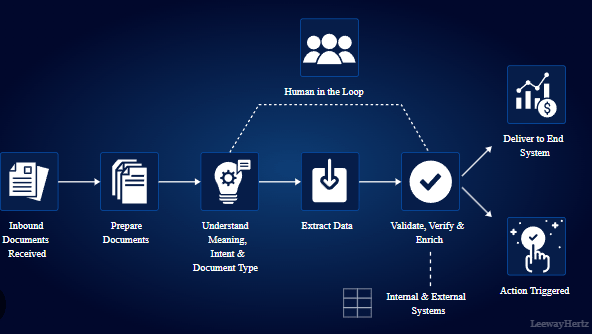
In today’s fast paced digital world, organizations are using
intelligent document processing
(IDP) to automate document workflows, reduce human
intervention and increase data accuracy. But manual review is still
a bottleneck causing inefficiencies, errors and compliance risks.
AI driven data validation and error
detection is transforming IDP by reducing manual oversight
while improving accuracy and scalability.
Challenges of Manual Review in IDP
While intelligent document processing solutions
automate large parts of document workflows, many organizations
still rely on manual review to validate extracted data and detect
anomalies. This brings several challenges, which are outlined
below.
Time and Cost Waste
Manual data validation is time consuming and slows down document
processing workflows. Employees spend hours reviewing extracted
data, crosschecking information and correcting errors, hence higher
operational costs. This prevents organizations from scaling their
document processing.
Human Error and Inconsistencies
Even with best intentions, manual reviews are prone to human
error. Fatigue, oversight and subjective decision making can lead
to data inconsistencies and inaccuracies. AI driven error
detection algorithms minimize these risks by applying
standardized validation rules across all documents.
Scalability Issues
As businesses grow and document volumes increase, manual review
becomes unsustainable. Large organizations processing thousands of
invoices, contracts and compliance documents daily need scalable
intelligent document processing tools to maintain
efficiency and accuracy.
Compliance Risks
Industries like finance, healthcare and legal services require
strict compliance with regulatory standards. Manual errors in data
validation can lead to compliance breaches, fines and reputational
damage. AI-driven IDP solutions ensure compliance
through accuracy and audit trails.
AI-Powered Data Validation in IDP
AI driven data validation in
intelligent document processing reduces human
oversight by automating verification and improving accuracy.
Rule Based Validation vs AI-Driven
Validation
Traditional rule based validation systems uses
pre-defined conditions to check extracted data.But these rules can
be rigid and fail to handle exceptions or variations in document
formats. AI-powered validation adapts and learns over time,
improving accuracy in data extraction and reducing
false positives.
Automated Data Cross Verification
AI systems compare extracted data with internal databases, ERP
systems and external sources to ensure consistency and accuracy.
For example an AI driven IDP system can
automatically validate invoice details against purchase orders and
past transaction records and flag discrepancies for review.
Pattern Matching for Anomalies
Machine learning models find patterns in document data to detect
anomalies like fraudulent invoices, duplicates and missing
information. AI driven anomaly detection reduces
manual intervention by highlighting the unusual for review.
Confidence Scoring
AI assigns confidence scores to the extracted
data. Low confidence data points trigger human intervention and
high confidence entries are auto approved. This intelligent
document processing reduces manual reviews
significantly.
AI for Error Detection in IDP
Advanced AI techniques for error detection and
data validation in intelligent document
processing are as follows:
Natural Language Processing
NLP enables context aware text extraction by
understanding language structure, semantics and intent. This is
crucial for validating legal contracts, compliance documents and
customer communications where contextual meaning determines data
accuracy.
Computer Vision for Document Analysis
Computer Vision improves OCR (Optical
Character Recognition) by detecting missing fields, bad
formatting and illegible handwriting in scanned documents. AI
driven image processing makes extracted data match
document layout.
Anomaly Detection Algorithms
AI uses unsupervised learning to detect unusual
patterns in document data. These algorithms detect fraud, incorrect
amounts and mismatched data across multiple documents.
Self Learning AI Models
Unlike traditional IDP tools, AI models learn
from historical data and get better at validation over time.
Self supervised learning allows IDP systems to
adapt to changing document formats and business rules.
Real World Applications of AI in IDP Error
Reduction
AI driven error detection and data
validation is being used in the following areas.
Financial Document Processing
Banks and financial institutions use AI to validate loan
applications, invoices and transaction records. AI makes financial
data comply with regulations, reducing fraud and errors.
Healthcare Records Management
AI powered IDP platforms improves accuracy in
electronic health records (EHRs), insurance claims
and medical prescriptions, reducing administrative burden and
compliance with healthcare regulations.
Legal Document Review
Law firms use AI-driven document processing
software to extract, validate and compare contract
clauses, ensuring accuracy and compliance.AI helps with legal
research by highlighting inconsistencies and missing clauses.
Supply Chain & Logistics
AI automates document validation for shipping
manifests, purchase orders and invoices, ensuring accuracy in
global supply chain operations. AI-driven error
detection minimises discrepancies in shipment records.
Why AI-Driven Validation Beats Manual
Review
AI-powered validation gives you speed, accuracy
and scale in document processing.
Faster Results
Automation of validation gets you results in
minutes, not hours, so you can decide on information and get work
done faster.
Higher Accuracy and Consistency
AI eliminates human error so you get consistent
extraction and validation across
all documents.
Scale for Large Ops
AI-driven IDP solutions let you process
thousands of documents at once so you can grow without adding
manual load.
Compliance and Audit Ready
AI ensures compliance by keeping accurate records and generating
audits for validation processes.
Challenges in Implementing AI for
Validation
Despite the benefits, AI-driven document
processing has its unique set of challenges.
Initial Training and Model Tuning
AI models need to be trained on historical data to be accurate.
You need to invest in model tuning to get the most out of it.
Integration with Existing IDP Systems
Integration of AI-driven validation with
legacy IDP systems and in-house
platforms requires technical expertise.
Data Privacy and Security
AI-driven document processing must comply with
data protection regulations, so you need to ensure
secure handling of sensitive info.
Human Oversight in Critical Cases
AI is great for error detection but still requires human
oversight for complex cases that need nuanced judgment and
context.
The Future of AI in IDP: Total Automation
AI is getting better, which is why document
processing is moving towards total automation.
Self-Learning AI
Self-improving models get better validation by
learning from document workflows.
Multimodal AI
NLP, computer vision and machine learning combined gets you
better document understanding and error
detection across multiple formats.
Blockchain for Secure Verification
Blockchain adds data integrity to
validation processes.
AI Predictive Analytics
AI predicts errors and flags potential issues
before they happen, reducing error correction
cost.
Changing the Face of IDP with AI
AI data validation and error
detection is changing intelligent document
processing, reducing manual reviews and increasing
accuracy, efficiency and compliance. By using self-learning
AI models, NLP and computer
vision, businesses can automate complex document
processing workflows, and get reliable data
extraction and validation. As AI gets
better, intelligent document processing companies
will benefit from full automation and accurate data
validation, transforming enterprise document
management.
