



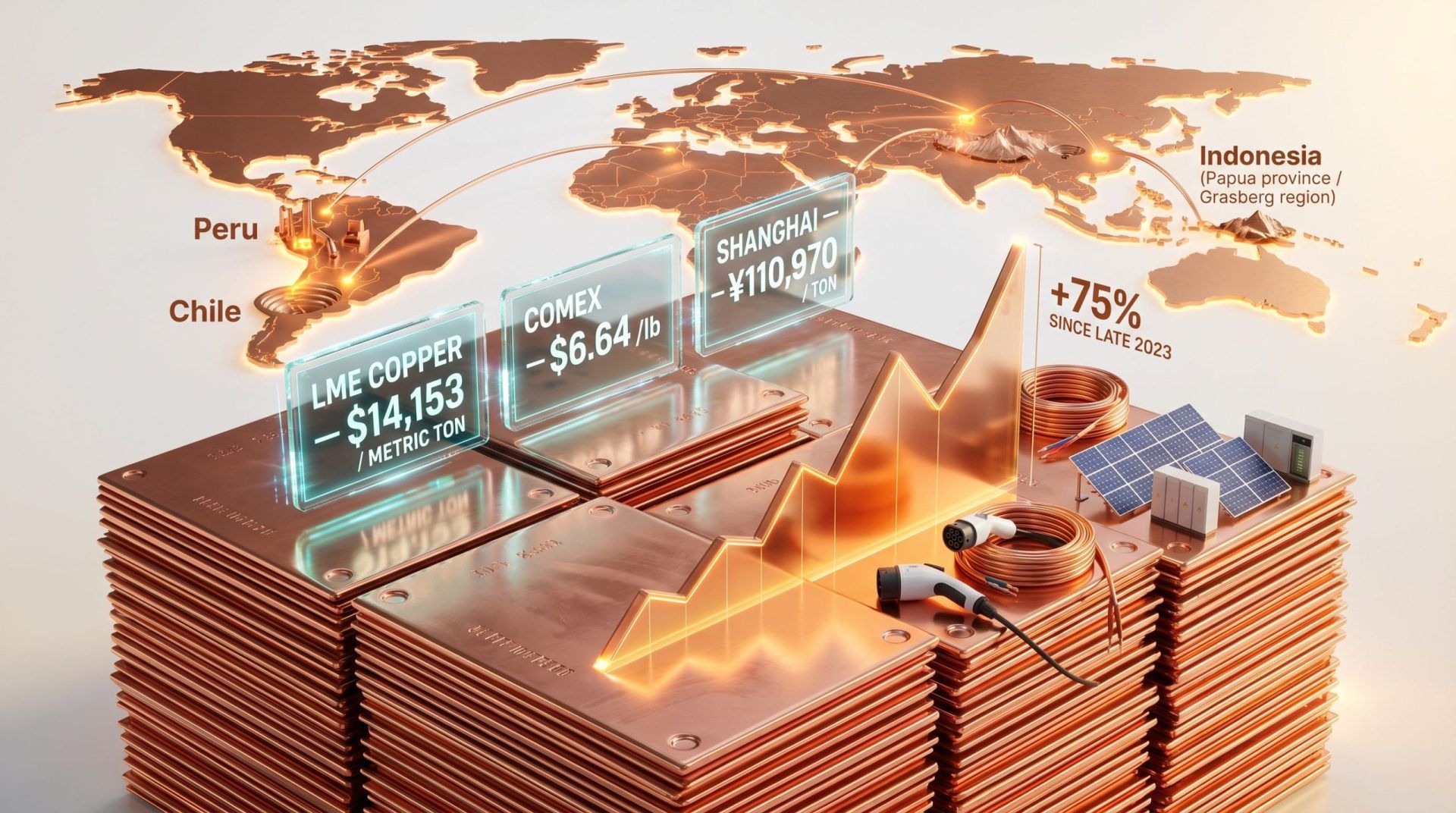
Copper’s climb to record pricing in 2026 (peaking at $14,527.50 per tonne on the London Metal Exchange (LME) on January 29) did not come out of nowhere. It rather reflects the cumulative effect of at least three factors: a persistent supply shortfall, a surge in structural demand, and a geopolitical shock that quietly rewired global trade routes.
At the root of the issue lies the mining industry’s failure to expand capacity quickly enough. The International Energy Agency says global copper supply will peak at just over 24 million tonnes by the end of the 2020s before slipping below 19 million tonnes by 2035.
The decline is largely the results of falling ore grades and unavoidable closures of aging mines. In addition, new mining projects often require more than a decade to move from approval to production, making any short-term supply fix unrealistic.
On top of that came acute disruptions that further tightened the market. A landslide at the Grasberg mine in Indonesia (the world’s second-largest copper mine) forced operator Freeport-McMoRan to pause part of its output, reducing its projected 2026 production by 35%.
Also, forecasts started diverging in a way that underscored the severity of the imbalance. The International Copper Study Group revised its 2026 outlook from surplus of 200,000 tonnes to a deficit of 150,000 tonnes. J.P. Morgan estimated the gap at 330,000 tonnes, while Citic Securities placed it closer to 450,000 tonnes.
Demand driven by electrification and artificial intelligence
On the demand side, three simultaneous shifts created unprecedented pressure. The global energy transition has made copper indispensable: electric vehicles use roughly five times more copper than in a combustion-engine car, while the metal is also essential to solar panels, wind turbines, and grid infrastructure.
BloombergNEF believes the global copper market is heading toward a structural deficit that could reach 19 million tonnes by 2050 if current trends continue. This dynamic is steadily pushing copper prices higher, much like the rallies gold (XAUUSD) and silver (XAGUSD) expirienced not long ago.
The second driver is digital infrastructure. According to the Banque de France, data centers consumed an estimated 500,000 tonnes of copper in 2024. Projections for 2050 go up to 3 million tonnes annually, equivalent to roughly 9% of total global demand.
The rapid expansion of AI infrastructure is accelerating this trend even further. Goldman Sachs named copper its top industrial metal pick for 2026, citing rising demand from power grids and digital infrastructure.
The Trump tariff shock and its market distortion
The immediate trigger for the latest price spike was a US trade policy decision. After threatening a 50% universal tariff on all copper imports, the Trump administration ultimately imposed a 25% duty on copper derivative products through a presidential proclamation on April 2, 2026. The tariff applied to the full value of imported goods rather than solely to their copper content.
The announcement unleashed a wave of anticipatory buying, pushing the premium of US copper prices over the LME benchmark above $1,200 per tonne.
The stated objective — rebuilding domestic copper production — faces a structural obstacle: the United States currently produces less than half of its own copper it consumes, while permitting new mines usually takes seven to ten years. Analysts at Saxo Bank warned that duties would primarily harm America’s key copper suppliers — Chile, Canada, and Peru — all of them close US allies.
The convergence of these forces has created a market with no immediate relief valve. The IEA forecasts a 30% copper supply shortfall by 2035. Recycling may provide a partial buffer, since secondary copper flows tend to increase when prices rise, but not nearly enough to close the gap.
In this context, today’s record prices appear less like a temporary market anomaly than a structural signal: the world is consuming copper faster than it can mine, refine, or replace it.


