



Introduction
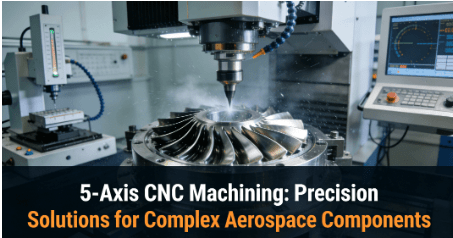
Currently, the aerospace, medical, and auto industries are demanding higher complexity components at a micron-level of precision within their manufacturing world. Generally, this cannot be easily accomplished through conventional 3-axis CNC machining because of setup inaccuracies, multiple setups, long lead times, and cost overruns because conventional machinery cannot handle complex geometries such as FR and deep cavities.
The article introduces 5-axis CNC machining as a revolutionary technology that enables single-set processing with dynamically oriented tools and delivers unprecedented precision. Focusing on authoritative standards such as ASME Y14.5, this technology ensures quality consistency. We shall elaborate on the principles, advantages, and requirements for implementing 5-axis machining technology to address these issues.
What are the fundamental advantages that 5-axis machining has over conventional machining?
5-axis CNC machining is an improvement over traditional 3-axis machining in many respects, especially in accuracy and speed. The especial flexibility of 5-axis machining makes possible the production of complicated parts without much manual operation.
1. Removing Cumulative Errors Using Single Setup Processing
Conventional 3-axis machining has to be done with a number of setups and positioning, which allows for the accumulation of a tolerance error that may jeopardize the integrity of the parts. For instance, a turbine blade that needs three setups for completion via a conventional 3-axis CNC will be accomplished in one setup in the 5-axis model and will exhibit an error rate reduction of over 30%. Such strict standards as ASME Y14.5 ensure the compliance of geometric dimensioning and tolerancing, which is crucial in aerospace and medical equipment application where integrity is paramount.
2. Reduction in Production Time and Operational Costs
By combining processes, the time and labor required by 5-axis machining are reduced to a considerable extent. A case study by experts in precise manufacturing shows that by changing from a 3-axis to a 5-axis machining process, the manufacturing time for a component of a drone was reduced from 18 hours to 11 hours, increasing efficiency by nearly 40 percent. The modern manufacturing method cuts down on downtime and tool changes to a negligible extent, resulting in a fast time-to-market and saving a lot of dollars in prototyping or volume manufacturing.
3. Extended Capabilities for More Complex Geometries
The dynamic orientation in 5 axes means that 5-axis systems have the ability to perform undercuts and cavities that would not have been able to be done by 3-axis machining. There shall not be any splitting in the parts made, which will reduce points in assembly as well as points that may lead to failure. For example, impellers with curved blades are made in a single setup to get good finish without having to resort to secondary operations. These concepts are based on ISO 9001 guidelines for managing quality.
What are the mechanisms involved in performing 5-axis CNC machining?
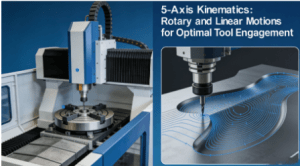
The mechanism or principle that 5-axis CNC machining is based on is related to kinematic motion, where two other axes, namely A or C, which are rotatory, function together with other motion types, such as linear motion, to position tools correctly. Such collaboration allows an entire part to be accessed in one fixture.
- Principles of 5-Axis Motion Kinematics: The 5-axis machine has the ability to change the orientation of the tool using dual rotary tables or tilting-rotary heads. The work piece needs to be rotated around two axes, while the tool has to move along a linear path for effective cutting position or angle. The technology prevents the existence of dead zones, making it possible to effectively cut contours as well as pockets. In implants, for illustration, the tool is able to maintain perpendicular positions along the curved surfaces, ensuring tolerances of +/– 0.01 mm.

- Role of CAD/CAM Software in Toolpath Optimization: The use of advanced software like Siemens NX creates smooth tool paths by working on 3D models with rotational coordinates. Other significant features that this software has are the vector control mechanism in tool axes and collision detection methods that eliminate any mechanical conflicts, thus lowering scrap rates. Research shows that optimized approaches in CAM can decrease machining time by 25% with increased accuracy in manufacturing. The hardware and software integration emphasizes the viability of integrating digital solutions by 5-axis CNC machining services.
- Practical Applications in Aerospace Components: A good example of this type of bracket is the aerospace bracket, which uses thin-walled and pocketed design. This component was made using only one set-up by the machining process of 5-axis, whereas for 3-axis machining, dis-assembling and re-adjusting were required. The process followed the guidelines of ISO 9001, which ensured that all the processes involved were at a high level of quality. In this way, the speed of manufacturing was increased, whereas the reliability of the parts was enhanced.
What Factors Affect the Accuracy and Cost of 5-Axis Machining Directly?
There are a number of technical parameters involved in the precision and economics of 5-axis machining. Understanding these can enable manufacturers to maximize the processes with respect to economics without sacrificing quality.
1. Spindle Speed and Tolerance Control: Technical Parameters
Spindle speed, as well as the rate of feeding, directly affects the finish, as well as tool durability. A high-speed spindle enables accurate material removal even at 20,000 RPM, as the tolerances are preserved at ±0.01mm. The thermal stability system corrects for any heat expansion, which is necessary for titanium alloys, for example. It provides ASME Y14.5 dimensional accuracy with calibration, which minimizes costs associated with rework.
2. Cost Drivers Including Machine Depreciation and Programming Time
The high capital investment in 5-axis CNC will be countered by efficiencies derived from decreased setup and costs associated with tools. However, some variables that influence total costs could be programming complexity and costs of materials. For example, complex parts would need sophisticated CAM programming, which could be more time-consuming but saves on costly mistakes.In addition, obtaining a comprehensive 5-axis CNC machining quote is helpful for financial planning, as suppliers that disclose their cost models will do so.
3. Quality Control Systems and Total Cost of Ownership
In-process analysis by means of probes and sensors enables early detection of malfunctions and thus prevents high scrap rates. Qualified systems for quality management like ISO 9001-compliant systems are helpful in avoiding untimely risks as they guarantee plausibility and traceability. Closed-loop feedback systems were found in one study capable of cutting down wastage by 20% and thus making 5-axis machining economically favorable for short-run production changeovers.
Choosing a Trustworthy Supplier of 5-Axes CNC Machining Services
Precision machining demands accuracy, which depends on several factors, including supplier selection. The most important requirements are qualifications, certifications, and experience with difficult jobs.
1. Assessment of Technological Capabilities and Equipment Certification
Suppliers would have to offer state-of-the-art equipment that features multi-axis synchronization and real-time inspection. The supplier would be required to be certified in either the aerospace industry, which is denoted by the AS9100D certification, or the medical industry, denoted by ISO 13485, which is required to signify the supplier’s understanding of industry-standard practices. A supplier that has International Aerospace Quality Group (IAQG)-approved processes in place to control the parts that go into the aerospace industry involves strict safety measures, and a firm will assume fewer risks.
2. Evaluating Experience with Case Studies and Portfolios
A comparable past project evaluation with similar requirements to yours can help to determine the skillset of a supplier. You can examine case studies illustrated with intricate part machining, such as items with complex shapes like free-form surfaces. A good 5-axis CNC machining service provider will have case studies demonstrating their skillset with similar industry profiles like automobile, medical, etc.
3. Developmental Communication & Supportive Services
Efficient suppliers are also capable of offering complete engineering solutions, such as DFM feedback and rapid prototyping. The suppliers must make clear how they cooperate using tools allowing for real-time quoting. For example, web-based quoting turnarounds in 24 hours enable quick decision-making, thus ensuring enhanced supply chain optimization.
What is the Significance of 5-Axis Machining in Prototype Development?
Besides industrial applications in manufacturing prototypes, 5-Axis machining technology has revolutionized Rapid Prototyping & Small Batch Production, which requires agile innovation and cost-efficient manufacturing for niche markets.
- Acceleration of Product Development Cycles: With 5-axis technology, having the capability to produce a part within a single setup reduces the time to create a prototype by as much as 35% compared to conventional means. This is quite important for industries such as medical products that involve testing and iterations. Just to demonstrate, with this technology, a prototype of a custom implant could be developed within days, not weeks.
- Economic Feasibility for Low-Volume Batch Manufacturing: The flexibility offered by these 5-axis systems reduces the need for special fixtures. Smallscale production becomes feasible. The cost savings in the case study on drone parts, in 50-unit lots, included 40% savings in total setup costs. It aids in on-demand production, thereby satisfying mass customization.
- Seamless Integration with Workflows for Efficiency: The 5-axis machining interfaces are combined with the digital twin systems as well as MES systems for smooth flow of data. In addition, this will help facilitate the simulation process for optimal tool paths before the machining process that leads to the minimization of material wastage. The suppliers that utilize the above automation tools are able to provide turnarounds with precision, as seen in the smart factories.
In What Ways can Cutting-Edge Programming Approaches Improve 5-Axis Machining
It is all about advanced programming methods to unlock the potentials in 5-axis machines. Advanced programming concepts have brought tool path programming, collision avoidance solutions, and adaptive control into the spotlight.
1. Optimize Toolpaths for Least Machining Time
Algorithms that are implemented in CAM systems develop the most optimal tool paths in the shortest possible time with minimal air cuts and tool wear. Certain methods are developed with constant tool engagement in mind, thus ensuring longer tool life and improved surface quality. Efficiency improvements of up to 25% have been demonstrated in research programs related to complex contours of parts.
2. Collision Detection and Simulation for Error Prevention
In more advanced software, there is simulation that prevents collisions of a tool holder and a work piece. This is an important preventive measure that saves on time and avoids scrap. For example, in the machining process of aircraft brackets, simulation ensures that operations in deep cavities are not interrupted while meeting stated quality standards, such as that of AS9100D.
3. Adaptive Machining and IoT Integration for Smart Manufacturing
Predictive maintenance through spindle status monitoring or vibration is made possible through the integration of IoT sensors. These sensors allow for real-time adjustments to parameters for adaptive control systems, ensuring optimized energy use and tooling. This integration of 5-axis machining with the principles of Industry 4.0 makes 5-axis machining a foundation for the modern manufacturing industry.
Conclusion
The development of 5-axis CNC machining is seen as an answer to many of the vital issues that have existed in precision-oriented sectors as it provides both precision and the capability of handling complex geometry at an affordable cost, which makes it an inevitable technology in various sectors, ranging from aircraft to medical devices. To make it more reliable, manufacturers ensure that the process followed is ASME Y14.5 and ISO 9001 certified. As more integration opportunities are being worked out in terms of smart factories, its applications are expected to enhance.
FAQs
Q1: To what extent can a tolerance be attained in the general area of five-axis CNC machining?
A: 5-Axis CNC Machining-With high accuracy based on material and calibration, tolerance could be as small as ± 0.01 mm. The tolerance could be compared to standards such as ASME Y14.5.
Q2: How long does it take to receive a quote for 5-axis CNC machining?
A: A reputable supplier takes roughly 24 hours to submit a quote after design submission, which will comprise of all the elements for a DFM analysis, including cost of material, complexity levels, among other factors.
Q3: Is such material as titanium alloys amenable to 5-axis machining?
A: Yes, they perform well on harder material like titanium because dynamic cutting tool engagement helps to prevent the buildup of heat and tool wear. This is particularly so in aerospace parts where high strength to weight is required.
Q4: What file formats are required in the submission of the 5-axis CNC machining design?
A: These usual formats include STEP, STL, IGES, and support full 3D model analyses. However, most file suppliers will permit the file size no larger than 15MB.
Q5: What role does 5-axis machining play in sustainable manufacturing technology?
A: Other than this, the 5-axis machining process meets the international environmental quality standard, such as ISO 14001, as it ensures minimal waste of materials. This is attributed to the precise cuts and optimized processes, allowing for a lower carbon footprint without reducing productivity.
Author Bio
The author belongs to the precision manufacturing group of LS Manufacturing and aims to empower engineers in resolving the challenges of complex parts in the field of aerospace engineering, medical device manufacturing, and the automotive industry. With various certifications in ISO 9001, IATF 16949, AS9100D, ISO 14001, the company delivers quality and sustainable solutions through the use of modern technology. If you are looking for a free project review or more information, contact them today.


