



There’s a moment every senior executive knows well. You’ve just landed at Changi after a red-eye from London. Your phone shows three unread messages from the client you’re meeting in ninety minutes. You step out of Arrivals and start scanning for your driver.
That scan — the uncertain one — is what professional ground transport is supposed to eliminate entirely.
Over the past several years running a corporate chauffeur operation in Singapore, I’ve noticed a consistent pattern: the companies that treat ground transport as a commodity almost always regret it at the worst possible moment. The ones that treat it as part of the executive experience never look back.
Here’s what I’ve learned from working with EAs, procurement heads, and travel managers across Singapore’s CBD.
First Impressions Are Set Before the Meeting Room
Singapore positions itself — correctly — as one of the world’s premier business hubs. Delegations fly in from Tokyo, Frankfurt, New York, and Sydney specifically to negotiate, partner, and invest. The moment a senior guest lands at Changi Terminal 1 or 3, the hospitality clock starts.
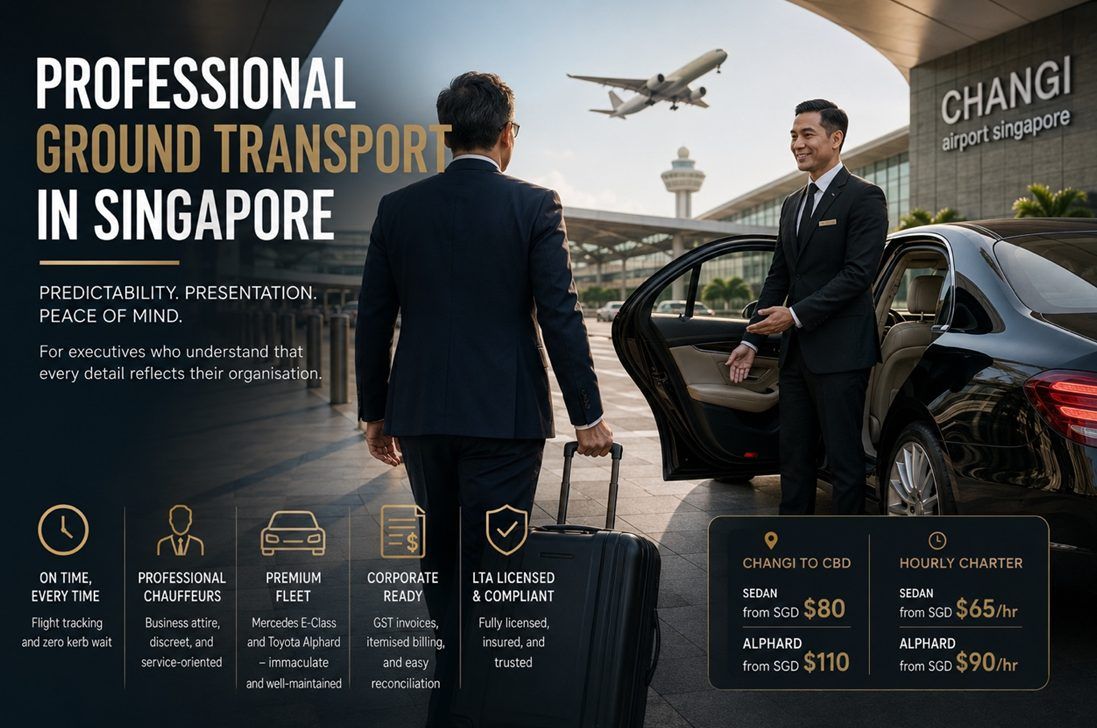
A chauffeur who is already waiting kerbside, vehicle pre-cooled, holding a discreet name card — that communicates something. It tells the guest that the organisation on the other side of today’s meeting runs a tight ship.
A driver who is circling the carpark, three minutes late, calling with an unfamiliar number — that communicates something too.
The vehicle is not just transport. It is forty-five minutes of controlled environment where a senior guest either arrives composed or arrives rattled.
What “Corporate Standard” Actually Means on Singapore Roads
Not all chauffeured vehicles are created equal. In Singapore’s private-hire market, the gap between a budget ride-hail and a properly configured executive sedan is significant — and it shows up in ways that matter to corporate clients.
A genuine corporate standard means:
- Formal dress and conduct. Chauffeurs dressed in business attire, trained to open doors, handle luggage without prompting, and maintain professional silence unless the passenger initiates conversation.
- Vehicle presentation. A well-maintained Mercedes E-Class or Toyota Alphard with clean, odour-free interiors and no personal effects visible. If the vehicle smells like someone else’s lunch, the experience has already failed.
- Zero kerb wait. The vehicle is at the designated pickup point when the passenger arrives — not two minutes later, not “just around the corner.” For airport runs especially, timing discipline between a chauffeur tracking the flight arrival and being positioned correctly at the terminal exit is what separates professionals from the rest.
- Consistent billing. Corporate clients — particularly finance teams — need clean, itemised invoices with GST breakdowns for expense reconciliation. Not PayNow requests and WhatsApp screenshots.
The Hidden Cost of Getting This Wrong
I’ve spoken with EAs who’ve had to apologise to visiting C-suite guests because a last-minute ride-hail didn’t show up. I’ve heard of a regional director who arrived at a hotel check-in sweating in a non-air-conditioned vehicle — in Singapore’s June heat — before a board presentation.
These incidents don’t make it into post-mortems. They rarely surface formally. But they leave impressions.
The business case for professional corporate ground transport in Singapore is not complicated. The sedan rate from Changi to the CBD starts at around SGD $80. The Toyota Alphard — the preferred vehicle for senior delegations and multi-person transfers — typically runs around SGD $110 for the same route. Against the total cost of hosting an international business visit, these figures are negligible.
What’s not negligible is the reputational cost when the transport falls apart at the visible moment.
Why Singapore Specifically Warrants a Dedicated Approach
Singapore’s geography and corporate culture create specific demands that a generic ride-hail platform doesn’t handle well.
Point-to-point transfers between Changi, the CBD, one-north, Jurong Lake District, Sentosa, and Marina Bay are the bread and butter of corporate ground transport here. These are predictable, high-stakes routes. A dedicated Singaporechauffeur service will have drivers who know the terrain, and will position accordingly.
There’s also the question of surge pricing. Ride-hail platforms price dynamically. On a Friday evening when three conferences are ending simultaneously in the Marina Bay area, prices climb and availability drops. A corporate account with a fixed-rate chauffeur service insulates the company from exactly that variability.
For hourly bookings — executive roadshows, multi-stop client days, investor presentations — fixed hourly rates (sedans from SGD $65/hour, Alphard from SGD $90/hour) allow travel managers to budget accurately and confirm bookings weeks in advance.
What Procurement Managers Should Actually Be Evaluating
When reviewing ground transport vendors, the evaluation criteria that matter most are rarely the ones on the initial RFQ:
- LTA licensing. Every private-hire vehicle in Singapore must carry the relevant LTA authorisation. Verify this — not as a formality but as a baseline filter.
- GST registration. For companies that need to claim input tax on transport costs, the vendor must be GST-registered and issue compliant tax invoices.
- Fleet consistency. Can the operator guarantee the same vehicle class and standard across all bookings? Corporate clients should not be receiving a different vehicle specification each time.
- Account management. Is there a single point of contact for booking amendments, billing queries, and complaints? For a busy EA managing fifteen bookings a month, chasing a different number every time is a process failure.
The Standard to Hold Operators To
The best corporate chauffeur operators in Singapore are not the largest or the cheapest. They are the ones who have built their entire operation around predictability — predictable vehicle quality, predictable driver conduct, predictable billing, predictable arrival times.
For Singapore businesses that regularly host regional leadership, international clients, or need to move their own senior executives between engagements, that predictability has direct commercial value.
Ground transport is one of the few visible, tangible elements of corporate hospitality that is entirely within your control. It costs almost nothing relative to what it protects.
The executives I work with didn’t reach their positions by leaving controllable variables to chance. Their ground transport shouldn’t be one either.
About the Author
Jovin Liau is the co-founder of Veloce Limo Pte Ltd, operating a dedicated corporate chauffeur service in Singapore. Veloce Limo holds LTA licensing and GST registration, and serves corporate clients across Singapore’s CBD, Changi Airport, and the wider island. Website: chauffeurservicesingapore.com • LinkedIn: linkedin.com/in/liaujovin


