



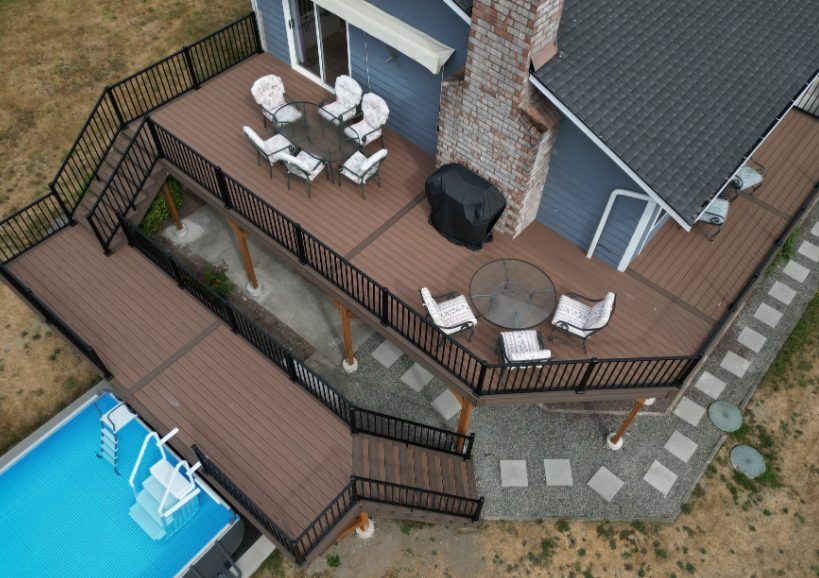
When the composite decking industry started rolling out 25-year warranties in the mid-2000s, the pitch was straightforward. Buy the boards once, install them, and your great-grandkids will probably outgrow the deck before it fails. For homeowners in drier climates that pitch holds up reasonably well. In the Pacific Northwest, the picture is messier.
I’ve spent the last few months talking to Daniel at Decks Restore, a contractor who’s been building and repairing decks across Tacoma, Federal Way, and Gig Harbor for over a decade. He pulled his client records on composite warranty claims going back to 2018, and what he found doesn’t match what the brochures promise. I asked him if I could write it up. He agreed, as long as I didn’t sugar-coat any of it.
What the warranty actually covers
The first thing worth understanding is that a 25-year composite warranty is not a 25-year guarantee that the deck will look new. Most of the major manufacturers cover three things. Structural failure, meaning the board breaks under normal load. Stain and fade resistance, usually with specific limits measured on the Delta E color difference scale. And material defects, which means manufacturing problems like delamination or splitting from the factory.
What they don’t cover is moss growth, surface scratching from furniture or pets, mold staining that comes off with cleaning, color variation that falls inside their listed tolerance, or installer error. That last category is where a lot of claims die.
What Daniel’s claim records actually show
Out of roughly 340 composite deck installations Daniel’s crew completed between 2014 and 2023, his team has helped clients submit 47 warranty claims to manufacturers. Of those 47, the breakdown surprised me.
Twenty-two claims were approved with full product replacement. The manufacturers covered the cost of new boards. They did not cover labor to remove the old boards and install the new ones. On a 400-square-foot deck, the labor side of that bill usually lands somewhere between $3,800 and $6,200 in this region.
Fourteen claims were partially approved, meaning the manufacturer offered a prorated credit toward replacement product. Most of these were on decks that were 8 to 14 years old, where the warranty schedule reduces the payout each year.
Eleven claims were denied outright. The reasons varied. A few were declared installer error even though Daniel’s team installed them to spec. A couple were rejected because the homeowner had pressure-washed the deck at too high a PSI and damaged the cap layer. The remaining denials came down to the manufacturer saying the conditions on the deck fell within their definition of normal weathering, even when the boards looked obviously degraded to the homeowner.
The single most common reason for a claim in Daniel’s data is mold staining that won’t come off. About 60 percent of the calls he gets about a composite deck “failing” start with the homeowner sending a photo of dark blotches across the surface.
Why the Pacific Northwest is harder on composite than the marketing suggests
Most composite boards are tested in conditions that look nothing like a winter in Puget Sound. The accelerated weathering tests manufacturers use are typically based on UV exposure and temperature cycling, not the kind of sustained moisture saturation we get here from October through May.
Daniel walked me through what happens to a typical capped composite board in our climate. The cap layer, which is the plastic shell that wraps the wood-flour-and-polymer core, does what it’s supposed to do for the first few years. Around year 5 or 6 on a north-facing or shaded deck, microscopic surface erosion starts to expose the core just enough for moisture and mold spores to get a foothold. Once that happens, the staining is no longer a cleaning problem. It’s a permanent surface change that the warranty almost always classifies as normal weathering.
The boards aren’t broken. They aren’t structurally compromised. They just look bad in a way the manufacturer doesn’t have to fix.
The 25-year claim, in plain numbers
If you take Daniel’s installation base and his claim outcomes together, the math looks like this. About 14 percent of his composite decks generate a warranty conversation within their first 15 years. About 6 percent end with a full product replacement approval. The rest either fall outside what’s covered or get prorated down to a payout that doesn’t justify the hassle of filing.
That is not the same as saying composite decking is a bad product. The same data shows that 86 percent of his composite installs have not had a single warranty issue worth filing, which is a stronger record than cedar in the same climate. But the 25-year number on the warranty card is misleading if homeowners read it as a 25-year promise of how the deck will look. It’s a 25-year window during which a narrow set of failures might be covered.
What this means if you’re shopping right now
A few practical takeaways from going through this with Daniel.
Read the warranty PDF before you sign the contract for the build. Most of the major composite brands publish their full warranty terms on their site. The summary card the salesperson hands you is not the full document. Pay specific attention to the language around “weathering,” “natural variation,” and the maximum allowable Delta E shift.
Ask the contractor how many warranty claims he has filed and how many got approved. If the answer is “I’ve never had one,” that’s either a very new contractor or a very lucky one. Daniel’s openness about the 11 denials in his record is, honestly, the kind of thing more clients should ask for.
If you have a heavily shaded yard, especially under fir or cedar canopy, ask specifically about which composite lines hold up best under sustained shade in our region. Some brands have moved to thicker cap layers in the last few years. Those tend to perform better.
If your existing composite deck is showing surface staining that won’t come off, you have options that aren’t a full tear-out. Daniel’s team has been doing a lot of work where they save the existing framing and just deal with the surface, which is covered in detail on their resurfacing service page. That route runs 40 to 60 percent of the cost of a full replacement.
The honest summary
Composite decks last a long time in the Pacific Northwest. Longer than wood, with less ongoing maintenance, and with a structural lifespan that genuinely does push toward that 25-year number for most installations. The warranty itself is mostly worth what it covers, which is less than the marketing implies.
The contractors who tend to do right by their clients are the ones who can show you their actual claims history, not the ones who quote the warranty back at you like it’s a guarantee. If you’re looking at a composite build in the Tacoma area, finding experienced deck builders who will walk you through the realistic 15-year outlook is worth more than any line on a manufacturer’s brochure.
The 25-year warranty isn’t a lie. It’s just smaller than it sounds, once Pacific Northwest weather has had its say.
This is a post based on interviews with Daniel of Decks Restore, drawing on his hands-on experience building and repairing composite decks across Tacoma, Federal Way, and Gig Harbor since 2014. The figures, percentages, and outcomes cited reflect his professional observations from years of fieldwork in the Pacific Northwest. Results vary by region, manufacturer, installation conditions, and contractor. Nothing in this article should be read as a guarantee of warranty outcomes on your own deck, and homeowners should always review the full warranty terms published by their composite manufacturer before making a purchase decision.


