



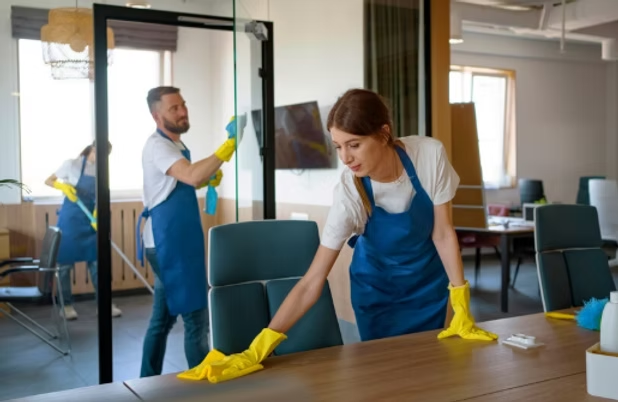
The distinction between janitorial work and commercial cleaning services has blurred in common usage to the point where the two are treated as interchangeable. They aren’t, and the difference matters more than most businesses realise when they’re evaluating what they actually need. Janitorial work is the baseline: emptying bins, vacuuming floors, wiping surfaces, restocking consumables. It keeps a space functional. The commercial cleaning services that are genuinely changing outcomes for their clients are doing considerably more than this, and the gap between janitorial baseline and comprehensive commercial cleaning is where most of the value in the category actually lives.
Deep Cleaning as a Scheduled Programme, Not an Emergency Response
Most commercial spaces receive regular janitorial maintenance and occasional deep cleaning when something has become visibly problematic. The best commercial cleaning operations like https://www.cleanbeecommercial.ie/ have inverted this model, treating deep cleaning as a scheduled preventive programme rather than a reactive one.
Deep cleaning at scheduled intervals, quarterly for most commercial environments and more frequently for high-occupancy or regulated spaces, addresses the accumulation of contamination in areas that routine maintenance can’t reach. Ventilation grilles, the backs of kitchen equipment, the drainage infrastructure in food service areas, upholstery in waiting rooms, the grout lines in tiled areas, the seals around sanitary fixtures: all of these accumulate biological and particulate contamination over time that routine cleaning doesn’t address and that eventually affects the hygiene standard of the space in ways that become visible and in some cases problematic from a compliance standpoint.
The economics of scheduled deep cleaning versus reactive deep cleaning are consistently better. A kitchen extraction system cleaned quarterly costs a fraction of the emergency remediation required when grease accumulation creates a fire risk. A scheduled fabric and upholstery programme extends the life of furniture significantly compared to waiting for visible soiling before cleaning. The preventive argument for deep cleaning is the same as the preventive argument for any maintenance programme, and in commercial cleaning it’s equally well-supported.
Specialist Services That Extend the Value of the Relationship
The commercial cleaning services that are genuinely expanding their value to clients are building specialist capabilities alongside routine maintenance rather than offering solely the baseline.
Exterior cleaning, including facade washing, car park sweeping, gutter clearing, and the maintenance of building approaches and entry surfaces, represents the part of a property’s first impression that a janitorial programme never touches. The exterior of a commercial property tells the same story about the organisation as the interior, often to a wider audience, and it’s typically less well-maintained because the responsibility falls between facilities and janitorial budgets without clear ownership. A cleaning service that manages both eliminates this gap.
Post-construction and post-renovation cleaning is a specialist service with distinct requirements from routine commercial cleaning. Construction debris, plaster dust, adhesive residues, and the surface contamination that builds up during building work require specific approaches and equipment to address properly. A commercial cleaning provider with genuine post-construction capability delivers a site that’s ready for occupancy in a way that general cleaning staff applying standard programmes don’t.
Carpet and hard floor specialist cleaning, using extraction equipment and appropriate chemistry, goes considerably further than regular vacuuming and mopping in restoring floor surfaces and extending their working life. For commercial environments where flooring represents a significant capital investment, periodic specialist floor care produces measurable returns in reduced replacement frequency.
Window cleaning at height, handled safely with appropriate equipment and working at height certification, is another service that most janitorial programmes don’t include but that most commercial buildings require. The external appearance of commercial glazing is a significant component of building presentation, and it’s one that deteriorates visibly with weather, atmospheric deposit, and the accumulation of surface contamination that rainfall redistributes rather than removes.
Consumables Management and Supply Chain Integration
This is a category that receives very little attention in discussions of commercial cleaning service quality but that affects the daily experience of a building’s occupants more directly than almost anything else in the cleaning programme.
Consistent availability of toilet paper, paper towels, soap, and hand sanitiser sounds basic. The reality in many commercial environments is that consumables run out, aren’t restocked at the right intervals, and create daily friction for everyone in the building. A cleaning service that manages consumables as part of its service, with responsibility for monitoring stock levels, ordering to appropriate pars, and restocking on the service schedule, removes an operational complexity from the client and delivers a more reliable experience to the building’s users.
Cleanbee commercial cleaning has developed its service offering in this direction, treating consumables management as a core component of the cleaning relationship rather than as the client’s separate responsibility. The practical benefit to the businesses it serves is that the facilities management task of keeping a building properly stocked with hygiene consumables sits with the same provider as the cleaning programme, reducing the coordination overhead and eliminating the category of problems that arise when the two responsibilities are handled separately.
Environmental Reporting and Sustainability Documentation
Corporate clients with sustainability reporting requirements are increasingly asking their cleaning providers for documentation that supports their supply chain environmental data. This is moving from a nice-to-have to a specification requirement in procurement conversations with larger commercial occupiers.
The cleaning services equipped to meet this demand provide data on the products used, their environmental classifications, waste generation, water use, and in some cases carbon metrics associated with their service delivery. This documentation integrates into the client’s broader environmental reporting rather than being a separate exercise the client has to manage independently.
For commercial cleaning services that have genuinely restructured their product programmes around lower-impact chemistry, this reporting capability reflects a real operational reality rather than marketing language. For those that haven’t, assembling the documentation is more difficult because the underlying data isn’t favourable.
Account Management as a Distinct Capability
The best commercial cleaning services have recognised that the quality of the relationship with the client determines outcomes as much as the quality of the cleaning itself. An account management capability that includes proactive communication, regular service reviews, and a responsive escalation process for issues is what distinguishes a cleaning relationship that improves over time from one that holds steady at best.
Reactive cleaning providers handle complaints when they arise. Proactive account management surfaces issues before they become complaints, adjusts service programmes as the client’s space and needs evolve, and maintains a dialogue about whether the current programme is still the right one. A business that has expanded, reconfigured its space, or changed its occupancy patterns needs its cleaning programme to evolve accordingly, and that evolution requires a provider willing to have the conversation rather than simply continuing the original scope.
The commercial cleaning services that are genuinely going beyond basic janitorial work are the ones that have built all of these capabilities: deep cleaning as a preventive programme, specialist services across the full range of a property’s needs, consumables management, environmental documentation, and account management that treats the client relationship as something worth investing in actively. The distance between this and a standard janitorial contract is considerable, and the businesses that have experienced both tend to be clear about which one produces better outcomes for them.


