



Walk into any gaming community — Reddit, Discord, YouTube comment sections — and the gacha debate is always running somewhere in the background. People defending their favorites, dismissing the competition, or quietly admitting they play three of these games simultaneously while pretending they only play one.
Fair enough. The genre is enormous now, and picking where to invest time is a genuine decision.
So here is a proper look at where things actually stand.
Spending in Gacha — Getting Honest About It
The criticism is fair: getting specific limited characters in Genshin without spending requires either extraordinary luck or grinding over multiple patches. Primogems trickle in through daily commissions, exploration, and events. Saving up for a guaranteed five-star takes time.
Where Genshin holds up better than many competitors is that spending is never required to enjoy the game. Progression is not paywalled. The endgame Spiral Abyss has been cleared on countless occasions with four-star teams by free-to-play players who knew what they were doing. The game just does not force wallets open to keep playing.
For players who do top up, being smart about it matters. LootBar is a trusted gaming store where a Genshin topup often comes at better rates than buying directly — promotional discounts run regularly, and the transaction process is clean and fast. It has built a solid reputation among players who top up consistently and care about getting actual value from what they spend.
Using a reliable shop like LootBar for a Genshin topup is simply a smarter approach than going through default channels every time, especially for anyone playing long-term.
The Problem Most Gacha Games Never Solved
Here is something worth saying upfront — a huge portion of the gacha genre is built backwards. The game exists to support the gacha system, not the other way around. Pull a character, watch a cutscene, clear some auto-battle stages, maybe read a few lines of story, repeat. The actual playing part is secondary to the collecting part.
That worked for a while. It still works for certain audiences. But it created a ceiling on what gacha games were allowed to be.
Genshin Impact ignored that ceiling. When HoYoverse released it in September 2020, they essentially built a console-quality open-world RPG and attached a gacha system to the side of it. The exploration, the combat, the world design — none of that required spending. The gacha was there for characters. The game was built to be played regardless.
That single decision changed what was possible in the genre.
Teyvat Is Not a Loading Screen With Lore Attached
Other open-world gacha attempts have existed. Most of them build wide and shallow — big maps with not much to find, story that exists as justification for combat rather than something worth following on its own terms.
Genshin’s world does not feel that way. The regions — Mondstadt, Liyue, Inazuma, Sumeru, Fontaine, Natlan — each carry genuine identity. Different architectural styles, different political climates, different music. Liyue sounds and looks nothing like Fontaine. Natlan fights differently from anywhere that came before it. The world is not a reskin with new enemies. Each nation feels researched.
The lore runs deep too, buried in item descriptions, environmental details, and NPC dialogue that most players never dig into. It is the kind of world-building that rewards curiosity rather than demanding attention — which is harder to pull off than it sounds.
Combat That Actually Has Something Going On
Turn-based systems dominate gacha gaming. Not because they are bad — Honkai: Star Rail proves they can be excellent — but because they are cheaper and faster to build at scale. Real-time action combat at the quality Genshin delivers takes significantly more investment.
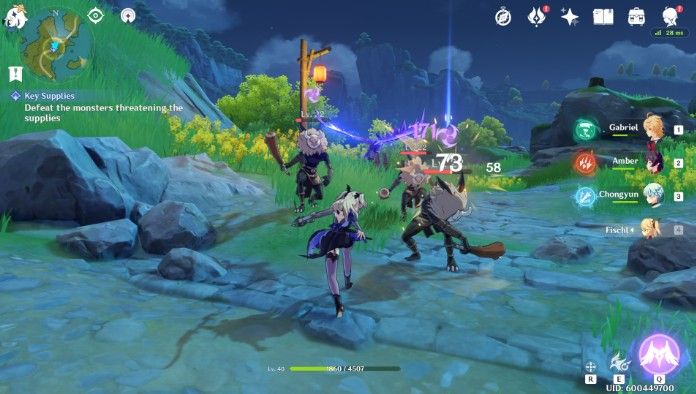
The elemental reaction system is what makes Genshin’s combat genuinely interesting. Pyro, Hydro, Cryo, Electro, Dendro, Geo, Anemo — these elements do not just deal different damage types. They interact. Freeze enemies solid with Cryo then Hydro. Vaporize with Pyro meeting Hydro for amplified damage. The Dendro reactions added entire new layers when Sumeru launched. Good team building in Genshin is actually a puzzle worth solving, not just stacking whoever has the highest numbers.
That depth is rare. Most gacha games do not bother.
Looking at the Competition Without Bias
Fate/Grand Order built an empire. No exaggeration — it remains one of the highest-grossing mobile games ever released, particularly in Japan. The story, tied to the expansive Fate universe, is genuinely ambitious in scope. Veteran players have an almost tribal loyalty to it.
But the gameplay never evolved much past its 2015 origins. Simple turn-based combat, static character art, pull rates that have historically been brutal. The story carries a lot of weight that the moment-to-moment gameplay cannot.
Arknights is the tactical defense game that attracted players who wanted something cerebral. The character designs are striking. The strategic depth is real — some of its endgame stages require genuine planning to clear. It has earned its audience.
What it struggles with is accessibility. Heavy text delivery, a steep learning curve, and an aesthetic that skews toward a specific taste. Players who love it tend to really love it. Others bounce off immediately.
Honkai: Star Rail — also HoYoverse — is the fairest comparison to Genshin and worth treating separately. The production quality matches. The writing is sharp. The turn-based combat is among the best in the genre, and its Simulated Universe mode shows real design creativity. Many players run both games comfortably because they scratch different itches. Calling one better than the other is mostly a question of whether someone prefers action combat or strategic turn-based — not a quality gap.
Tower of Fantasy had the most aggressive positioning against Genshin at launch. Open world, action combat, online multiplayer features. On paper, the closest challenger. In practice, the story never found solid footing, the character designs felt derivative, and launch-period bugs damaged the first impression significantly. It has recovered and built its own community, but never landed the knockout it was supposed to deliver.
Why Genshin Still Has the Conversation
Five years in, Genshin is still a major release event whenever a new region drops. Still trending when a new character banner goes live. Still generating fan art, concert tours, cosplay — cultural weight that no other gacha game has managed to replicate at the same global scale.
The six-week update rhythm keeps content arriving before the previous patch goes stale. The story has grown into something with genuine emotional moments. The music — performed live at orchestral events across multiple countries — has fans who follow it independently of the game.
That kind of staying power does not come from marketing. It comes from a game that keeps delivering reasons to return.
The Bottom Line
Personal taste is always the final word. Some players will always prefer turn-based combat. Some are locked in with FGO because of franchise loyalty nothing else can touch. Some find the tactical demands of Arknights more satisfying than Genshin’s action combat ever could be.
All of that is legitimate.
But if the question is which gacha game has built the most complete experience — deepest world, strongest combat mechanics, most consistent content delivery, highest production value — Genshin Impact’s answer is hard to argue with. The competition has had five years to close the gap and has not managed it.


