

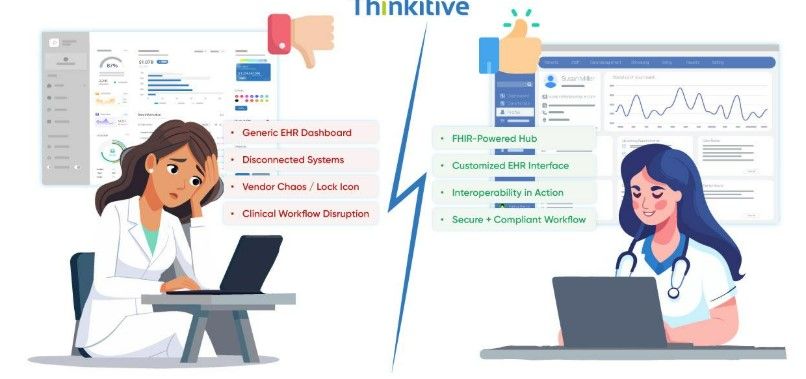
Mr. John is a cardiologist who has recently implemented his EHR; however, rather than efficiency, he is facing roadblocks. The problem here is using generic EHR integration and not an EHR integration that seamlessly connects unique workflows and specialty devices.
If you are a specialist or a specialty-focused healthcare provider, you might be facing the same troubles. This occurs due to unique workflows and different needs as specialty changes, like cardiologists’ needs for integrating ECG and other devices with EHR.
While generic practices face troubles with medical software integration, they only have to worry about a single front. But specialty practices require both general healthcare capabilities and tailored features that generic systems can’t provide.
For instance, dermatologists need high-resolution imaging systems for accurate diagnosis, and oncologists need 3D imaging capabilities integrated into their workflows.
Moreover, in today’s connected healthcare, surviving without EHR integration is not possible. This is why successful integration can decide whether or not the specialty can maintain clinical excellence and achieve operational efficiency at the same time.
If you know what challenges and how EHR integration solutions can help you overcome them, succeeding becomes much easier.
In this blog, we are going to explore this same thing. You will know what unique challenges specialty practices face and how they can overcome them without compromising efficiency on both the clinical and operational fronts.
Let’s get to understanding the unique integration landscape of specialty practices.
Understanding the Unique Integration Landscape of Specialty Practices
For specialty practices, EHR integration is not just hard; it’s completely different from generic practices. Because of unique workflows, compliance requirements, and complex tech stacks, traditional EHR integration can’t cover all the aspects of specialty practice. Here’s what makes specialty EHR integration challenging:
- Custom Workflows for Clinical Complexity
Standard EHRs are made with generic clinical workflows in mind, whereas in specialty practices, workflows change according to the specialty. A cardiologist will require different workflows than a dermatologist. Moreover, they have specialized data like stress levels and image measurements that need to be captured accurately.
- Specific Regulatory & Compliance Requirements
Specialty providers need to meet additional regulations along with standard compliance like HIPAA and GDPR. For instance, cardiologists need to submit quality reports to ACC NCDR registries, whereas oncologists must report to QOPI.
Additionally, medical devices need to be approved by the authorities, such as the FDA, to ensure device safety and accuracy. And the practices that focus on research need integration with the research or clinical databases.
- Different Patient Population Affecting Integration Strategies
The patient population changes based on the specialty, and this means the patients’ needs also change. Complex and chronically ill patients need remote tracking and specialized monitoring. Whereas to manage highly acute patients, providers must have real-time access to patient histories and vitals. Care coordination must also be seamless, as you can’t know when a patient will need you or the care team.
- Complexity of Technology Ecosystem for Specialty Environments
Specialty practices handle multiple systems, like imaging and EKGs, which means added complexity while integrating with EHR. This also creates a situation where there are multiple vendors that have different integration needs and infrastructures. Moreover, equipment is often outdated and comes with limited integration capabilities, making it difficult to seamlessly integrate them into workflows.
Common Integration Challenges Across Medical Specialties
Although each specialty is different, there are some challenges that all specialty practice medical software integration faces. Whether you are a cardiologist, neurologist, or orthopedic, these challenges will trouble you during the integration process. Let’s take a look at those challenges:
Device & Equipment Integration Complexity
Specialty practices use advanced devices for diagnosis, and connecting those devices to EHR is not always simple. Common pain points include:
- Proprietary data formats and protocols that resist standard integration.
- Real-time monitoring requirements for high-risk patients.
- Seamless sync of calibration and quality control data for regulatory compliance and patient safety.
Data Standardization & Interoperability Issues
Not every specialty uses the same medical codes; specialty practices sometimes use custom coding systems that are not always supported by generic integration. Some consistent blockers are:
- Difficulties in the integration of multimedia files, such as diagnostic images or video loops.
- Standardizing measurements from diverse devices and platforms.
Workflow Disruption Risks
Integration processes can stop the day-to-day routine and clinical workflows if not handled well. These are the problems:
- Transition downtime can stop care continuity.
- Change can be resisted by the staff and create confusion if not explained well.
- Disruption to scheduling and coordination processes.
Vendor Management & Support Complexity
Speciality practices have many vendors, and not aligning them accurately can lead to maintenance conflicts and patchwork updates. This also increases costs if the multiple specialized systems are connected seamlessly with each other and the EHR system.
Specialty-Specific Integration Solutions & Best Practices
When it comes to solving the integration challenges for specialty practices, each practice needs different and tailored solutions. Let’s take a look at how you can solve the issues for some practices:
- Cardiology Integration Strategies & Proven Approaches
Cardiology practices need to collect ECG data, cardiac imaging data, and handle remote monitoring tools. This is why EHR integration solutions need to directly link diagnostic equipment to EHR for real-time data capture.
Also, all the catheterization lab, imaging reports, and data from medical devices like pacemakers and ICD monitoring must be viewed in one unified window. This way, cardiologists can be aware of all changes and leverage EHR integration to its full potential.
- Orthopedic & Surgical Specialty Integration Solutions
Practices that specialize in orthopedic and surgical require end-to-end integration that includes pre-operative planning software. By syncing these systems with patient records and scheduling tools, practices can ensure surgical teams are fully prepared.
Imaging and templating tools help quite a lot when it comes to documenting patient details. It makes it easy by directly feeding the details into patient profiles on the EHR systems. Integrating physiotherapy and rehab tracking tools helps close the gap between post-surgery and improving care continuity and outcomes.
- Dermatology & Visual Specialty Integration Approaches
For dermatology and dermascopy integration, it needs to connect with imaging systems. It should support digital photography, dermoscopy, and cosmetic procedure documentation, with the ability to compare before and after results. Lab integration is also key for managing biopsy results efficiently and accurately.
- Mental Health & Behavioral Specialty Integration Considerations
Mental health providers need seamless access to assessment tools, therapy notes, and medication records. Integration here supports structured documentation of treatment plans, risk assessments, and psychiatric medication monitoring, ensuring patients receive consistent, coordinated care.
Technology Architecture & Platform Selection for Specialty Integration
Choosing the right tech stack is essential for a seamless and successful integration. From APIs to data storage, each layer of architecture plays a critical role in performance, scalability, and compliance.
- Evaluating EHR Platforms: First step here is to find a right EHR platform that goes beyond basic EHR features and has integration flexibility. The points that you should consider are robust API availability, high-quality documentation, and a certified app marketplace with speciality-focused modules. Check if the platform lets you customize the workflows and templates to match your complex workflows.
- Integration Platforms & Middleware Solutions: In a multi-system environments, integration engines and middleware are essential to seamlessly manage data exchange. Cloud-based solutions offer scalability and flexibility, while interface engines tailored to healthcare handle specialty workflows effectively.
- Data Architecture & Storage Considerations: Specialty data often includes multi-medial files such as diagnostic images or videos of procedures. Here optimized database architecture is essential to ensure fast query performance. Having backups and disaster recovery in place is also necessary to protect patient data in case of system breakdown.
- Security & Compliance Architecture: In healthcare keeping patient data secure and private is the top priority. So, ensure the platform and specialty applications are HIPAA compliant. It must also meet additional security requirements like FDA and certain registries. End-to-end encryption, role-based access control, and audit trails must be embedded into the architecture from day one.
Implementation Strategies for Successful Specialty Practice Integration
EHR integration in specialty practices isn’t just a tech project, it’s a high-stakes clinical transformation. Without a thoughtful rollout plan, even the best integration can lead to workflow disruptions, frustrated clinicians, and poor adoption.
Successful implementations blend phased rollouts, targeted staff training, and rigorous vendor coordination to ensure clinical continuity and long-term value. Here’s how to approach it strategically:
| Implementation Area | Best Practices |
| Phased Rollouts & Clinical Continuity | – Start with pilot programs in a single department or workflow
– Roll out gradually to balance change with stability – Use parallel system operation during the transition to avoid care disruption |
| Change Management & Training | – Develop specialty-specific training programs
– Identify physician champions to drive peer adoption – Offer ongoing support and optimization post-go-live |
| Vendor Coordination & Project Management | – Use master project plans to align timelines across vendors
– Set up clear communication and escalation channels – Test all systems together to validate interoperability |
| Performance Monitoring & Optimization | – Track specialty-specific KPIs and clinical efficiency metrics
– Implement contin |
Conclusion
In a nutshell, EHR integration in specialty practices face unique challenges that a standard EHR integration cannot solve efficiently. For overcoming these challenges you need to adjust the integration according to each specialty.
The key to successful integration for specialty practices is to understand one-size-fits-all approach do not work here. So, ready to optimize your specialty practice through strategic EHR integration?
Thinkitive can help you in your specialty medical software integration and achieve seamless integration. Click here to book a call with our specialists right now.
Frequently Asked Questions
- How do integration requirements differ between specialty practices and primary care practices?
Specialty practices often require deeper integrations with advanced diagnostic tools, imaging systems, and niche workflows, unlike primary care, which typically uses more standardized processes. Their integrations must support complex care coordination, specialty-specific data, and tighter compliance demands.
- What are the most critical systems that specialty practices need to integrate with their EHR?
Specialty practices often need to integrate systems like diagnostic imaging tools, lab information systems, surgical planning software, and remote monitoring devices. Seamless EHR connections to these systems ensure smoother workflows, better data access, and more coordinated patient care.
- How can specialty practices evaluate EHR platforms for integration capabilities before implementation?
Specialty practices should look beyond flashy features and ask, “Can this EHR actually work with our tools and workflows?” Evaluate API support, integration certifications, customization options, and whether it offers specialty modules tailored to your specific clinical needs.
- What are typical costs and timelines for comprehensive specialty practice EHR integration?
Comprehensive EHR integration for specialty practices typically takes 6 to 12 months and can cost anywhere from $100K to $500K, depending on complexity, vendor count, and customization. The real investment, though, is in long-term efficiency and patient care.
- How do specialty practices handle device integration and medical equipment connectivity?
Specialty practices tackle device integration by working with vendors to connect equipment like ECGs, imaging tools, or surgical systems directly to the EHR. This often involves a mix of custom interfaces, middleware, and hands-on coordination to ensure data flows smoothly.
- What regulatory compliance considerations are unique to specialty practice integration?
Specialty practices often face extra layers of compliance, such as FDA regulations for connected devices, specialty board reporting standards, or clinical trial data rules. Integration needs to support these unique requirements while still meeting core HIPAA and HITECH obligations.
- How can small specialty practices afford comprehensive integration solutions?
Small specialty practices can afford integration by starting small—focusing on high-impact areas first, using scalable cloud-based solutions, and partnering with vendors offering flexible pricing. Grants, value-based care incentives, and phased implementation also help spread out costs.
- What are the biggest risks and challenges in specialty practice integration projects?
The biggest risks in specialty practice integration include disrupting patient care, poor user adoption due to inadequate training, and data mismatches between systems. Without careful planning, it’s easy to end up with fragmented workflows and frustrated clinicians.
- How do specialty practices maintain clinical workflow continuity during integration implementation?
Specialty practices maintain workflow continuity by starting with small pilot programs, running new and old systems in parallel, and gradually rolling out changes. This phased approach helps staff adapt without disrupting patient care or daily clinical operations.
- What training and change management strategies work best for specialty practice staff?
The best training and change management strategies for specialty practice staff are personalized, hands-on, and peer-driven. Think specialty-specific training sessions, physician champions leading by example, and ongoing support that respects each clinician’s unique workflow and learning curve.
- How can specialty practices measure ROI and success from integration investments?
Specialty practices can measure ROI by tracking improvements in clinical efficiency, reduced manual workload, faster data access, and fewer errors. Pair that with metrics like patient outcomes, staff satisfaction, and billing accuracy to see the real impact.
- What future technologies will most impact specialty practice integration strategies?
Emerging tech such as AI-driven interoperability tools, FHIR-native platforms, and ambient clinical intelligence will reshape specialty integration. These innovations promise faster data exchange, smarter workflows, and fewer manual tasks, giving clinicians more time to focus on complex patient care.
