



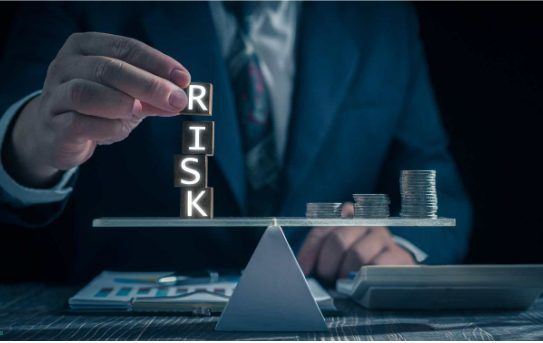
Every leader must deal with uncertainty. The question is not whether risk exists, but how it is handled. Less experienced decision-makers often see risk as something to avoid completely. More experienced leaders understand that risk itself is not always the problem. Unmanaged risk is.
There is an important difference between taking a risk and managing one. Taking a risk means accepting the possibility of an uncertain outcome. Managing risk means assessing the context, likelihood, and potential consequences before deciding how to proceed.
The most effective leaders do both. They are willing to act without guarantees, but they do not act without preparation.
How experienced leaders think about uncertainty
Experienced leaders do not try to eliminate uncertainty. They create frameworks for making sound decisions. This is one of the clearest differences between confident leadership and reactive leadership: when pressure rises, less experienced decision-makers may delay action, rely too heavily on instinct, or treat every possible threat as equally urgent. Strong leaders take a more measured approach.
A useful way to understand this mindset is to examine structured situations in which outcomes remain uncertain but decisions are guided by information, probability, and established rules. Consider decision-making in a game of blackjack, for example: a skilled player does not simply guess. They assess the visible information, consider the probable outcomes, and follow a disciplined strategy. The result is never guaranteed, but the decision itself is not random.
Business leaders operate in a similar way. They gather relevant data, consider different outcomes, and act with intention. The result may still be uncertain, but the process can remain consistent and rational.
Risk assessment frameworks that support better decisions
Effective leaders use structured risk frameworks to support their judgment. A risk matrix, for example, can help teams identify threats, assess their likelihood, and estimate their potential impact. This allows leaders to decide which risks require immediate action and which can be monitored.
The goal is not to treat every threat equally. A frequent but minor problem requires a different response from an unlikely event that could cause serious financial, operational, or reputational damage.
Scenario planning provides another useful approach. It encourages leaders to ask what might happen under several different conditions rather than relying on a single forecast. By mapping out possible outcomes in advance, teams are better prepared to respond when markets, customer behaviour, or operating conditions change.
These frameworks do not remove uncertainty or bias. They reduce their influence and give teams a shared method for discussing high-stakes decisions. For executives, this consistency is especially important when decisions affect budgets, staffing, strategic priorities, or long-term commitments.
Probabilistic thinking as a leadership skill
Many people view decisions in simple terms. An idea will either work or fail.
Strong leaders think differently. They consider a range of possible outcomes and estimate the likelihood of each. Instead of seeking certainty, they make choices that offer the greatest long-term value based on the available evidence. This is not reckless. It is a structured way of thinking.
Probabilistic thinking also recognises an uncomfortable truth: a good decision can still produce a poor result, while a badly judged risk can occasionally succeed. That is why leaders should evaluate the quality of the decision-making process, not just the final outcome.
Leaders who develop this skill tend to make better-calibrated choices over time. They are less likely to panic after an unexpected setback or become overconfident after an early success.
Building this mindset takes practice. It requires leaders to challenge their assumptions, look for evidence that may contradict them, and avoid reducing complex problems to simple yes-or-no answers.
Contingency planning and the prepared leader
Taking a significant risk without considering fallback options is not bold; it is often reckless. Contingency planning helps leaders prepare for situations in which the original strategy no longer works. A useful plan answers several practical questions. What happens if the expected result does not occur? At what point should the team change direction? Who has the authority to make that decision?
Resilient organisations make this kind of thinking part of their culture. Teams are encouraged to identify possible failures early, not to discourage action, but to reduce avoidable disruption.
Clear trigger points are particularly important. Leaders should decide in advance which warning signs will require a change in direction. Roles and decision-making authority should also be defined before a crisis begins. Trying to clarify responsibilities while an organisation is already under pressure can delay action and increase operational risk.
Long-term strategic decision-making
Short-term thinking is a common leadership trap. Avoiding risk today may create higher costs later, while accepting a calculated risk may strengthen the organisation’s position over time.
Strong leaders deliberately extend their time horizon. Instead of asking only, “What does this solve today?” they also ask, “What could this enable in five or ten years?” That shift changes how risk is evaluated.
A decision that appears expensive or uncertain in the short term may support stronger capabilities, better systems, or a more durable competitive position. At the same time, leaders must ensure that long-term ambition does not ignore current cash flow, operational capacity, or stakeholder expectations.
For management teams, this means balancing future opportunity with the organisation’s ability to absorb setbacks in the present.
Risk should not simply be minimised. It should align with strategic priorities, be supported by evidence, and be matched to the organisation’s capacity to respond.
From unplanned risk to deliberate action
Uncertainty is not the enemy. Unmanaged risk is.
Great leadership is not about avoiding every uncertain decision. It is about improving the odds through preparation, evidence, and disciplined judgment. When leaders use clear frameworks, think in probabilities, prepare alternative responses, and maintain a long-term perspective, risk becomes more deliberate and manageable.
Handled well, risk management can become a meaningful source of strategic advantage.


