

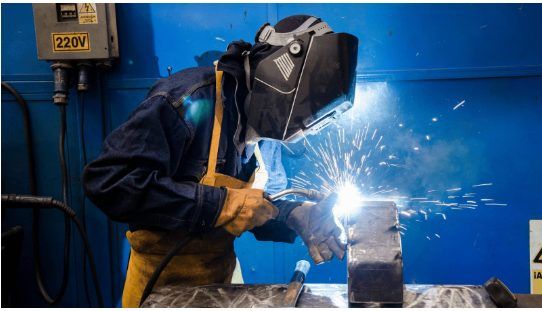
### Understanding MIG Welding
Before going to learn optimisation tricks its mandatory to have basics of **MIG Welding**. A process which employs a continuous filler wire (electrode) that feeds through a welding gun and into the weld puddle, joining base materials with the resulting weld having high mechanical properties. The welding gun also sends out a shielding gas (usually an Ar-CO2 mix) to protect the weld from airborne contaminants.
Note: UDO.CO.TH is a leading supplier of all types of welding wires. We maintain a ready-to-ship stock to meet the needs of businesses and industries. Additionally, if you have any questions about our welding products, our experienced specialists are available to offer advice and guidance.Visit us to learn more about welding wires at https://www.udo.co.th/category_product/กลุ่มลวดเชื่อม
**MIG Welding**: **MIG** Your Move on High Production Lines typically requiring high production rates would go to the MIG welding process because of its user-friendly and speed. A Successful Weld Requires more than just Laying a Bead In this post, we examine a few of the essential details that help make your one pager effective.
### 1. Selecting the Right Equipment
Choosing the right equipment is one of the first steps toward optimal **MIG Welding**! When your welder is unable to penetrate the materials in which you are working on. For instance, if you welding a thick steak then you welder with a high amperage range. Conversely, a great low control welder will prevent burn-through for some super thin sheet metal.
Also, a spool gun for aluminum welding is worth considering as it will eliminate wire feeding concerns. Additionally, your welding gun choice, the type of shielding gas used and even the diameter of wire you are going to use can have a notable impact on how well or poorly your welds will be based on those factors.
### 2. Proper Material Preparation
Base Material Preparation: The Key to Better **MIG Welding** Contaminants are often introduced into the weld from dirty, rusted or painted surfaces resulting in poor joints and long term durability. Make sure that you clean the material well with a wire brush or grinder before welding.
Proper fit-up (or better to say bombed?) between the metals is also paramount. If there are gaps or misalignments, the weld will not be uniform and they typically result in a reduced strength. Correct clamping of the materials will secure retention, proper alignment and prevent movement during welding.
### 3. Configuring the Right Params
Mistake #1: Incorrect Machine Settings in MIG Welding **One** of the most common mistakes **made while MIG welding** is using improper machine settings. The three important settings to focus on are voltage, wire feed speed, and shielding gas flow.
– **Voltage:** Voltage regulates the arc heat. [/column] If set too low, there is a risk of poor penetration and if set too high, excessive spatter and burn-through may result.
Wire Feed Speed: It determines the quantity of filler material entering into the weld. Match the wire speed with the voltage for a consistent arc operation. A wire speed that is too fast will create a huge amount of netting, while wire speed that is too slow can cause poor penetration.
– **Gas Flow Rate:** When the gas flow is not consistent enough, contaminants in surrounding air can make way into the weld and cause porosity or weak joints. Set the gas flow rate correctly for your working environment (winds may require higher flows).
### 4. Welding Technique Mastered
Most importantly, no matter the equipment or material preparation but if your **MIG Welding** technique sux then you are looking at weak and non-durable *welds. Controlling the bead width and thus crayons — A steady hand that moves at an even pace will produce a strong weld bead.
– **Travel Speed:** traveling too fast can result in incomplete fusion and poor welds, while moving too slow will cause the material to overheat which will lead to excessive penetration. Keep your travel speed steady to produce a regular bead and good penetration.
— **Torch Angle**: Torch angle also helps control the weld bead. Most of the time, you will want to hold your gun at 10-15 degrees off vertical. A correct torch angle provides better arc control and gas coverage.
– Weaving and Stringer Beads: Sometimes it may be used to weave or stringer bead Technique based on material and joint type. Weaving — this is moving the torch from side to side, which adds width to the weld bead. Stringer beads are straight passes and used in thinner materials. Test the methods according to your project needs.
### 5. Ensuring Proper Penetration
Penetration is the depth to which the weld extends into the base material. You definitely want to ensure that you get sufficient penetration without overdoing it for the the best strength and durability. If the penetration is too great it will weaken the weld and cause burn-through, but if it is too little then you end up with a poor bond.
Penetration is checked or inspected on the back side of the weld. Some small welding that can be seen on the back side suggests good penetration. If your weld has not fully reached the back, you may have to crank up your voltage or switch up a little on your technique.
### 6. Inspection And Testing Of Post-weld
After you have completed your weld make sure to inspect for any failures on the weld (cracks, porosity, undercut,…). Many of the issues on this list can be caught simply by looking at your work, but in critical applications you will need to do additional testing including (but not limited to) performing X-ray or ultrasonic inspections to make sure that welds meet necessary standards.
Also, the right type of welding-related post-cleanings matter for a life-long weld. Trapped impurities must be avoided in subsequent weld layers, and thus the removal of slag and spatter is essential especially with multi-pass welds.
### Conclusion
Improving your **MIG Welding** skills will make sure that you routinely create good strong and sturdy welds. Every step, from choosing the correct equipment and arranging the materials to entering the right parameters and perfecting your skills, contributes to achieving good results. If you follow these steps and keep practicing, you can become a better welder and make sure your welds are strong. To get more information about **MIG Welding**Gears, Accessories and Professional tips go to https://www.udo.co.th/category_product/กลุ่มลวดเชื่อม
