



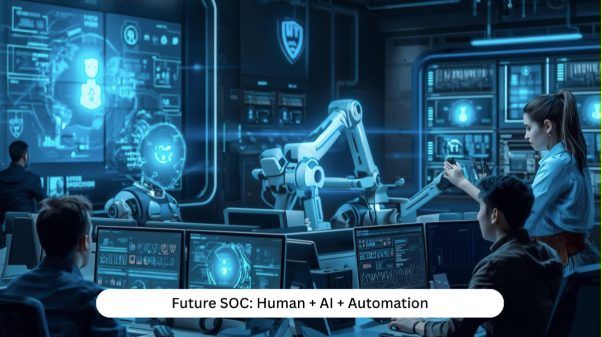
The Security Operations Centre (SOC) is still the most important part of a company’s digital defence. As threats change, the SOC will use AI and automation along with human knowledge to find threats more quickly, respond more quickly and give clearer security information.
AI and automation make incident response, threat detection, and security analytics better, but human analysts give machines the context and judgement they can’t replicate. This model of working collaboratively helps security teams lower risk and improve security outcomes overall.
The Evolution of Security Operations Centres
The Security Operations Centre (SOC) has changed from manual monitoring to continuous, tool-driven defence. The future of SOC depends on people, processes and technology to work collaboratively and protect a company’s data and systems 24/7 because threats and attack surfaces have grown.
Traditional SOC Models and Their Limitations
Traditional SOC models depend a lot on human analysts and isolated tools. That method struggles with scalability and costs a lot to operate. It also has a higher chance of human error. These limits make it hard for older models to provide the speed and range of coverage that is needed today.
The Shifting Cybersecurity Situation in India
India’s quick adoption of technology has made it easier for hackers to get into systems and increased the amount of telemetry and alerts that SOCs have to deal with. Indian businesses increasingly need security operations that can grow and work together to handle faster data and smarter enemies.
Why SOCs Need to Change
SOCs need to switch from manual, reactive models to hybrid systems that use automation, AI, and better integration to stay useful. Updating the model reduces time to detect and respond, lowers costs and enables analysts to focus on higher‑value security work.
Problems that Modern SOCs are Facing Right Now
Modern SOCs face several ongoing problems that make it hard for them to quickly and reliably find and respond to threats. To fix these problems, we need better tools, smarter workflows and improved analyst support.
Analyst Burnout and Alert Fatigue
Alert fatigue remains a top operational problem: analysts receive high volumes of alerts from multiple systems and struggle to separate true positives from noise. That overload makes it more likely that alerts will be missed and adds to analyst burnout.
Skill Shortage in Cybersecurity
The global shortage of skilled cybersecurity professionals leaves many SOCs understaffed and dependent on overworked teams. So, hiring and retaining experienced analysts is a major constraint on improving detection and incident analysis.
Growing Sophistication of Threats
Adversaries are using more advanced methods like AI-assisted attacks and targeted social engineering. These evolving threats need more contextual analysis and adaptive detection, not just static rule sets.
Data Volume and Velocity Challenges
SOC’s job is to handle more telemetry and event data from logs, endpoints and cloud services. High data velocity makes it hard to extract signal from noise and slows down detection.
The Role of Artificial Intelligence in Modern SOCs
As hackers get better at using sophisticated methods, AI has become an important tool for the future of SOCs. When used correctly, AI helps teams find subtle clues, speed up investigations and give analysts the information they need to act.
Machine Learning for Threat Detection
Machine learning models analyse a lot of telemetry and event data to find patterns that static rules miss. These models can find anomalies, like unusual lateral movement, by learning what normal behaviour is. This improves overall threat detection and reduces the time it takes to find them.
Natural Language Processing for Intelligence Analysis
Natural Language Processing (NLP) sorts through unstructured sources like threat reports, alerts, logs and open-source intelligence to find useful indicators and generate concise info for analysts. That automated summarisation turns raw data into actionable information.
Predictive Analytics for Proactive Defence
Predictive analytics uses historical and current data to forecast likely attack patterns or vulnerable assets. This lets SOCs prioritise hardening efforts before incidents occur. And it shifts the model from reactive monitoring to proactive risk reduction.
AI-Driven Triage and Prioritisation
AI‑driven triage sorts alerts by risk and how relevant they are to the situation, so analysts focus on high‑impact incidents first. For example, an ML model that correlates an unusual authentication event to known threat intelligence can raise that alert for immediate human review, which cuts down on noise and speeds up response times.
These AI capabilities, which range from modelling to natural language processing (NLP) and predictive techniques, improve the capabilities of the SOC and make security operations more scalable and effective.
Human Expertise: Still the Core of Effective SOCs
Even though automation and AI can do a lot of tasks, human expertise is still what makes security operations work well. Machines can process volume and surface signals; people supply context, judgement and creativity that machines can’t.
What Machines Can’t Replace: Intuition and Context
The future of SOC depends on tools and automation, but it cannot replace intuition and context. Analysts use their intuition to link unrelated events, spot subtle shifts in behaviour, and prioritise incidents based on how risky they are for the organisation. For accurate threat analysis, you need to know how systems are used, what assets are most important, and what normal behaviour looks like.
The key aspects that people bring to SOC operations are:
- Organisational context and setting priorities for assets
- Understanding incomplete or ambiguous data
- Evaluating the effects and needs for escalation
- Creative problem‑solving for novel attacks
Conclusion
The future of SOC is a collaborative model in which human expertise, AI and automation work together to make detection better, speed up response times, and make overall security operations stronger. Organisations that bring together people, platforms and processes will be better able to deal with threats that continuously evolve over time.
First, figure out how mature your SOC is. Then, run a focused pilot (detection + SOAR playbook) and invest in training analysts and managing data. These practical steps help make security operations more scalable and lead to measurable improvements.
Well-trusted cybersecurity firms can also help you achieve the optimal security using SOC. CyberNX is one such firm which provides AI powered SOC services that use automation to proactively identify and neutralize threats in real time.
The time to act is now: figure out your capabilities, choose a small and high-impact pilot and measure the results. The next generation SOC is built step by step, with people and machines working together to provide stronger protection.


