



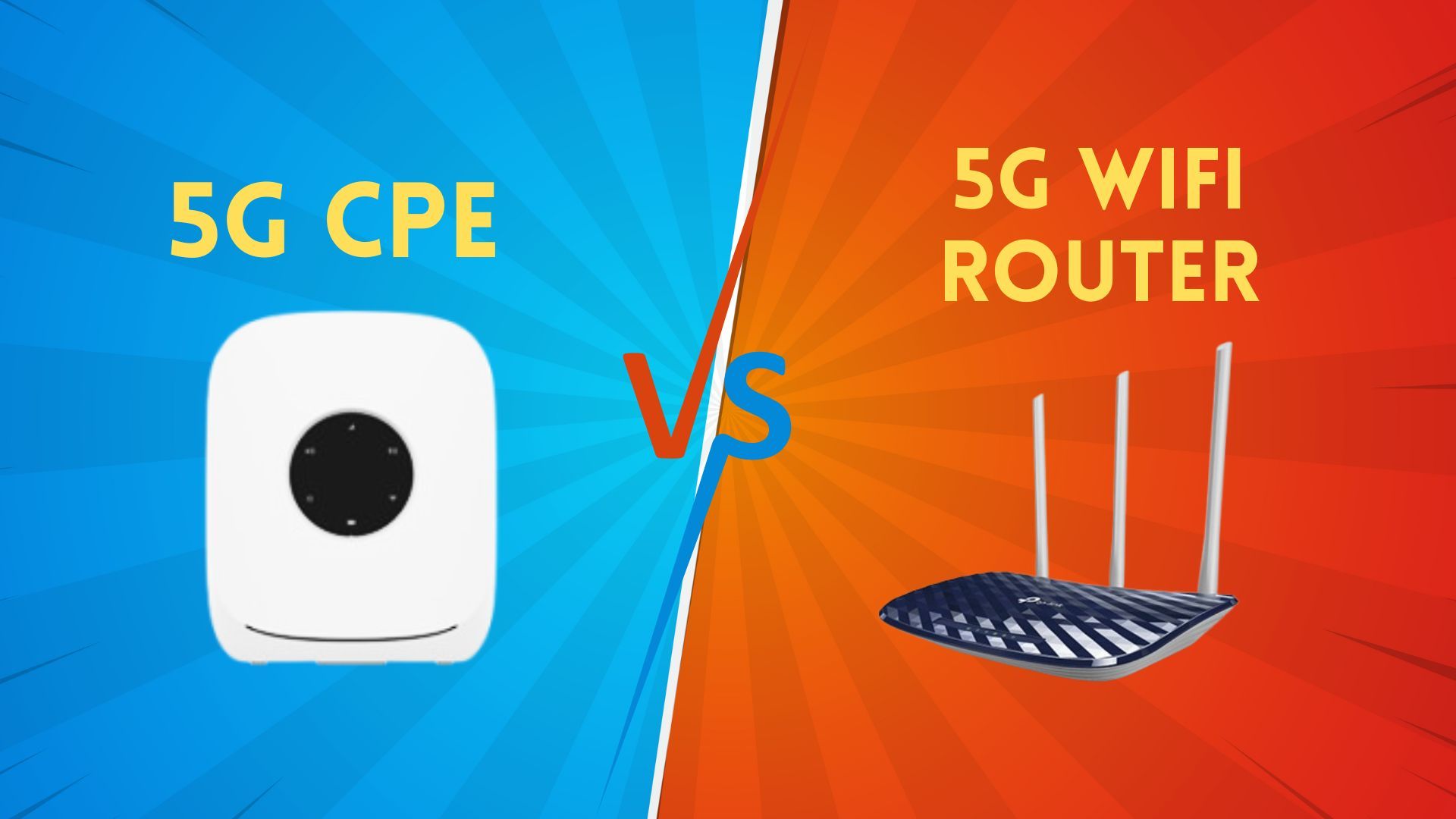
As connectivity becomes a core requirement across homes and enterprises, the comparison between 5G CPE and traditional Wi-Fi routers is increasingly relevant. While both deliver wireless access, they operate on different network foundations and are designed for distinct use cases. Understanding this distinction is key to making the right deployment decision.

This article reframes the comparison into a more practical, scenario-driven analysis, with reference to solutions from VSOL.
Two Devices, Two Different Roles
At a fundamental level, a 5G CPE and a Wi-Fi router do not solve the same problem.
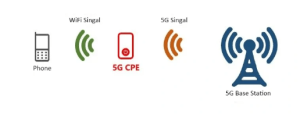
A 5G CPE functions as both the internet access gateway and wireless distributor. It connects directly to a 5G mobile network and converts that signal into usable Wi-Fi or wired connectivity.
By contrast, a Wi-Fi router is only responsible for local network distribution. It depends entirely on an upstream broadband connection such as fiber or cable.
This architectural difference explains why comparisons between the two often lead to confusion. One replaces fixed broadband, while the other relies on it.
Performance in Real Conditions, Not Just Specifications
In theory, 5G promises high bandwidth and low latency. In practice, performance depends heavily on deployment conditions.
A 5G CPE can deliver impressive speeds when signal quality is strong and network congestion is low. However, throughput and latency may fluctuate throughout the day due to environmental factors and shared spectrum usage.
A Wi-Fi router connected to fiber, on the other hand, benefits from a dedicated and stable backhaul. This results in more consistent speeds and lower latency, particularly in bandwidth-intensive or real-time applications such as video conferencing or cloud-based workloads.
The practical takeaway is straightforward: 5G CPE offers flexibility, while fiber-based routing offers consistency.
Deployment Logic: Flexibility vs Structure
The decision between these two solutions becomes clearer when viewed through deployment requirements.
In environments where infrastructure is limited or nonexistent, 5G CPE provides a clear advantage. It eliminates the need for trenching, cabling, and lengthy ISP provisioning, enabling near-instant connectivity. This makes it particularly valuable in rural areas, temporary sites, or rapid rollout scenarios.
Conversely, structured environments such as enterprise campuses or office buildings benefit more from fiber-based networks paired with Wi-Fi routers. These setups allow for controlled network design, predictable performance, and easier scalability.
Solutions from VSOL illustrate this contrast well. Their 5G CPE products enable rapid wireless access deployment, while their PON and enterprise router portfolio supports highly stable, large-scale network architectures.
Where Each Solution Fits Best
Rather than treating this as a direct replacement debate, it is more useful to examine how each technology aligns with specific scenarios.
In remote or underserved areas, 5G CPE often becomes the primary broadband solution due to the absence of fixed-line infrastructure. It provides a practical way to bridge the digital divide without heavy investment.
In enterprise and campus environments, fiber combined with high-performance Wi-Fi routers remains the preferred architecture. These networks require predictable latency, strong security isolation, and the ability to scale across thousands of devices.
For temporary deployments such as exhibitions, construction sites, or emergency setups, 5G CPE stands out due to its portability and ease of installation.
In homes and small businesses, the choice is more nuanced. Users prioritizing stability and long-term cost efficiency tend to favor fiber with Wi-Fi routers, while those needing quick setup or flexibility may lean toward 5G CPE.
Cost Considerations Over Time
Cost differences between the two solutions are not only about hardware, but also about operational models.
5G CPE typically involves lower initial setup costs, as it avoids infrastructure deployment. However, ongoing expenses depend on mobile data plans, which may increase with usage.
Wi-Fi routers, when paired with fiber broadband, often require higher initial installation effort but benefit from predictable monthly costs and better long-term value in high-usage scenarios.
This distinction becomes particularly important for businesses planning network investments beyond the short term.
Integration and Network Evolution
Modern networks are no longer isolated systems. They are expected to integrate with centralized management platforms, security frameworks, and cloud services.
5G CPE is well-suited for standalone or edge deployments, but its role in complex enterprise architectures is typically limited.
Fiber-based networks with Wi-Fi routers offer stronger integration capabilities. They support centralized control, structured topology design, and compatibility with advanced management systems. VSOL addresses this through unified network management solution VSOL INCE that cover OLTs, ONUs, and wireless devices within a single platform.
A More Practical Answer to “Which Is Better?”
The question is not whether 5G CPE is better than a Wi-Fi router, but which one aligns with your constraints and objectives.
If the priority is rapid deployment, mobility, or connectivity in infrastructure-limited areas, 5G CPE is the more effective solution.
If the requirement is long-term stability, high performance, and scalable network design, a Wi-Fi router combined with fiber access remains the stronger choice.
Final Perspective: Complementary, Not Competitive
In real-world deployments, these technologies are increasingly used together rather than in opposition.
A common approach is to use fiber-based Wi-Fi networks as the primary connection, while deploying 5G CPE as a backup link or for rapid expansion scenarios. This hybrid model balances reliability with flexibility.
With a product portfolio spanning 5G CPE, Wi-Fi 6 and Wi-Fi 7 routers, and full PON solutions, VSOL enables this kind of adaptive network design.
Ultimately, the most effective strategy is not choosing one over the other, but understanding how each technology contributes to a resilient and future-ready network.


