






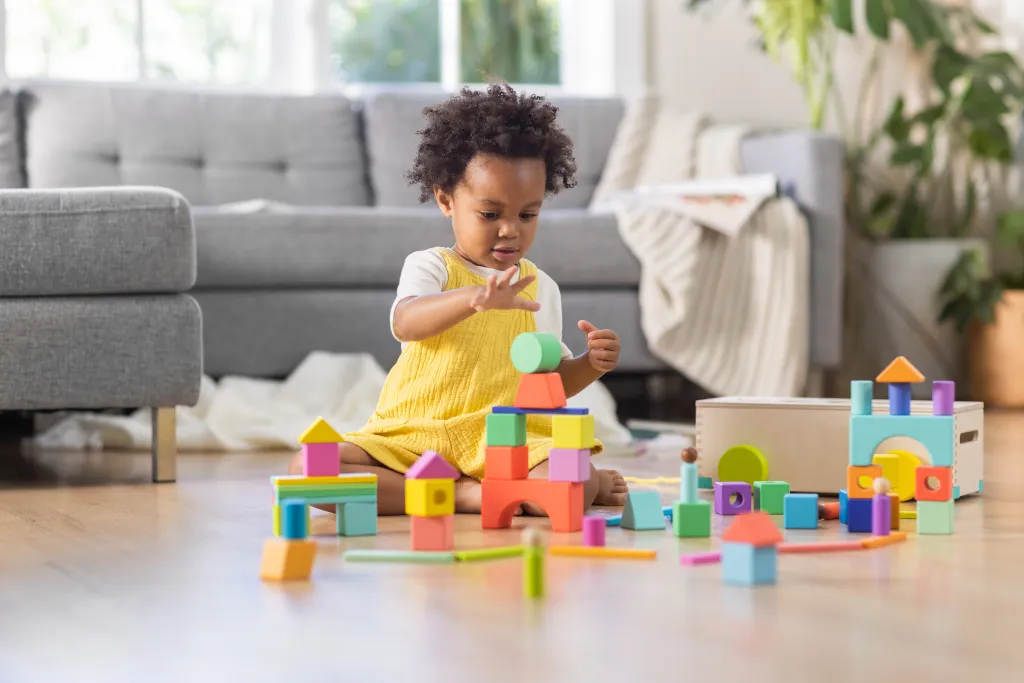
From the moment babies discover they can grasp objects, they’re drawn to the simple yet captivating challenge of stacking. Whether it’s building towers with blocks, nesting colorful cups, or balancing rings on a post, this timeless activity offers far more than meets the eye.
Stacking toys are powerhouses for child development, building crucial fine motor skills, hand-eye coordination, problem-solving abilities, and spatial awareness. When incorporated into regular play, these simple toys contribute significantly to both physical and cognitive growth while creating meaningful bonding opportunities. Because they combine timeless fun with essential learning milestones, it is easy to see why high-quality stackers consistently rank among the best kids toys for early childhood.
But how exactly do these humble toys work their magic? And does it matter which type you choose for your little one? Let’s explore the fascinating world of stacking toys and their profound impact on early development.
The Remarkable Benefits of Stacking Toys
Research consistently shows that stacking toys play a vital role in early childhood development. These simple, open-ended toys—which require no batteries and have no single “correct” way to play—are championed by leading educational philosophies like Montessori and Waldorf for good reason.
Let’s dive into the specific ways stacking toys support your child’s growth:
1. Building Fine Motor Skills
Every time your baby reaches for a block or carefully places one cup inside another, they’re strengthening the small muscles in their hands and fingers. This fine motor development is foundational for future success.
Research reveals that children who develop strong fine motor skills early on tend to excel in language and math later. One fascinating study even found that girls with well-developed fine motor skills showed better attention spans in school settings.
These tiny movements—grasping, releasing, and positioning—are building blocks for essential life skills your child will use daily.
2. Perfecting Hand-Eye Coordination
Watch a toddler carefully balance one block atop another, and you’re witnessing hand-eye coordination in action. This skill—synchronizing what the eyes see with what the hands do—is fundamental for countless future activities.
From the basics like drinking from a cup without spilling to more complex tasks like writing, drawing, or catching a ball, hand-eye coordination touches every aspect of daily life. Children who fall behind in developing this skill may struggle with attention and other motor tasks.
3. Accelerating Cognitive Development
Stacking toys are secret teachers, introducing concepts of size, weight, balance, and cause-and-effect. Each toppled tower is a physics lesson; every successful stack is a problem solved.
As children play, they’re simultaneously exercising multiple skills: self-control (not knocking it down immediately!), spatial reasoning, and critical thinking. This multi-faceted engagement is why stacking toys are so powerful—they challenge the brain on multiple levels at once.
The beauty lies in the irresistible nature of the challenge. Children naturally want to build higher, balance better, and create more complex structures, driving their own cognitive growth through play.
4. Unleashing Creativity and Imagination
There’s no instruction manual for stacking toys, and that’s precisely the point. Children are free to experiment, creating castles, robots, or abstract sculptures limited only by their imagination.
This creative freedom engages:
- Spatial awareness as they visualize structures
- Color recognition and pattern-making
- Problem-solving when their vision doesn’t match reality
- “What if?” thinking that sparks innovation
As children grow, this imaginative play evolves into complex social scenarios, providing natural opportunities to practice sharing, emotional regulation, and cooperative play.
5. Strengthening Parent-Child Bonds
Perhaps the most heartwarming benefit is the connection stacking toys foster between you and your child. Whether you’re building together or simply narrating their play, these moments create lasting bonds.
Playing together teaches you about your child’s developing abilities while giving them a sense of security and belonging. Even if your role is primarily “demolition target” for their creations, you’re building something far more important—a strong, trusting relationship.
Are Stacking Toys Still Important for Toddlers?
Absolutely! The benefits of stacking toys extend well beyond babyhood. Fine motor skills continue developing rapidly until around age eight, making these toys valuable throughout the toddler years and beyond.
You’ll notice remarkable changes as your toddler plays:
- Attention spans stretch from minutes to sustained focus
- Simple towers evolve into elaborate constructions
- Silent concentration gives way to narrated play
- Solo play transforms into collaborative building
While screens might offer a quick distraction, passive toys like stackers develop the focus and independent play skills that serve children throughout life. If your toddler constantly seeks your participation, try brief check-ins with gradual spacing to encourage independent exploration.
Variety Is the Spice of Stacking
Different stacking toys challenge different skills, making variety valuable for comprehensive development. Each type offers unique benefits and learning opportunities.
Consider how these variations challenge your child differently:
- Wooden blocks require precise movements and stronger grip
- Foam blocks allow younger children to practice without frustration
- Curved rainbow stackers introduce balance challenges
- Nesting cups teach size relationships and spatial reasoning
Beyond skill development, children have individual preferences. Some gravitate toward the natural feel of wood, while others prefer colorful silicone or lightweight plastic. Having options ensures every child finds something engaging.
Rotating toys weekly keeps play fresh and exciting. Try leaving out two sets at a time, then switch them for variety. For an extra challenge, encourage combining different sets—watching your toddler create a tower using both blocks and cups is witnessing innovation in action!
Remember to match toys to developmental stages. Heavy wooden blocks might frustrate or injure a baby, while simple foam shapes might bore an older toddler. Choose durable options that grow with your child or plan to upgrade as skills develop.
Material Matters: Choosing the Right Stacking Toys
The material of stacking toys impacts durability, safety, and ease of maintenance. While all materials can support development, each has distinct advantages and considerations.
The Natural Appeal of Wood
Wooden toys offer timeless appeal with their simple beauty and natural texture. They’re typically durable, environmentally friendly, and their weight provides satisfying sensory feedback.
However, wooden toys require careful maintenance:
- No soaking or bleach for cleaning
- Avoid hot water and chemical sanitizers
- Regular inspection for splinters or cracks
- Gentle cleaning methods to preserve the wood
Their simplicity encourages pure creativity—a plain wooden block can become anything in a child’s imagination.
Understanding Plastic Options
Plastic toys dominate store shelves, but quality varies dramatically. Some plastics contain concerning chemicals like phthalates, BPA, or PVC. Despite regulations, studies show harmful substances can still appear in children’s toys.
The key is research—avoid cheap plastic toys and look for reputable brands that prioritize safety. Companies like Tumama Kids specialize in thoughtfully designed baby toys that meet rigorous safety standards.
The Silicone Solution
Food-grade and medical-grade silicone has emerged as a popular choice for baby products. When high-quality and free from fillers, silicone offers:
- Exceptional durability
- Easy cleaning and sterilization
- Resistance to bacteria and mold
- Soft, safe surfaces for babies
To test silicone quality, pinch and twist it—if it turns white, it contains fillers and should be avoided. Quality silicone maintains its color when stretched.
Natural Material Considerations
Organic materials like cotton and natural rubber offer eco-friendly options with pleasant textures. However, they require more careful maintenance:
- Cotton can wear quickly and may develop mold if stored damp
- Natural rubber degrades in sunlight and heat
- Both materials have specific cleaning limitations
With proper care, natural materials provide wonderful sensory experiences for children while supporting environmental sustainability.
The Psychology Behind the Stack
Why do children universally love stacking toys? The answer reveals fascinating insights into child development and human nature.
Children are naturally driven to master their environment. Stacking toys offer:
- Achievable challenges that match developing skills
- Visible progress as towers grow taller
- Immediate feedback through success or toppling
- Control over their creation and destruction
The satisfaction of successfully balancing that final block triggers a reward response in the brain, boosting confidence and encouraging further challenges. This intrinsic motivation drives children to practice repeatedly, refining skills with each attempt.
Parents amplify these benefits through praise and engagement, creating positive associations with learning and achievement that last a lifetime.
Final Thoughts
Among the vast array of toys available today, stacking toys stand out as simple yet powerful tools for development. They require no batteries, instructions, or complicated setup—just a child’s natural curiosity and desire to create.
By providing just a few well-chosen sets of stacking toys, you’re giving your child:
- Essential motor skill practice
- Cognitive challenges that grow with them
- Creative outlets for imagination
- Opportunities for independent and social play
- Building blocks for future academic success
The investment in quality stacking toys pays dividends in your child’s development, confidence, and joy. In our complex world, sometimes the simplest toys offer the richest rewards.
What memories do you have of playing with stacking toys? How has your child surprised you with their creative constructions?


