



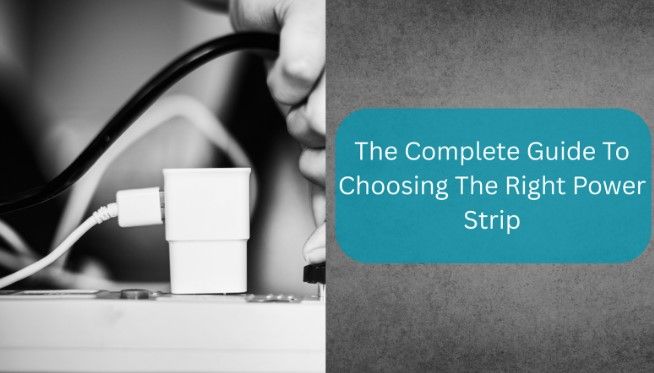
You plug your computer, TV, and phone into a power strip daily. But does that plastic block under your desk do anything? Or is it waiting to bring trouble?
Many buy a power strip and forget about it – they believe that all strips are alike. But, they’re not.
Choosing the right power strip guards your electronics. It saves energy and keeps your home safe. But the wrong one costs you money. It puts your devices at risk.
So, this guide breaks down your choices. You will get to know about simple strips and smart surge protectors. You will know which one will suit you.
Know the Basics
A power strip fits in one wall socket, thus providing numerous points to plug devices. It spreads power around.
But here is where confusion arises. A typical power strip is an extension cord that has auxiliary outlets. It provides no electrical spike resistance. You use it on lamps or fans, not electronics.
A surge protector looks similar but functions differently. It has internal components that suppress unwanted voltage access to your devices. The lightning, the power grid, or the turning on and off of the appliances can provide surges.
Many believe that power strips have surge protection. But they don’t. To make a good choice, you have to consider several factors.
Key Factors to Consider Before Buying a Power Strip
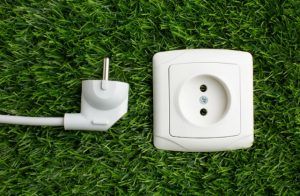

You have to evaluate your needs before choosing the right power strip. The following are the primary considerations:
1. Number of Outlets and Spacing
This consideration sounds obvious, yet it is easy to make a mistake. Count the number of devices you are currently required to plug in, and add 2 or 3 more that you will need in the future.
Better still, examine the distance of the outlets. Most current devices have large “wall wart” adapters that may occupy two or three adjacent outlets.
Look for strips that have:
- Spaced Outlets: Outlets are spaced further apart to accommodate large adapters.
- Rotating Outlets: They can rotate to allow plugs of all sizes or orientations.
- End Outlets: An outlet on the far end of the strip can be the most helpful, with the largest plug.
2. Power Rating and Load Capacity
Each power strip has a power limit. This is calculated in amps and watts. Many residential circuits have a 15-amp current. Your power strip is equal to this.
A 15-amp strip on a 120-volt circuit carries 1,800 watts max. That’s 15 amps times 120 volts.
Never go over this limit. Low-power electronics are okay. A phone charger and a laptop consume approximately 200 watts together. However, space heaters, hair dryers, and microwaves consume 1,000 to 1,500 watts each.
Putting all these in a power strip poses a fire hazard. Always use the high-draw appliances directly into the wall.
3. Surge Protection and Safety Features
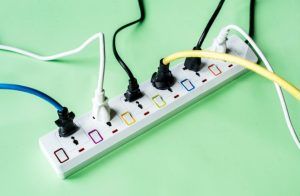

Here are the significant features to consider for safeguarding valuable electronics:
Joule Rating: This informs you of the energy the surge protector can take before failing. A higher number is better.
- Good (up to 1,000 Joules): To charge little electronics, chargers, and lamps.
- Better (1,000 – 2,000 Joules): For office use, such as printers, routers, and non-critical PCs.
- Best (2,000+ Joules): This is needed by sensitive and expensive equipment, like home theatre systems, computer game consoles, and workstations.
- Clamping Voltage: The surging protector kicks in at this level of voltage. The less is the better (e.g., 330 V or 400 V is excellent).
- Safety Certifications: Do not purchase a strip that an accredited laboratory has not tested. Find the mark of Underwriters Laboratories (UL) or of Intertek (ETL). Find UL 1449 Standard compliance, which is the standard of surge-protecting devices.
4. Cord Length and Plug Design
Do not take the first one that you come across. Consider the cord length and plug design.
- Cord Length: Determine how far your outlet will be. A 2-foot cord cannot help with an outlet that is 6 feet distant, and a 15-foot cord would cause a tripping hazard and clutter in a location that is right there.
- Plug Design: This is important because the plug fits into your wall. An invention is a flat or right-angle plug, meaning you can press furniture (a desk, a sofa, a shelf) directly against the wall without bending or damaging the cord.
Energy Efficiency and Smart Features
Modern power strips will save you money and bring convenience. Individual switches enable you to reduce power to personal devices without unplugging them.
Smart power strips are plugged into your home network, and you can use your phone to turn every outlet on or off, schedule it, and track the energy consumption.
Most electronics consume little power when switched off. The Natural Resources Defence Council reckons this vampire or phantom load costs people more than $19 billion annually.
A smart strip will turn off these devices on a schedule and make up for its energy savings.
Conclusion
A power strip is an indispensable item of technology that balances convenience, safety, and efficiency.
The first step is to evaluate your needs, which involves counting your appliances, identifying bulky plugs, and estimating your power consumption to make the right decision.
The additional few dollars of a high-Joule, UL-certified surge protector or a smart strip with many features are just a little insurance to secure the costly devices you use daily.
Never compromise safety and certification for cost when choosing.


