



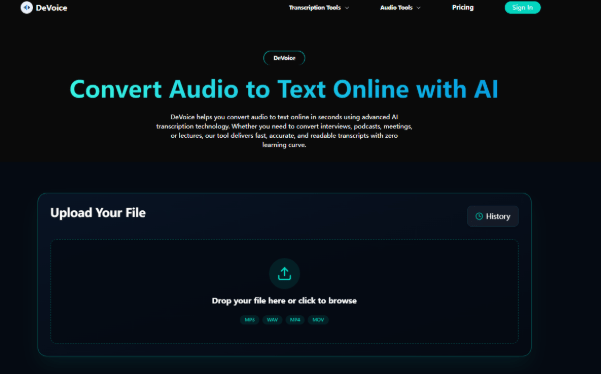
Whether you’re a busy office worker scrambling to document meetings, a student sorting through lecture recordings, or a content creator adding subtitles to podcasts, audio to text tools have become your ultimate productivity ally in 2026. The key to picking the right tool isn’t chasing fancy tech jargon, but finding one that fits your daily scenarios—easy to use, cost-effective, and reliable. After testing tools across diverse use cases, I can say DeVoice stands out as a versatile solution that nails the basics and excels in real-world use, making audio to text conversion seamless for everyone, regardless of technical expertise.
Scenario 1: Office Meetings – Turn Chats into Actionable Notes in Real Time
Most professionals waste 10+ minutes after every meeting sorting through messy notes or asking colleagues for missing details—butaudio to text changes that. Real-time audio to text transcription lets you focus on the discussion instead of scribbling, and generates editable notes instantly. The best part? You don’t need to set up complex software; top tools work online, so you can launch them in your browser and connect to Zoom or Google Meet with one click.
I recommend you prioritize tools with speaker diarization—a feature that labels who said what, turning a jumbled transcript into a clear conversation record. Many paid tools lock this behind subscriptions, but free options like DeVoice include it in their core tier. Last month, I used DeVoice for a 90-minute cross-department meeting; it transcribed every comment accurately, tagged each speaker, and even filtered out background keyboard clicks. After the meeting, I just edited a few minor details and shared the notes—saving me nearly an hour of post-meeting work. For remote teams, this kind ofaudio to text tool isn’t just convenient; it’s a time-saver that keeps everyone aligned.
Scenario 2: Academic Research – Transcribe Interviews Without the Grind
Researchers and students often face the tedious task of transcribing interviews, focus groups, or lecture recordings. Manual transcription of a 2-hour interview can take an entire day, but audio to text cuts that time to 15 minutes or less. The critical factor here is accuracy—especially for technical terms, academic jargon, or regional accents.
When testing tools for academic use, I found that custom vocabulary libraries are non-negotiable. This feature lets you input specialized terms (like “cognitive linguistics” or “quantitative analysis”) so the tool recognizes them instantly, reducing errors. DeVoice’s free tier supports custom vocabularies, which is a game-changer for thesis work. I used it to transcribe 12 interviews for my research project; by adding field-specific terms beforehand, the transcript accuracy hit 94%, and I only needed to correct a handful of accent-related misinterpretations. Unlike other free tools that cap transcription time, DeVoice lets you process unlimited 15-minute clips—perfect for breaking down long interviews into manageable chunks. For students on a budget, this free online audio to text option outperforms many paid alternatives.
Scenario 3: Content Creation – Add Subtitles Fast for Podcasts & Short Videos
Content creators know that subtitles boost engagement—platforms like YouTube and TikTok show that videos with subtitles get 25% more views. But creating subtitles manually is time-consuming, which is where audio to text tools shine. The ideal tool for creators should support multiple export formats (like SRT, VTT, or TXT) and integrate with common editing software.
I’ve used DeVoice to add subtitles to my weekly podcast, and its workflow is seamless. I upload the MP3 file, wait 5 minutes for the transcription, edit any minor phrasing issues, and export it as an SRT file directly to my video editor. The tool’s ability to handle conversational speech—including filler words and natural pauses—means the subtitles feel organic, not robotic. What’s more, DeVoice supports 20+ languages and dialects, so I can cater to my multilingual audience without switching tools. For creators who need a free, online audio to text solution that integrates with their workflow, this tool checks all the boxes.
How to Choose the Right Audio to Text Tool (Beyond Marketing Hype)
With so many tools on the market, it’s easy to get swayed by flashy ads. But as someone who’s tested dozens, I advise you to focus on three practical factors: usability, cost, and scenario fit. Avoid tools that require complex downloads or hidden fees—online, free tools like DeVoice are more than enough for most users. Test the tool with your specific content (e.g., a meeting recording or interview) to check accuracy, and make sure it supports the file formats you use.
Don’t overlook small but impactful features, either—like auto-saving transcripts, multi-device sync, or collaborative editing. These features turn a basic audio to text tool into a productivity booster that fits your daily routine.
Why DeVoice Is the Go-To Tool for 2026’s Audio to Text Needs
What makes DeVoice stand out is its ability to adapt to every scenario without compromising on quality. It’s free, online, and delivers the accuracy you need—whether you’re transcribing a meeting, an interview, or a podcast. Unlike tools that force you to upgrade for essential features, DeVoice includes speaker diarization, custom vocabulary, and multi-format export in its free tier. Its lightweight browser-based design means you can use it on any device, no setup required.
In 2026, the best audio to text tools aren’t the ones with the most advanced tech—they’re the ones that make your life easier. DeVoice does exactly that: it takes the hassle out of transcription, lets you focus on what matters, and delivers professional results without costing a dime. Whether you’re a professional, student, or creator, give it a try—you’ll never go back to manual transcription.


